Summary

Media caption,
How the Meta trial could change social media for young people
  1. Meta whistleblower the first witness to give evidencepublished at 20:20 BST 18 August

    Meta whistleblower Arturo Béjar, former senior engineering and product leader at Facebook, is the first witness.

    Béjar says he will talk about his experience at the company, including concerns he brought to leadership as well as his role testing Meta's safety features, which he found to be ineffective.

    He adds that Meta took a "don't ask, don't tell approach" to kids under 13 being on the platform.

  2. Schmidt addresses idea of social media addiction as he wraps up opening argumentspublished at 20:13 BST 18 August

    Wrapping up the opening arguments for Meta, Schmidt addresses the idea that social media is addictive, particularly for young people.

    “There can be no dispute that Meta has recognised people struggle, or can struggle, with their use of social media, and has come up with tools to try and address that,” Schmidt says.

    However, he points to past statements from Mark Zuckerberg and Adam Mosseri that not only were Facebook and Instagram not designed to be addictive, scientific research has not yet come to support the idea that an addiction to social media is possible.

    Meta has pushed back repeatedly in past litigation this year on the idea that social media addiction exists.

    Schmidt also indicates that the states pursuing the case against Meta have largely failed to prove that the company not only directed Facebook and Instagram to young users and those under 13 years old, but that it knew of specific underage users and did nothing to get them off of the platforms.

    He says state attorneys have presented no specific children that they have found that were on Meta’s platforms improperly, and that an expert witness will only be able to show some 150,000 underage users were found to have been on the platforms.

  3. Meta will present data that shows more than 90% of Facebook users adultspublished at 20:00 BST 18 August

    Schmidt says Meta witnesses will say they understood the government didn't require age limits but the company took steps anyway.

    Meta will present data that shows 96% of people who use Facebook are adults, and 4% are teens.

    Instagram skews more to teens and younger adults, but the data is similar, he says.

    How will the attorneys general prove these services are directed to children, he asks.

  4. Meta has in last three months 'has removed 600,000 accounts' made by under-13spublished at 19:46 BST 18 August

    Schmidt accuses the states suing Meta of "pulling out tiny subsets" of statements from employees over the years.

    He references an employee who testified to Congress that Meta does not market to eight to 12-year-old girls because they are not on Instagram. The employee said that, Schmidt says, because even though Meta recognizes that users lie about their age, the company actively works to remove users under 13 years of age.

    He adds that in the last three months, the company removed 600,000 accounts made by people under 13.

    He now references statements surrounding social media addiction, arguing that Meta has recognised that people struggle with their social media use and has come up with tools to help them.

    "I want to be clear," he says, "Meta has talked over the years about people struggling with their use of social media, including the years 2017, 2019 and 2022 and 2024."

    Meta asked a New Jersey public health official about the causal link to social media addiction, and she said such a link had not been established, Schmidt says.

  5. Are these features 'unconscionable', Meta to ask jurypublished at 19:40 BST 18 August

    Schmidt argues that the attorney generals are basing their unfair practices claim on three features: the ability for users to have multiple accounts; time management tools; and efforts to block users under the age of 13.

    He asks the jury to consider at the end of the case whether these features are "unconscionable or unfair".

    On multiple accounts, Schmidt argues that there is "value" in having multiple accounts, and being able to have separate accounts for different interests, like sports, music or family.

    On time management tools, he says: "They're not challenging as unfair, someone generally having access to Instagram. How can they make it unfair to give that person time management tools, even if they had criticisms?"

    And on age verification, he says that there are "real challenges", including privacy and fairness concerns.

    "Not everyone has government ID, not everyone has credit cards or wants to share them," he says.

    Meta is legally not allowed to keep children's data which might otherwise allow it to create computer models to detect under-13 users, he says.

    But the company has always required age entry on Facebook and later on Instagram and allows people to report underage users, he adds.

  6. Lawyer for Meta says states claim there are unfair practicespublished at 19:33 BST 18 August

    Schmidt says the case being made against Meta is about three things.

    Firstly, the states bringing the case say there are unfair practices - specifically 32 Meta features.

    The second refers to alleged misstatements made by the company, including some 50 over the course of a few years, and the third is the claim made by the states about child privacy.

    He says the attorneys general must prove that Meta knew there were features aimed at kids but didn't remove them.

    The case is not about "hook, harvest, harm," he says, referring to the earlier allegations made by the Californian lawyer.

    The states suing Meta are not bringing people affected as witnesses, he says.

    "They are not going to bring people from their states to say 'I suffered harm or I was deceived,'" Schmidt says.

  7. Meta urges jury to 'keep an open mind'published at 19:22 BST 18 August

    Meta attorney Paul Schmidt says the jury will be seeing documents about teen use of social media. That includes a survey showing that 41% of teens say Instagram makes them feel better about themselves, around 40% say it had no effect and about 20% say it makes them feel worse.

    Meta employees, he says, are actively working to find ways to make those 20% of teens feel better. He cites internal communications among Meta employees where they are identifying concerns about users' wellbeing and working to address them.

    "Those are some of the things that Meta does," Schmidt says.

    He asks the jury to reserve judgment until the end of the trial, including waiting for witnesses to talk about the documents they were involved in writing.

    "Keep an open mind," he says.

    Paul Schmidt ahead of Tuesday's hearingImage source, Reuters
  8. Content policies are 'complicated', says Meta lawyerpublished at 19:14 BST 18 August

    Continuing with his opening argument, Schmidt says Meta has policies about what kind of content appears on Instagram and Facebook, which he describes as "complicated" because every time something is barred, some people criticise this as "censorship".

    He tells the jury they will hear from Meta witnesses on its content, including one employee who will talk about "improving the experience" of users.

    Another category of documents they will see, Schmidt says, is "Meta acting as a business", and he says one way the company measures itself is by whether people are using the service, including time spent on platforms.

    This is just like movie companies and Netflix, he says.

  9. Meta's lawyer tells jury they'll see documents with 'loose language'published at 19:06 BST 18 August

    Lily Jamali
    North America technology correspondent, reporting from court

    The hearing has now resumed.

    Meta's lawyer Paul Schmidt tells the jury that they will see Meta documents during this trial.

    "Some documents you’ll see have language in them that sounds loose because two people are at work," he says.

    "Some of them use loose language.

    "You already heard one example of that."

    He references the email in which an employee writes to another: "Oh my gosh IG is a drug". And the response is: "Lol."

    “You’ll be able to hear from that person and hear her explanation not just of what they were saying there but what they were trying to do in terms of addressing concerns,” Schmidt adds.

  10. Protesters gather outside courtpublished at 18:57 BST 18 August

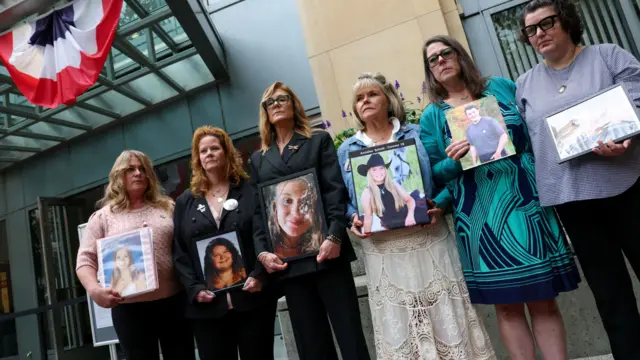
    Protesters and campaigners have gathered outside the federal courthouse in Oakland, California, where the Meta hearing is taking place.

    Some of those in the crowd were parents of young people who say their children's deaths were related to social media.

    They held up photos of their lost children.

    People hold pictures of children and young adults, as parents of children whose deaths were related to social mediaImage source, Reuters
    Parents of chilldren whose death was  related to social meidaImage source, Reuters
  11. Meta lawyer says company has track record of sharing information about social media harmspublished at 18:52 BST 18 August

    Lily Jamali
    North America technology correspondent, reporting from court

    In an opening statement, Meta attorney Paul Schmidt argued that Meta has a track record of sharing information about potential social media harms with the public.

    Schmidt pointed to a Meta publication from 2019 that stated its data showed some feel their use of the company’s platforms were problematic and that such perceptions were most prevalent among teens and young adults.

    Schmidt then argued that Meta acted on this information by creating tools including those aimed at time management.

    The judge has now stopped the hearing due to issues with audio going into the overflow room and the online feed.

  12. Meta lawyer begins opening remarkspublished at 18:42 BST 18 August

    Court has now resumed following a short break.

    Meta lawyer Paul Schmidt is presenting his opening arguments.

  13. Who we may hear from later in proceedingspublished at 18:33 BST 18 August

    This Flourish post cannot be displayed in your browser. Please enable Javascript or try a different browser.

  14. Jury asked to 'hold Meta accountable' at end of trialpublished at 18:14 BST 18 August

    O'Neill also references internal Meta documentation that she says points to estimates that 20% of 11-year-olds and 30% of 12-year-olds in the US are on Instagram, despite the company's policy that children shouldn't be on the apps.

    Meta is aware of this, she says, and does nothing to combat it.

    "These young children on the platforms, they're not accidents, they're choices," she tells the jury.

    O'Neill finishes up her opening arguments by asking how parents can do their jobs to protect their children if they don't know the truth.

    "We will ask the jury to hold Meta accountable at the end of trial, and to make sure the company will do its share," she says.

    The hearing is now taking a 20 minute break.

  15. Daily limit tool only there to 'improve Meta's public image' - lawyerpublished at 18:05 BST 18 August

    O’Neill speaks about Meta's daily limit tool, which was supposed to limit the amount of time children spend on the apps.

    She says the tools to limit the time were not really barriers, just there to "improve Meta's public image and make parents feel better", she says.

    One of the tools, the daily limit, is not a limit, she says, adding it can be dismissed by the child.

    She refers to a chart in court that she says shows only 0.05% of users meaningfully adopted it and put the app down.

    "That's by design, these tools aren't meant to make meaningful change," she says, adding they were only introduced after states filed lawsuits against Meta.

  16. California lawyer: Meta 'actively intervened' in own mental health researchpublished at 17:48 BST 18 August

    California Deputy Attorney-General Megan O'NeillImage source, Reuters

    The California deputy attorney-general says Meta "harvests" a lot of data from children, including their posts and interactions, and argues it "misled" the public by saying its social media sites were safe for kids.

    "Facebook and Instagram were designed to keep kids on them and to keep them coming back, even when they knew it was bad for them," O'Neill says.

    After listing a number of Meta's internal studies and surveys reflecting children's negative experiences on its platforms, O'Neill accuses Meta of being "so concerned about what it knew about kids getting out [to the public], that it actively intervened on its own research in mental health and wellbeing issues".

    O'Neill says the company also prevented people in the company from access to this research and stopped others from carrying out similar studies that might expose risks or dangers to users.

    The reason for that, the California lawyer adds, was so that Meta could avoid trials like this one by exercising "plausible deniability".

  17. Social media giant knew a lot about children's minds, lawyer continuespublished at 17:32 BST 18 August

    O'Neill says the jury will be shown how children are drawn onto platforms such as Facebook and Instagram, and how Meta "hooks them", with features that keep people on those apps and draw them back.

    Meta knew a lot about children's brains, she says, and how they are constantly seeking rewards, and are so sensitive to social feedback, she says.

    O'Neill says she has an internal document - which she shows on the screen - where a Meta employee looked at these aspects of the teenage brain, and then talked about how Instagram could change some features of the app.

    The lawyer says Meta knew about the effects. She says its apps are addictive, and the court will also hear from a doctor about social media use contributing to an "alarming rise" in conditions such as depression.

  18. Meta 'hid the truth' over child safety - California deputy attorney-generalpublished at 17:14 BST 18 August

    O'Neill says the company told the US Congress, social media users and parents that "Instagram and Facebook were safe for kids".

    "All the while it hid the truth," she adds.

    O'Neill says the plaintiffs on this case are a group of 29 attorneys general, led by California, Colorado, Kentucky and New Jersey, adding the jury will hear from several attorneys general throughout the trial.

    "This case is not about taking away Instagram", or whether social media has some benefits, O'Neill says.

    "This case is about whether Meta misled the public about the risk to kids on its platforms, about whether Meta acted unfairly, and about whether Meta violated the Children's Online Privacy Protection [act]".

  19. Meta's business model designed to 'hook users, harvest data', California lawyer sayspublished at 17:05 BST 18 August

    Megan O'Neill, Deputy Attorney General at California's justice department, has begun speaking.

    She says Meta's business model can be summed up this way: "Hook the users; hold them for as long as they can; harvest their data; hide the truth from the public when making public statements."

    O'Neill says this "worked well for kids", adding Meta designed the platform so children kept coming back to it.

    Children are a "product", O'Neill says, adding Meta tracked their behaviour to sell them products and keep them "hooked".

  20. California social media trial beginspublished at 16:53 BST 18 August

    The trial of social media giant Meta is now under way before Judge Yvonne Gonzalez Rogers, in a federal court in Oakland, California.

    We'll be bringing you live updates.