Summary

  1. A recap of the two-day appeals hearingpublished at 08:12 BST 20 August

    We're wrapping up our live coverage.

    Here are the highlights from the two-day hearing before Victoria's Court of Appeal:

    • Patterson's lawyers argued that a "catastrophic" mix-up that led to the jury staying at the same hotel as prosecutors and a key witness had undermined the trial
    • They also claimed the cross-examination of Patterson during last year's trial was "unfair and oppressive" and that the closing address made by prosecutors was "problematic"
    • The prosecutors rejected these complaints and instead argued that the trial judge erred in handing down a life sentence with a non-parole period of 33 years
    • Patterson should not be allowed a chance at parole, the prosecutors say, noting that her mushroom poisonings fell into the "worst category" of offending
    • Erin Patterson was not in court on both days, tuning in to the proceedings instead via video link from prison

    Thank you for sticking with us - read more in our news story here.

  2. What happens next?published at 07:40 BST 20 August

    Katy Watson
    Australia correspondent

    As we mentioned earlier, the Court of Appeal has not yet indicated when it might reach a verdict, but these deliberations could take months.

    If the three appeal court judges decide to overturn her convictions, they could order that the case be retried, or to fully acquit her.

    If the prosecution's appeal is successful, Patterson could see her parole period being extended beyond 33 years, or she may even be sentenced to life without parole.

  3. What had prosecutors said?published at 07:08 BST 20 August

    Simon Atkinson
    Australia producer

    The court has now reserved its decision in both appeals, but prosecutors had earlier said more weight needed to be given to the nature of the crime - spelling out why Patterson’s offending was “truly dreadful":

    • The huge effort over a long period to “orchestrate” the fatal lunch: From learning about death caps and obtaining enough to kill, to sending the invites and cooking the meal, there was plenty of time for Patterson to change her mind.
    • The enormous betrayal of trust: The Pattersons and Wilkinsons accepted the lunch invite “completely unsuspecting”, prosecutors say. “Not only did the respondent sit by and watch her victims consume the deadly meal... but the meal ended with a prayer for her, following her lie about having been diagnosed with cancer."
    • The “murderous intention” continued long after the lunch: As the guests lay critically ill, Patterson could have admitted using foraged mushrooms without admitting her guilt, the prosecution team wrote. But she denied it was possible to police and health workers, “even when she knew that some of the victims were on life support”.
    • The cruelty of the method of murder: Patterson feeding her guests death caps led to “shocking illnesses".
    • The elaborate cover up: This included lying to police and disposing of evidence – perhaps most famously the food dehydrator dumped at her local rubbish tip which was found to have traces of death caps on it.
  4. Court adjourns with judges reserving decisionpublished at 07:02 BST 20 August

    Court has now been adjourned - after several minutes spent revisiting the legal definition of "solitary confinement" toward the end of the hearing.

    The judges have reserved their decision in both appeals, and its not clear when a verdict might be reached.

  5. Trial judge's sentence was 'unimpeachable' - defencepublished at 06:57 BST 20 August

    Turning now to the prosecution's argument that the trial judge handed down a "manifestly inadequate" sentence, Edney says his team believes Beale "did everything right in this complex sentencing exercise".

    As a recap, Beale had sentenced Patterson to life, with a non-parole period of 33 years.

    "He's clearly taken into account all relevant considerations," Edney says, adding that Beale "made appropriate findings about how serious this matter was".

    He concludes by describing Beale's decision as "unimpeachable".

  6. Patterson can't always access prison facilities, lawyers saypublished at 06:46 BST 20 August

    We're hearing from Patterson's barrister Richard Edney about her prison conditions.

    "Her current circumstances... are clearly solitary confinement," he tells the court, and that according to international conventions, a "prolonged" period of such conditions is deemed to be any period of more than 15 days.

    Edney also points out that the features listed by the prosecution such as a library and leisure centre are not always available to Patterson due to staff shortages and other reasons.

    There's a "real practical deficit in those programmes being achieved given the nature of the custodial environment," he says.

    He also points out that Patterson's cell is four metres by two metres, describing it as "an incredibly small confined space to be... for some 22 to 23 hours a day".

  7. Prosecution says its argument takes into account 'seriousness' of crimespublished at 06:42 BST 20 August

    One of the judges had earlier said, in response to Kissane, that the sentence had included a "realistic" chance of parole given Patterson's age, or it would simply be an artificial promise of parole.

    Kissane then said the court ought not to sentence based on its estimate of one's life expectancy.

    Kissane further argued that the prosecution's argument that the minimum sentence of 33 years was "manifestly inadequate" takes into account "all relevant sentencing matters... including the seriousness of offending".

  8. Harsh jail conditions should not matter in sentencing, says prosecutionpublished at 06:24 BST 20 August

    We're now hearing from Director of Public Prosecutions Brendan Kissane KC and how the trial judge erred when allowing a non-parole period of 33 years due to Patterson's tough prison conditions including solitary confinement.

    Kissane lists a range of things that Patterson has access to while in prison such as a treadmill, a small exercise yard, a library and leisure centre as well as regular video visits with her children.

    He says while Patterson's notoriety won't diminish, "the interest in who she is will" and that the trial judge's consideration of "harsher than usual" prison conditions was "not the appropriate way to deal with the fixing of a non-parole period".

    "Your honour cannot sentence on the basis of prediction or speculation," Kissane asserts.

  9. Was 33 years the right number?published at 06:10 BST 20 August

    Simon Atkinson
    Australia producer

    The prosecution argues Patterson should never be freed – they say that if the appeal court disagrees – then it should at least increase the minimum sentence, calling 33 years “manifestly inadequate”.

    The minimum term open to the judge for the offences was 30 years - and in written arguments they say adding just three to this lower limit “utterly fails to reflect the gravity of the offending or vindicate the dignity of each of the four victims”.

    Lawyers will often look to previous cases for guidance – and while acknowledging there was no factually comparable case – the prosecution cited two examples where people were given longer parole periods for serious murders, in the case of murdered comedian Eurydice Dixon and Osman Shaptafaj who shot his daughter and son-in-law, external over a wedding invite.

    Patterson’s lawyers reject this, in their written rebuttal saying: “The purportedly comparable cases, which are relied upon again on appeal, are not only of little assistance but also fail at a fundamental level to adhere to the clear edict that other cases should not – and are not – to be treated as precedents”.

  10. Prosecution challenges trial judge's 'solitary confinement' findingpublished at 06:02 BST 20 August

    The prosecution starts off their argument reiterating that Patterson should not be granted any chance at parole.

    The trial judge had wrongly believed that Patterson would remain in solitary confinement for years to come, Director of Public Prosecutions Brendan Kissane KC tells the court.

    Supreme Court Justice Christopher Beale had sentenced Patterson to life in prison, with a non-parole period of 33 years, during which she will be 82. In handing down the sentence, the judge had found there was "substantial chance" [Patterson] would be held in "solitary confinement for years to come".

    The prosecution however, says Patterson shouldn't be granted any chance at parole maintaining that her mushroom poisonings fell into the "worst category" of offending.

  11. Court turns to appeal against Patterson's 33-year sentencepublished at 05:50 BST 20 August

    Katy Watson
    Australia correspondent

    There’s less than two hours left before the end of the court’s working day and they are only now turning to the prosecution’s appeal against the sentence.

    It’s a much shorter submission – 10 pages, compared to the 78 pages submitted by Erin Patterson’s team trying to overturn the conviction.

    It’s also a simpler argument with only two grounds for appeal. First that the judge’s reason for allowing parole – because of the harsh conditions expected in prison because of her notoriety – is not supported by the evidence.

    And secondly, that the sentence is what they call "manifestly inadequate" - that Patterson should be locked up for life with no chance of ever walking free.

  12. No need to 'go on a fishing expedition', says prosecutorpublished at 05:48 BST 20 August

    Simon Atkinson
    Australia producer

    Just before the appeal moved onto the sentencing – the judges asked more about the issue that dominated so much of yesterday - what Patterson’s lawyers call a "catastrophic" mix-up that led to the jury staying at the same hotel as prosecutors and a key witness.

    They are asking the prosecution if any more investigations are needed, and more questions should be asked, to make sure that the jurors did not have “irregular” contact at the hotel.

    The director of Public Prosecutions Brendan Kissane is adamant it doesn’t, saying it was all dealt with at the time. It was “not a matter of perception” he said, but was about “the evidence”.

    If anyone had been seen by jury supervisors – known as jury keepers – doing anything they should not have “it would have been communicated to the judge”.

    “There’s no need for this court to go on a fishing expedition to see if jury keepers need to be cross-examined about what occurred, because there’s been no contact,” Kissane told the court.

  13. Photos from SD card showed 'innocent interest' in foraging, court hearspublished at 05:46 BST 20 August

    Defence barrister Veronika Drago brought the court's attention to photos of mushrooms on an SD card at Patterson's home, which they argue were wrongly excluded as evidence.

    The photos showed mushrooms in the wild as well as mushrooms with dirt on them in a kitchen setting and prove that Patterson had an "innocent interest in mushrooms or foraging in mushrooms," Drago says.

    A judge on the panel points out that the photos are dated 2020 so are limited in what conclusions can be drawn on Patterson's mushroom foraging habits.

    Drago also refers to online posts where Patterson asked for advice on how to dehydrate mushrooms, which, she argues, shows an interest in mushrooms.

    The panel brings up a point that the posts only refer to mushrooms bought from a supermarket, not wild foraged ones.

    Drago then re-asserts the point made yesterday that Patterson was denied her "right to silence" and was "forced to give evidence" about her interest in mushroom because the photos were not allowed to be used in court.

  14. Court resumes after breakpublished at 05:18 BST 20 August

    The hearing has just resumed.

    We're expecting Patterson's legal team to continue its arguments on appeal while the prosecution will also set out their grounds in appealing her sentence.

  15. Watch: CCTV shown to court in mushroom trialpublished at 04:45 BST 20 August

    After that deadly mushroom lunch, the court heard that Erin Patterson discharged herself from the hospital. Here's CCTV footage that jurors were shown in court:

    Media caption,

    Australia: CCTV and phone recording shown to court in mushroom trial

  16. The mushroom killer was obsessed with true crime - now fans are obsessed with herpublished at 04:26 BST 20 August

    Katy Watson
    Australia correspondent

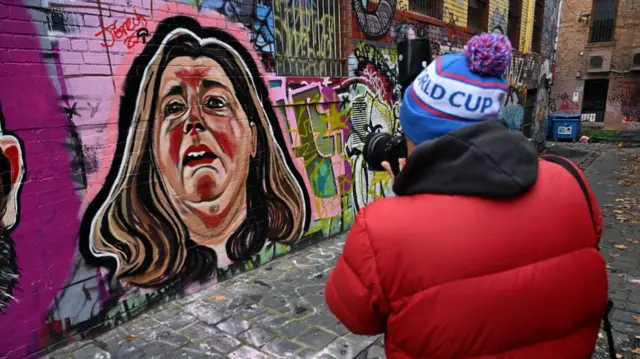
    A person takes a photo of a mural of Erin PattersonImage source, EPA-EFE/Shutterstock

    For years, from behind a computer screen, Erin Patterson built up a reputation in an online true crime community as a "super sleuth".

    Then she herself became a true crime obsession.

    Journalists descended from around the world to cover her lengthy murder trial, spectators queued daily to nab a spot in the courtroom, and thousands of people picked apart details of the case online.

    Tammy Egglestone commuted for more than an hour to reach Morwell most days of the trial. "I'm a bit of a true crime fanatic," she explained.

    Despite a jury finding her guilty on all charges last year, the frenzy of speculation and depth of fascination has only intensified.

    "It has those typical cliché things that make true crime sell," Ms Egglestone said, explaining why she and flocks of others have become obsessed with the case.

    "Poison's the weapon, the fact that she did take out family members... [she's] white, female, financially stable, you know. And they're all church people."

    Read more in this story.

  17. Defence zooms in on prosecution's 'selective' use of evidencepublished at 04:08 BST 20 August

    Patterson's defence team is now arguing that the prosecution has tendered evidence selectively.

    Patterson's barrister Richard Edney earlier accused prosecutors' "selective questioning of medical experts" who attended to Patterson and her relatives after the beef wellington lunch.

    Given their claim that Patterson feigned illness to ward off suspicion, the prosecution should have put specific questions to experts who attended to her after the meal - but they did not, Edney said.

    Veronika Drago, another defence lawyer, also argues the prosecutors selectively provided cell phone data for analysis. The prosecution had said it was "too expensive" to extract all records, but this created a "vacuum" of evidence, Drago says.

    With that, the court has adjourned for a lunch break. It will resume at 14:15 local and we'll bring you the latest updates as we have them.

  18. Patterson's cross-examination 'oppressive' and 'unfair' says defencepublished at 03:57 BST 20 August

    Patterson's legal team are responding to the prosecution's rebuttal of their appeal with barrister Richard Edney first up to speak.

    First, he addresses ground one - that the jury staying at the same hotel as a police witness, prosecutors and media was a major issue. The defence have argued there's no evidence that jurors communicated with anyone they shouldn't have.

    But Edney says it is "of concern" that the prosecution "did not disclose the arrangement" with the defence at the time and that no other formal information about the hotel accommodation has been submitted.

    "We have nothing," from the prosecution, Edney says, except for an "email which perhaps raises more questions". The email he refers to is one that the prosecution sent, saying they had no contact with jurors.

    On ground five, Edney maintained that Patterson's cross-examination was "oppressive" and "unfair".

  19. 'No creeping, surreptitious change' in prosecution's case - McWilliamspublished at 03:45 BST 20 August

    The prosecution has also rejected grounds four and seven of Patterson's appeal, which argue that Facebook posts where Patterson complains about her relatives were prejudicial and should not have been used.

    Crown prosecutor McWilliams maintained the prosecution at trial had not used those posts to hint at a motive for the murders. The use of those posts was "clearly orthodox" and meant as "relationship evidence", he said.

    "There was no room for mischief" in citing those posts and "no creeping, surreptitious change" in the prosecution's case, he said.

    The defence is now responding.

  20. Problems with closing address is 'Frankenstein of a ground', court hearspublished at 03:24 BST 20 August

    The court is now hearing about ground six of Patterson's appeal - that the prosecution's closing argument in the trial had 35 problems, namely cherry-picking of evidence.

    In response, the crown prosecutor says that of the 35 issues, many have been counted twice and the overall claim is "devoid of any persuasive merit".

    By combing through the closing address after the trial to find issues, the defence is using it as a "cudgel... with which to attack the crown case," Jeremy McWilliams says.

    Some of the issues were dealt with at the trial while others were simply not raised as problems as the defence did not object, McWilliams argues.

    The claims of 35 issues in the closing address "bundles them up... in order to make good this Frankenstein of a ground".

    One of the three judges on the panel asks if including some of the issues is about the "cumulative effect" of the closing statements.

    “A group of zeros is still zero," McWilliams replies.