Summary

Have a question about life under the Taliban?

  1. 'What will happen to my daughter's future?'published at 05:20 BST 14 August
    A blue banner with the words "Maryam. Midwife - age & region held for security reasons".

    Maryam is a midwife in an area where one female doctor and one midwife serve a population of around 50,000 people, and is expecting a baby girl.

    Sometimes I think about my daughter's future.

    If things continue like this, what will happen to her? She will not even have the chance to finish school like I did, let alone go to university.

    If one day she gets married, becomes pregnant and needs a female doctor during childbirth, what if there isn't one? This is a matter of life and death.

    I am a midwife. I have seen mothers die. I know this is not only my concern.

    I believe it is the concern of every mother in Afghanistan.

  2. How foreign journalists operate in Afghanistanpublished at 05:02 BST 14 August

    Yogita Limaye
    Afghanistan correspondent

    To enter the country to report in Afghanistan, foreign journalists must receive permission from the Taliban government’s foreign ministry.

    That is usually just the first step in the process.

    Once on the ground, depending on what you want to cover, including if it is filming on the streets of Kabul or at a hospital or traveling to other provinces, other departments and ministries would need to be approached for approvals.

    However, we are able to operate independently on the ground with no minders or officials accompanying us.

    During interviews with Taliban officials, we have had editorial independence to ask any questions we had.

  3. A timeline of the Taliban's restrictions on women and girlspublished at 04:38 BST 14 August

    As a reminder, here's a timeline of how the Taliban has tightened restrictions on women and girls over the past five years:

    September 2021: Secondary schools reopened for boys not girls.

    December 2021: Women traveling long distances must be escorted by male relative.

    May 2022: Women ordered to be covered from head to toe, only eyes visible.

    November 2022: Women barred from parks, gyms, swimming pools, public baths.

    December 2022: Women barred from university.

    July 2023: Beauty salons closed.

    August 2024: New law barring women from raising voices in public.

    December 2024: Women banned from midwife and nursing training.

    December 2024: Taliban bars all NGOs from employing Afghan women.

    September 2025: Afghan women banned from visiting UN headquarters.

    May 2026: Law codified implying legal approval for child marriage, says silence of minor girl can be treated as consent to marriage.

  4. How did the Taliban take power again in 2021?published at 04:14 BST 14 August

    Media caption,

    Chaotic scenes at Kabul airport as Afghans escape Taliban

    The Taliban retook control in 2021, two decades after being removed from power by a US-led military coalition.

    They advanced rapidly across the country, seizing province after province before taking the capital Kabul on 15 August that year as the Afghan military collapsed.

    Foreign forces, which had agreed to leave, were stunned by the speed of the advance and had to accelerate their exit. Many Western-backed Afghan government leaders fled, while thousands of their compatriots and foreigners, fearing Taliban rule, scrambled to find room on flights out of the country.

    Within weeks, the Taliban were in control of all of Afghanistan - something they had not managed to do in their first stint in power between 1996 and 2001.

    Read more about their rise to power: How the Taliban stormed across Afghanistan in 10 days

  5. Who are the Taliban?published at 04:02 BST 14 August

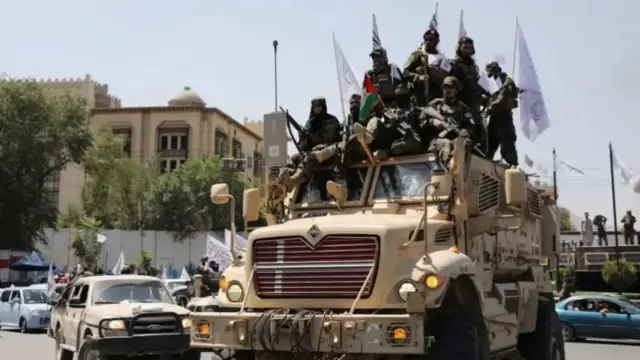
    Afghan Taliban, celebrating the third anniversary of their takeover of Afghanistan, are piled into the bed of a military truck holding machine guns and flags outside the former US Embassy in KabulImage source, Getty Images

    The Taliban, or "students" in the Pashto language, emerged in the early 1990s in northern Pakistan, following the withdrawal of Soviet troops from Afghanistan.

    The group first took power in Afghanistan in 1996 but were ousted by a US-led military coalition in 2001.

    Twenty years of war followed, during which tens of thousands of people were killed and millions were displaced, before the Taliban resumed control of the country in 2021.

    The Islamist group believes in an austere version of Islamic law, known as Sharia, which, alongside imposing a strict morality code on women, has involved public executions of convicted murderers and adulterers.

  6. Key facts about Afghanistanpublished at 03:57 BST 14 August

    This Flourish post cannot be displayed in your browser. Please enable Javascript or try a different browser.

  7. From Kabul to the countryside, we're hearing from women in Afghanistanpublished at 03:57 BST 14 August

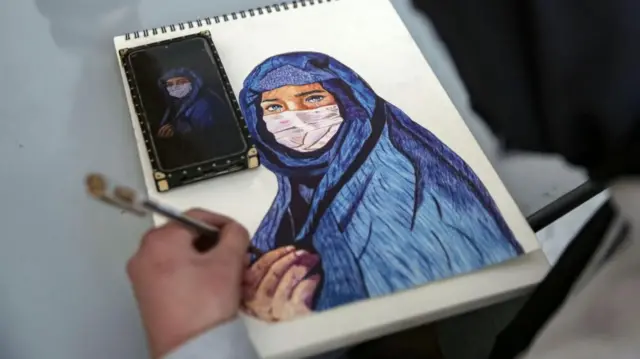
    A girl's hand is shown drawing a picture of a veiled and masked woman with tears in her eyes.Image source, EPA/Shutterstock

    It’s almost 07:30 in Kabul (04:00 BST) and we are beginning a day of coverage on the lives of Afghan women and girls.

    We will be speaking to women across Afghanistan - from the heart of Kabul to the depths of the countryside.

    They are all ages, and from many walks of life; including a jewellery maker, a student, and a former journalist.

    Along with the roughly 22 million women living in Afghanistan, they have spent the last five years living under the Taliban government. It has barred access to school for girls over 12, placed restrictions on travel without a male chaperone, and codified a law implying legal approval for child marriage.

    The restrictions impact almost every part of their lives, and make it difficult to tell their stories. Many of the women we are speaking to today will not be using their own names because they fear reprisals.

    We hope to show a small window on their world - as told by the women and girls themselves.

    So please stay with us as we bring you their stories.