Summary

  • A former gang leader is on trial in Las Vegas for the murder of Tupac Shakur, who died a week after being hit in a drive-by shooting on 7 September 1996

  • The prosecution and defence have delivered their opening arguments as Duane "Keffe D" Davis, 63, faces one count of murder with a deadly weapon

  • Prosecutors allege that although Davis did not himself fire the gun that shot and killed Shakur, he was the ringleader of the group responsible. Davis has pleaded not guilty

  • The defence says the prosecution's case is the product of a flawed, decades-long investigation

  • The prosecution has called their first witnesses, including one who was riding in a nearby car the night of the shooting has told the court "all hell broke loose" as gunshots rang out, as a former Las Vegas homicide detective says people were hesitant in testifying about the case

  • You can also follow the case on the BBC podcast Fame Under Fire: The Tupac Murder Trial, which is available now on BBC Sounds, BBC iPlayer or wherever you get your podcasts

  1. Who is who in the trial of Duane 'Keffe D' Davis?published at 01:31 BST

    We've heard a lot of names on the first day of the trial of Duane "Keffe D" Davis, the man charged with the 1996 murder of Tupac Shakur.

    • Frank Alexander: Tupac's bodyguard in 1996 who was in the convoy of cars the night Tupac was shot. Former Las Vegas detective Brent Becker said when he later showed Alexander a line-up of suspects in Tupac's murder - which included Orlando Anderson and Duane Davis - Alexander could not positively identify anyone.
    • Christopher Wallace: Birth name of rapper Biggie Smalls, also known as The Notorious B.I.G., who was shot and killed six months after Tupac died. Investigators of both rappers' murders were in contact with each other.
    • Orlando Anderson: An alleged member of the South Side Compton Crips gang and Davis's nephew. Hours before Tupac was shot, video showed Anderson being beaten by a group that included Suge Knight.
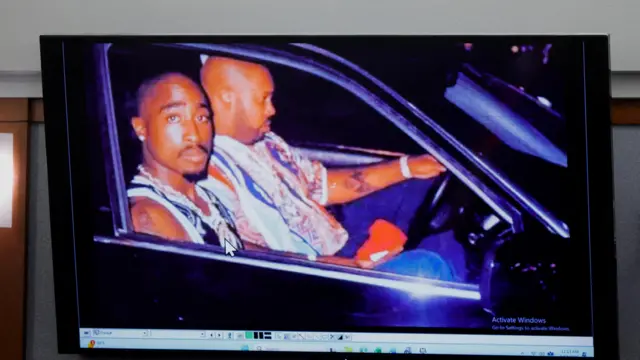
    • Marion "Suge" Knight Jr: Former executive at Death Row Records, the music label Tupac was signed with. Suge was driving the car Tupac was in the night he was shot.
    • Reggie Wright Jr: The former head of security at Death Row Records. Wright had told his people to lie to investigators about Tupac's murder, Davis' defence attorney alleges.
  2. What evidence have jurors seen?published at 01:13 BST

    With court wrapped up for the day, let's look at some of the visual evidence that was shown.

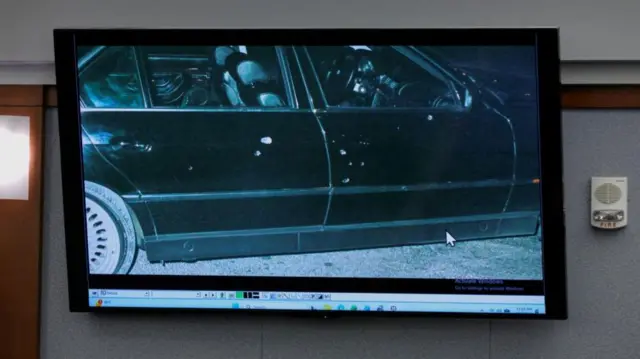
    The jury saw several images of the car that Tupac was riding in when he was shot.

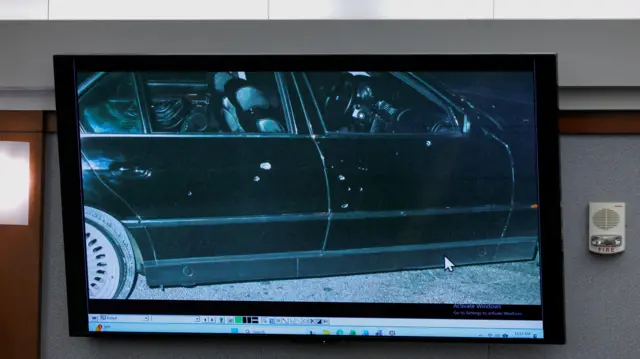
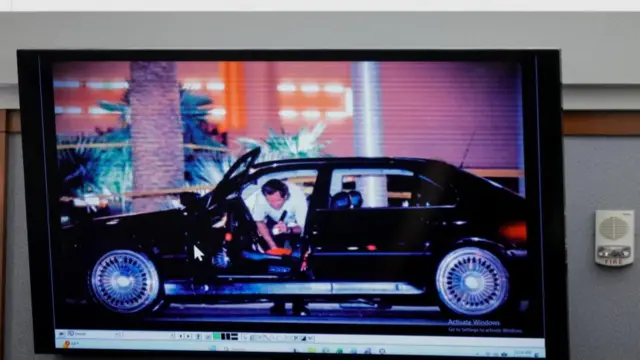
    Multiple bullet holes can be seen in one photo, while another shows an investigator scouring the vehicle for evidence.

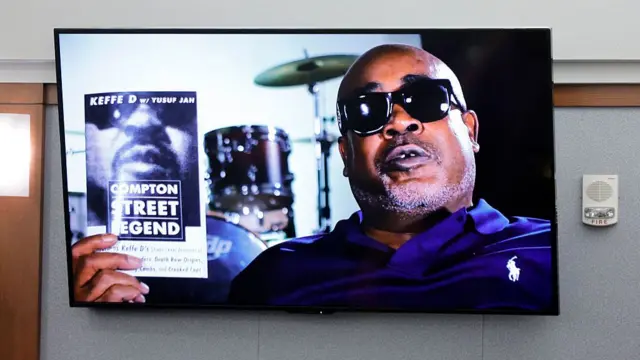
    We've also seen a photo of the accused when he was promoting his tell-all memoir.

    An investigator searching a black carImage source, Reuters
    The black car with bullet holesImage source, Reuters
    The suspect holding up his bookImage source, Getty Images
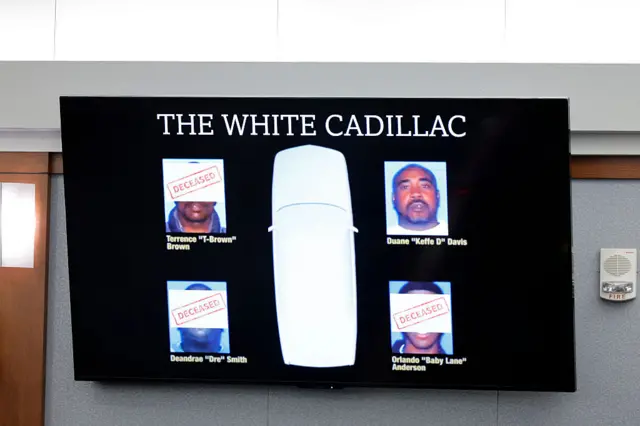
    A graphic showing people in a white cadillacImage source, Getty Images
  3. Jury sent home for the daypublished at 01:02 BST

    The audio recording of officer Frank Miller interviewing Duane Davis about Biggie Smalls' murder ended after about 40 minutes.

    And with that, the jury has been told they are done for the day.

    The judge and the legal teams are still in the courtroom, discussing something privately.

  4. 'Biggie got shot'published at 00:50 BST 18 August

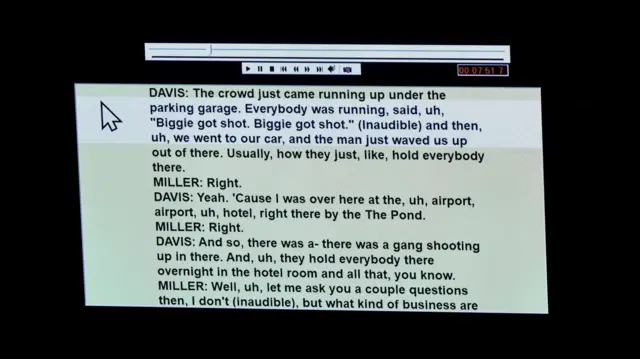
    A recording of an interview with Duane Davis and Los Angeles Police Department detectives is played during the Duane Davis murder trial, related to the 1996 killing of rapper Tupac Shakur, at Clark County District Court Regional Justice Center in Las Vegas, Nevada, U.S., Monday, August 17, 2026. The interview was conducted after the 1997 killing of Notorious B.I.G. (Christopher Wallace), also known as Biggie Smalls.Image source, Reuters

    In the historic police interview being played to the court, Duane Davis tells officer Frank Miller about the night of Biggie's murder. The audio is played and a video shows the transcript.

    Davis says he saw Biggie and Sean "Puffy" Combs, also known as Diddy, at the party. Davis goes over some of the details he remembers; someone was wearing new Jordan sneakers that had just been released, Davis was driving a dark green rental car.

    He says he was in a parking structure near the party when he heard people say, "Biggie got shot".

    Later in the lengthy interview, there's a moment of frustration from Davis. Miller tells him they are only questioning him because he was at the party.

    Miller says he is trying to find new details from those at the party to piece together how Biggie was killed.

  5. Court hears interview about the night Biggie Smalls was killedpublished at 00:26 BST 18 August

    Judge Carli Kierny excuses Fred Miller, a retired Los Angeles Police Department investigator, after he completes a stop-start witness testimony via Zoom that was peppered with technical glitches.

    Now we are hearing an audio recording of an interview between Davis and Miller which was conducted after the shooting of Biggie.

    This is one of the last pieces of evidence for today's proceedings.

  6. Trial resumes after technical issuespublished at 00:03 BST 18 August

    The jury has returned, after another brief break due to technical issues with the Zoom feed.

    The judge reminds that, while they are currently talking about the death of Biggie Smalls, the defendant Davis is not a suspect in that murder.

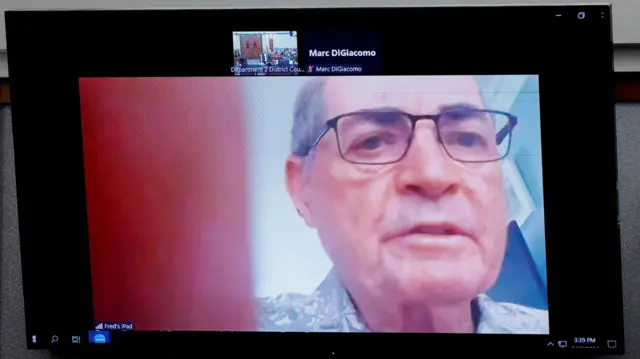
    We then go back to the video call, which seems to be free of tech issues now. The ex-LAPD witness appears to now be testifying via his iPad.

    Fred Miller on a Zoom call wearing glasses. His finger partially covers the lens of his camera.Image source, Reuters
    Image caption,

    On the bottom left corner of the former homicide detective's Zoom call were the words 'Fred's iPad'

  7. Court hears about murder of Biggie Smallspublished at 23:52 BST 17 August

    Former detective Fred Miller says Biggie was at a party before he was shot.

    Police had information about the suspect's car. Miller says it was a newer model of a Chevy Impala with "very fancy rims".

    He tells the court the suspect was a black male.

    The prosecutors were focusing on the death of Biggie but technical issues have put a temporary stop to questioning.

    Miller's video keeps stopping, and the court takes a break to try and figure out the glitches.

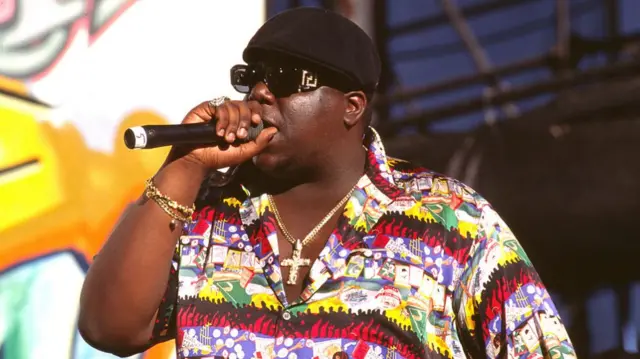
    Biggie wearing a patterned colorful shirt and big gold cross necklace performing into a microphoneImage source, WireImage via Getty Images
    Image caption,

    Biggie Smalls, born Christopher Wallace, performing in 1995

  8. Court resumes with detective from Biggie Smalls murder investigation testifyingpublished at 23:44 BST 17 August

    The jury has been brought back into the courtroom after a short break.

    The trial is resuming with testimony from Fred Miller, a retired homicide detective from Los Angeles, who worked on the investigation into the killing of rapper Notorious B.I.G.

    He spent 30 years with the LAPD, he begins.

  9. Former homicide detective is excusedpublished at 23:21 BST 17 August

    The lawyers finish questioning former homicide detective Brent Becker.

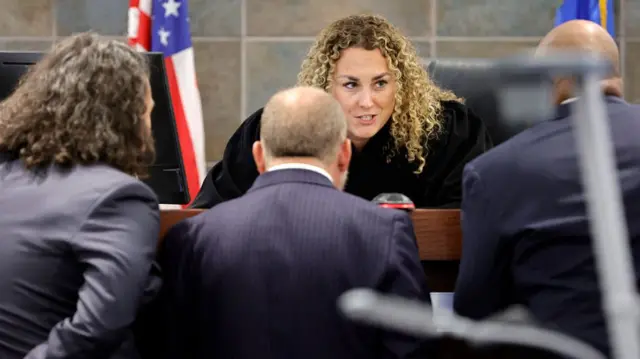
    He is excused, and the legal teams approach Judge Carli Kierny's desk.

    She calls a 15-minute recess, while the court tries to "get some Zoom things going".

    Judge leaning over her desk and speaking with attorneysImage source, AFP via Getty Images
  10. Defence asks about Death Row security chief telling people to lie to investigatorspublished at 23:08 BST 17 August

    The defence lawyer is asking about Reggie Wright Jr, the former head of security at Death Row Records.

    He asks if Becker was aware that Wright had told his people to lie to investigators.

    Becker says he didn't know at the time. "I was later told by Frank Alexander that he said that," says Becker.

  11. No positive ID from photo line-up, detective sayspublished at 22:52 BST 17 August

    Becker, the former Las Vegas detective, says that when he showed Frank Alexander the line-up of suspects in Tupac's murder, Alexander was not able to positively identify anyone.

    He adds that Alexander has since died.

    Investigators from Las Vegas made many trips to California, he says, because that's where everyone relevant to investigation was from.

    He says they tried to speak to Death Row Records but got the runaround.

  12. Notorious B.I.G. murder investigators were talking with Tupac detectivepublished at 22:39 BST 17 August

    The prosecutor asks about the murder of The Notorious B.I.G. (real name Christopher Wallace). The rapper was killed about six months after Tupac was shot.

    Becker says he had contact with one of the lead detectives from the Los Angeles Police Department, which was investigating that murder.

    Frank Alexander, Tupac's former bodyguard had "gotten cross with Death Row Records", Becker believes, and was willing to meet with them and they could show him the photo line-ups.

    Orlando Anderson and Duane Davis were among those pictured.

  13. Witness was later murdered, court hearspublished at 22:21 BST 17 August

    Becker says one witness described the driver of the Cadillac as having an "(expletive) face". He says he perhaps mistakenly thought that meant a younger face.

    Asked if any witnesses were able identify anyone in the car, Becker says only one person thought they could identify someone, but no one said they could identify the shooter.

    He says one of those witnesses, Yafeu Fula, was later murdered in New Jersey.

  14. Autopsy photo was leaked to media, ex-detective sayspublished at 22:18 BST 17 August

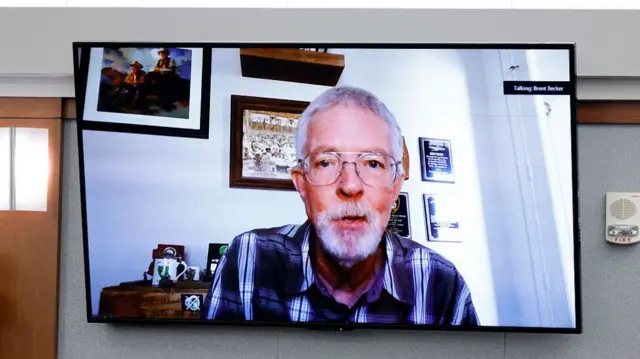
    a TV screen in a courtroom showing the face of Brent Becker via ZoomImage source, AFP via Getty Images

    The prosecution asks if information from the Las Vegas Metropolitan Police Department's investigation was being leaked.

    Becker responds that he was "concerned" about leaks. He describes locking the shelves were case files were kept due to "the nature of who the victim was" and the significant media interest in the case.

    The ex-officer says on a couple of occasions he returned to the files and found them "different" to how he left them.

    The prosecution then asks Becker if he was aware that some of his fellow officers sold a polaroid picture of Tupac on the autopsy table to the Daily Mail newspaper.

    He responds that yes, he saw someone walk into the room with a polaroid camera but didn't see the photo get taken.

    "It was not a photograph that we took... we had no reason to," Becker says.

    He then says he had ongoing concerns about the security of the investigation.

  15. People were not willing to testify, former detective tells courtpublished at 22:09 BST 17 August

    Becker tells the court that the Compton police department, in Los Angeles County, was shown the video from the MGM Grand casino and "immediately" identified Orlando Anderson as well as Knight and others.

    Anderson was an alleged member of the South Side Compton Crips, and the nephew of Duane "Keffe D" Davis.

    He says they also learned of a "series" of shootings following Tupac's murder and that they were getting a "lot of information" from informants.

    However, he says, they didn't have people willing to come forward and testify.

    The court also hears that Compton PD executed search warrants as part of their investigation into the ongoing gang war.

    "We were told they were serving search warrants on all these locations for these different groups or gangs, but there was also at least one murder warrant for Orlando Anderson that they had there in Compton - so it was our understanding they were going to be arresting him on an outstanding murder warrant there in Compton."

    He adds his understanding was the search warrants were based on informants and that he was present when Anderson was arrested.

  16. Ex-detective says he thought Suge Knight 'lied' to policepublished at 21:58 BST 17 August

    A 1996 photo of rapper Tupac Shakur (L) and Marion "Suge" Knight is displayed during the trialImage source, Reuters
    Image caption,

    A 1996 photo of rapper Tupac Shakur (L) and Marion "Suge" Knight is displayed during the trial

    The prosecution asks Becker about an incident at the MGM Grand casino earlier that night, which took place after a Mike Tyson fight.

    Becker says he saw video of Suge Knight kicking and beating someone, alongside a large group that included Tupac.

    He says he only learned of the victim's first name, Orlando.

    Becker says that police attempted several times to interview Knight about the shooting of Tupac.

    Knight repeatedly didn't show up, and when he did, he arrived with multiple lawyers, which Becker says he thought was weird because Knight was considered a victim in the shooting. He was driving the car that Tupac was in.

    He says Knight's interview seemed rehearsed and "timid".

    "I thought he lied to us," he says. "He just basically said he didn't know anything."

  17. Witnesses thought there were three to four suspects, but only saw the shooter's armpublished at 21:53 BST 17 August

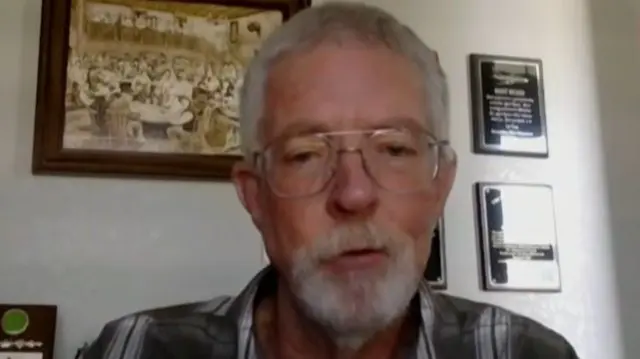
    A man with grey hair and a grey beard with wire-framed glasses sits in a room with various framed plaques and images behind himImage source, US Courts
    Image caption,

    Former homicide detective Brent Becker

    When asked if the police tested the weapon cartridge cases, Becker said they were, and that he "believes" the firearms examiner determined that the bullets came from a Glock brand of gun.

    Becker is then asked if he received descriptions of the suspects.

    "The only thing we had was two to four people, probably all black males," Becker answers. "The shooter, all we had was a black arm.

    The former officer then says witnesses to the shooting had "skedaddled" by the time he arrived on the scene.

  18. Witnesses told detective how gunman opened fire on car Tupac was inpublished at 21:48 BST 17 August

    A 1996 photo of the car that rapper Tupac Shakur was riding in when he was shot is displayed during the Duane Davis murder trial, related to the 1996 killing of the rapper, at Clark County District Court Regional Justice Center in Las Vegas, Nevada, U.S., Monday, August 17, 2026.Image source, Reuters
    Image caption,

    A 1996 photo of the car that rapper Tupac Shakur was riding in when he was shot is displayed at court

    Becker says he interviewed witnesses who said they were in the car behind Tupac and Knight. They told him a white car pulled alongside Knight's car and someone in the white car began "opening fire or shooting" into the car.

    He says the descriptions "varied a bit" but he believes they all said it was a white car, while there "might have been a little bit of variance" between two and four occupants.

    Asked next about the bullet holes - Becker says he saw "impact strikes" on the right hand side of the car as well as "some sort of mark or impact" on the windshield.

    He explains however that he cannot know how many shots were fired, only seeing those that struck the vehicle, and adds some fired cartridges could have been thrown aside by other traffic or caught up in the tread of tires.

  19. Former homicide detective called as witnesspublished at 21:35 BST 17 August

    Brent Becker is now testifying as a witness via a video link. He says he was a police officer for the Las Vegas Metropolitan Police Department from 1984 to 2011.

    At the time Tupac was killed in 1996, Becker was a detective for the homicide section, he says.

    He tells the court he was called out to a shooting on 8 September 1996, adding he got there about 1am.

    Becker says Tupac wasn't at the scene when he arrived, adding it was unusual for homicide to get called out when the victim was not yet dead. Tupac died six days after the shooting.

    The former detective says because "of the nature of who the victim was", he was asked to come out.

  20. Court resumespublished at 21:18 BST 17 August

    The court has returned - prosecutors are now calling their next witness.