Summary

  • We've ended our live coverage - read our story here

  • Hundreds of thousands of students in England, Wales and Northern Ireland have received their A-level, T-level and BTec results today

  • The percentage of top A-level grades edges up again, while a record number of students secure a place at university

  • Sam, a college student in St Helens, is "thrilled" with his A* in maths, while Ella in Cornwall feels "excitement and relief" after getting her results

  • Meanwhile our experts have been answering your questions on clearing, grade boundaries, gap years and many more

  • Did you not get the results you were hoping for? Use this tool to help you figure out your next steps

  • In Scotland, students received grades for their National 5, Highers and Advanced Highers exams last week

How were your results?

  1. From 'the next PM' to hopes of travelling, reactions to results have variedpublished at 15:10 BST 13 August

    Media caption,

    'My son the next PM!' - When you take dad to collect results

    It's been a day of high emotion for students in England, Wales and Northern Ireland receiving their results. Many have shared the experience with us, and their reactions have differed greatly:

    • "The next prime minister everyone!" says Michel's father after the student met his offer to study at King's College London
    • "I was so scared to disappoint everyone, my teachers and my parents, but I’m happy that it went the way I wanted it to go," says Marta Kumar in Bradford, who is off to study Law at Leeds
    • "I’ve always wanted to be a hairdresser so I am so excited to start," Grace in Canterbury says
    • "I'm only the second in my family to go to university, so this is a great honour," says Fred Fletcher from Maidenhead, who will be studying at Cambridge
    • "I was one mark off an A* in physics so I’ve asked for a remark," says Fabian Kowalewski, who is off to study Electrical Engineering at Imperial College London
    • "I want to go travelling and I hope to work a little bit to get a bit more experience," says Miriam Khan who is heading to Loughborough to study sport and exercise science
    • "Even though I’ve got my uni offer, I’d prefer to do an apprenticeship,” says James McAliksey at St Patrick's Academy in County Tyrone in Northern Ireland

  2. Aspiring zookeeper closer to dream after bagging distinction in T-levelspublished at 14:58 BST 13 August

    Freya Scott-Turner
    Live reporter

    Freya Montague wears a green hoodie and strokes the head of a rhinoImage source, Freya Montague

    Aspiring zookeeper Freya Montague is delighted with the distinction she’s bagged in her Animal Management and Behaviour T-level.

    “I’m so happy about my grade,” she tells me. “Exams aren’t easy for me, I thrive much more in practical examinations.”

    “It just proves to me all the hard work I have put in the last two years has all been worth it.”

    Freya plans to apply for zookeeping apprenticeships in the next couple of months and has already started work experience at local Whipsnade Zoo in Dunstable, Bedfordshire, where she’s been looking after a range of animals – from rhinos to giraffes – feeding them and cleaning out their enclosures.

    “I enjoyed it so much, as it further reassured me that being a zookeeper is what I want to do in the future."

  3. Nearly 20,000 students receiving T-levels grades as pass rate risespublished at 14:52 BST 13 August

    Hazel Shearing
    Education correspondent

    This is the fifth year of T-level results in England, and the number of students getting grades has rocketed as their rollout continues.

    More than 19,600 students received grades in 21 subjects this year, up from 11,900 students across 18 subjects last year.

    The pass rate increased slightly from 91.4%, according to last year’s provisional results, to 92.6%. The percentage of students achieving a merit or above grew from 65.3% to 68.9%.

    The dropout rate remains high, though – and some students take longer than the standard two-years to complete the course.

    Around 77% of students who started their T-level in 2024 and were expected to complete it this year have received results.

    This Flourish post cannot be displayed in your browser. Please enable Javascript or try a different browser.

  4. 'I thought I'd missed my chance at Oxford - then I checked Ucas'published at 14:38 BST 13 August

    Emily Doughty
    Education reporter, reporting from Carmel College in St Helens

    Stephen is seen holding his results paper in a large indoor hall, standing in front of a blurred background with several people. A vertical sign reading “BE INSPIRED” is visible on the left. The venue has high ceilings and bright lighting.
    Image caption,

    Stephen is off to study law at Oxford in September

    At Carmel College in St Helens, it’s been a rollercoaster of a day for Stephen, who initially thought he hadn’t achieved the grades he needed to study law at Oxford.

    “I was initially disappointed,” he says. "But when I opened Ucas, I saw I had been accepted anyway and now I’m so happy.”

    We've been hearing that the top, most academically-selective universities have seen the highest growth in the number of students being accepted on to their courses this year.

    Overall, the higher education sector has been struggling financially in recent years, partly because fees for UK students had been frozen for a long time before increasing last year.

    As our education correspondent writes, taking on more UK students may help those more selective universities to stave off the financial problems faced by the sector as a whole.

    For Stephen, he's simply excited to start his next chapter - though he says he will miss his nan and his life at home, including Chinese takeaways.

  5. More students taken on at most selective universitiespublished at 14:33 BST 13 August

    Hazel Shearing
    Education correspondent

    Ucas says a record number of UK 18-year-olds have been accepted into university.

    But the steepest growth is in acceptances to what it calls "higher tariff" universities - the most selective institutions, like those in the Russell Group.

    The number of 18-year-olds from the UK securing a place at these universities has grown by 5.5% compared to last year. And admissions teams still have places - the Russell Group itself said this morning that many of its members had courses available in clearing.

    The bigger picture here is about university finances, which have been under pressure in recent years.

    Taking on more UK students may offer some stability for those selective universities.

    But, with four in ten universities in England expected to report a deficit for the 2025-26 financial year, there will be institutions hoping to recruit more students through clearing.

    This Flourish post cannot be displayed in your browser. Please enable Javascript or try a different browser.

  6. 'I'm doing a degree apprenticeship to get real world experience'published at 14:27 BST 13 August

    Emily Doughty
    Education reporter, at Carmel College in St Helens

    Maya has shoulder-length dark hair and is wearing a black top and gold necklace in a bright indoor venue. Several people are gathered in the background near large windows and a refreshments table, with the foreground subject centred and in sharp focus.
    Image caption,

    Maya is going to be living at home while doing a degree apprenticeship

    What if you could get a university degree and not only avoid the fees, but get paid a salary as well?

    Not everyone who has got their results today will be heading to university, some will be going on to do degree apprenticeships.

    Maya, from St Helens, is going to be a quantitative surveyor.

    Carmel College, where Maya sat her A-levels, says about 10% of their students have applied for degree apprenticeships.

    Maya applied to university too, but says going down this path was always her preferred choice.

    “I wanted to get real world experience," she says.

    Maya is planning to live at home during her degree apprenticeship, but may have a further commute than most, as her office is based in Hull.

  7. Going through clearing? Top tips when calling universitiespublished at 14:22 BST 13 August

    Katie Williams
    Live reporter

    Richard Quayle at University of ManchesterImage source, Richard Quayle / University of Manchester

    Richard Quayle is part of a team of 400 people who'll be answering the phones at the University of Manchester today, as students look to secure places through clearing.

    He's head of student admissions, but says even the vice-chancellor has got stuck in previously. It's an "all hands on deck" sort of day, he tells me, with around 8,000 calls expected.

    He knows calling clearing can be nerve-wracking, but says the university's call handlers have been trained to help.

    His top tips?

    • Check online to see which courses are available before calling
    • Have your grades and Ucas ID to hand
    • Keep in mind why you want to do the course
    • It's a busy day but stay on the line; the university will answer as quickly as possible
    • Parents and carers: your job is to "radiate calmness"

    Remember, clearing isn’t just for those who have missed their grades.

    You can also use it if you didn’t previously get offers, have changed your mind about your course, or have done better than you expected.

    Quayle describes it as a "really powerful tool".

  8. Student brought up in care system wakes up to 'dream' spot at Oxfordpublished at 14:17 BST 13 August

    Jasmine Lowe
    BBC Lincolnshire

    Selfie of a young man with short, light brown hair and black glasses taken in front of a glass-panelled door

    A Grimsby teenager brought up in the care system woke up to his “dream” scenario today after securing a place at Oxford University to study history.

    Matthew Armitige, 17, has been in the care system since the age of eight, when he met his “amazing foster family", who he says have been there for him “every step of the way".

    Studying at Franklin Sixth Form College, Matthew achieved A* and two A’s in English, History and Politics.

    "I feel a sense of pride at my own perseverance," he says. "I do really want to try and take on that role of being an advocate for people in the same position as me, who I think, are too often pushed down by the systems that they have to exist in.”

    Matthew says he may want to consider a job in law once he graduates.

    “I want to thank the whole children's services team at North East Lincolnshire. They have been impeccable in their support of me,” he adds.

  9. 'It's an honour to celebrate with students,' clearing officer sayspublished at 14:08 BST 13 August

    Madeleine Lake
    Live reporter

    A woman working at a university deskImage source, The University of Derby

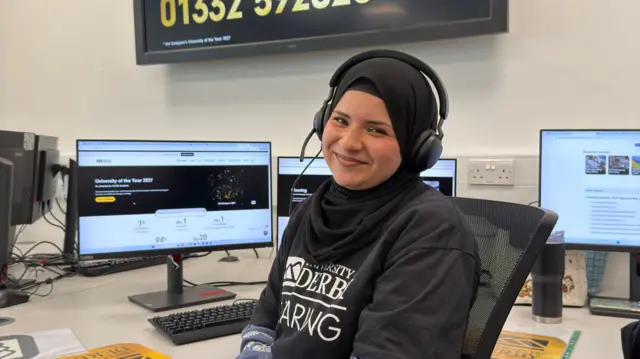
    The clearing team at the University of Derby has seen double the number of calls compared to this time last year, according to one clearing officer.

    Dounia Al-Hasiniani, 24, tells me health courses have been extremely popular so far today, with many already closed by just after 9am.

    Dounia says the team have been doing fist bumps in the air when they offer students a place and celebrating with families over the phone.

    "It's busy but in a very fun way, it's been a lovely morning," she says, adding that phone lines are open until 20:00.

    Earlier this morning, Dounia took a call from one student who had a "change of heart" about their next steps, and wanted to swap from humanities to study science instead.

    "We offered her a place, we heard her mum go 'woohoo'. They were both so thankful. It's an honour to celebrate with them and be a part of a change like that," says Dounia.

    While going through clearing can be a stressful time, Dounia says it is "not just for one day" - and students can call and then take time to consider their decision.

    "Take a deep breath, we will guide you through the next steps," she adds.

  10. The financial implications of taking out a student loanpublished at 13:49 BST 13 August

    Emer Moreau
    Money and Work journalist

    Criticism of the student loans system has been growing in the past year after the repayment threshold for Plan 2 loans was frozen.

    This means students will start repaying their loans sooner than they would otherwise have done, and their rising salaries will lead to greater repayments.

    Students say it’s unfair that the government is arbitrarily changing the repayment terms.

    Thousands of graduates also told a parliamentary inquiry that they didn’t understand the terms and conditions of their loans before taking them out.

    And a recent analysis by a think tank concluded that graduates on Plan 5 loans could struggle to save for house deposits or pensions because of their repayments.

    You can find out more about taking out a student loan and the repayments in our story here.

  11. How do student loans work?published at 13:34 BST 13 August

    Rahib Khan
    Education reporter

    A young person in a beige hoodie working on a laptop at a table in a softly lit home kitchen. Cabinets and appliances are blurred in the background, with the focus on the computer screen and workspace.Image source, Getty

    If you're getting your results and planning to head to university, you may be wondering how you're going to pay for it.

    Most students can apply for a loan to cover their tuition fees, as well as a separate maintenance loan to help with living costs like rent, food, books and going out, which vary depending on where you're from and your household income.

    The maximum maintenance loans for students living away from home this coming year are:

    • England: £10,830 (or £14,135 for those studying in London)
    • Wales: £11,570
    • Scotland: £9,400
    • Northern Ireland: £8,352

    Loan repayments for both tuition fees and living costs usually begin once you earn above a certain salary threshold after leaving uni, with 9% of your income above that level taken through the tax system.

    For current graduates, that threshold in England is £25,000. In Wales it is £29,385, in Scotland £33,795 and in Northern Ireland £26,900.

    Interest will build up on your loan until you're able to pay it off, or until any remaining debt is wiped off at the end of the loan term. In England, this is after 40 years. In Wales and Scotland it's 30 years, and in Northern Ireland it's 25 years.

    You can get more info on student loans from our explainer.

  12. Three things you need for a good results celebrationpublished at 13:20 BST 13 August

    Manish Pandey
    Live reporter

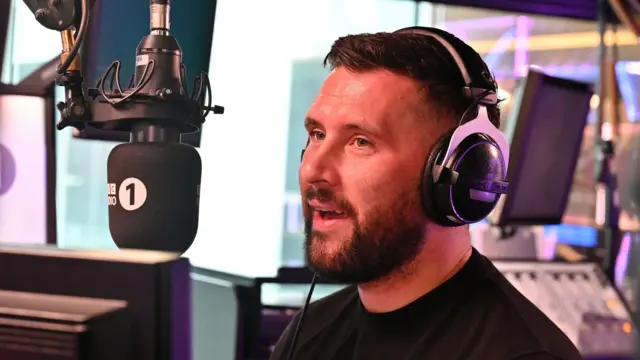
    Radio 1 DJ Danny Howard wearing headphones

    Whether you’ve got the grades you wanted or not, it’s still worth honouring all your hard work. So what does any good celebration need? Radio 1 DJ Danny Howard has shared his suggestions with us.

    Company: You’ve got to be with your nearest and dearest. What better way to celebrate than with the friends you’ve been through this whole journey with.

    Venue: Pick wherever you love to hang out with your mates, whether that’s the park or someone’s house (with permission).

    Music: Whichever member of your group has the best music taste - get them on the aux cable and get a good speaker. Dance music is the best soundtrack to let loose and celebrate.

    Danny’s picks to get your party started: Electronic house track Talk To You by ANOTR, featuring 54 Ultra, and Free Your Mind by Cloonee and Prospa.

    And if you’re really struggling for a playlist, tune into Radio 1 Dance with Danny Howard from 18:00 BST.

  13. Do I have to reject my insurance offer to go through clearing?published at 13:08 BST 13 August

    Matias Iglesias
    Mechanical Engineering Student & Clearing Advisor, Kingston University

    We can now bring you some more questions submitted to us via the BBC News YouTube account.

    Yes, to be released into clearing you first must reject your insurance offer.

    You can do this by logging into your account on the UCAS website, once you have done this you’ll be able to start the clearing process and start applying to courses through clearing.

    Only do this if you are sure you no longer want your place.

    A purple banner with white writing that reads your voice
  14. There's lots of options available if you didn't get your grades - education secretarypublished at 13:04 BST 13 August

    Education Secretary Lucy PowellImage source, PA

    Education Secretary Lucy Powell has shared her advice to students who didn't get the results they'd hoped for.

    In a video on X, she says lots of celebrations are going on, but things don't always go to plan and "that's okay too".

    "If you didn't get the results that you were hoping for - don't panic because there's lots of options open to you."

    She recommends checking Ucas for university or clearing places, speaking to school or college, or checking the National Career Service.

    Powell says there "might be lots of things open for you that you've never thought of", such as an apprenticeship, a degree apprenticeship or other qualifications.

    You can read more on what to do if you missed your grades in our earlier post.

  15. Opportunities shrinking for too many young people, former minister previously warnedpublished at 12:52 BST 13 August

    Alan Milburn speaks to the media on the publication of the interim Milburn Report, 28 MayImage source, PA Media
    Image caption,

    Former minister Alan Milburn is authoring a report on young people and work

    While a record number of 18-year-olds have secured a place at university today, others are stepping into an uncertain world.

    More than a million 16-24-year olds are not in education, employment or training (Neet), according to a report released by the Office for National Statistics (ONS) in May.

    It's a point of extreme concern for the government, which has commissioned a review into the topic by former minister Alan Milburn, who warned that the country is at risk of a "lost generation".

    Milburn said career opportunities for young people were "not growing" but "shrinking", with one in six set to be out of work, education or training in five years unless action is taken.

    Prime Minister Andy Burnham has said he is "on a mission" to reduce the number of Neets, while Milburn is expected to outline potential solutions to the crisis when his final report is published.

  16. Students taking T-levels reaches record highpublished at 12:45 BST 13 August

    Alex Taylor
    Education reporter

    A student opens her A-level results at Solihull School, Solihull, with her parents looking on.Image source, Getty Images

    More students may be heading to university, with Maths A-levels and STEM subjects on the rise, but this results day is showing it's far from the only route on offer.

    We've been hearing from students who have received their T-level results today. T-levels are a technical qualification, with a focus on understanding one industry and including a mix of classroom study and hands-on experience.

    T-Level results reached record levels, with over 65% more young people receiving technical qualifications, at a pass rate of over 90%.

    A growing number also took up training in construction this year through vocational technical qualifications, jumping by nearly 20% compared to last year.

    Prime Minister Andy Burnham holding his hands out in front of himImage source, PA Media

    Prime Minister Andy Burnham says it's "brilliant to see more students succeeding in T Levels", as well as more taking maths and STEM subjects as he congratulated students on their results.

    "The talent is there in every town and city in this country. Our task is to match that talent with opportunity, whether that's through university, an apprenticeship or a technical pathway that leads to a great career," he says.

    The new Labour leader has made increasing pathways into work a key part of his education plans. It follows concern that nearly a million 16-24 year-olds are not in education, employment or training (Neet).

  17. Postpublished at 12:16 BST 13 August

    This Riddle post cannot be displayed in your browser. Please enable Javascript or try a different browser.

  18. More employers are taking notice of T-levels, says engineering studentpublished at 12:13 BST 13 August

    BBC Newsbeat
    Abu Bakar Yasin, reporting from Mansfield

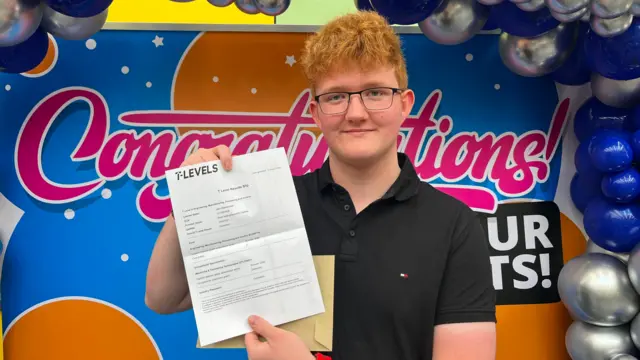
    Jake Myerscough wears a black polo shirt and holds up a T Levels results paper

    BBC Newsbeat have been talking to students opening T-level results at West Nottinghamshire College in Mansfield.

    Jake Myerscough tells us he “feels brilliant” after getting a distinction in his T-level in Engineering, Manufacturing, Processing and Control.

    “It’s been very difficult to get to that point but having the people around me to support me and being in an environment that was very good for what I wanted to do helped significantly,” the 18-year-old says.

    Jake says he’s “always been fascinated by how things work and how things are made” and picked T-levels because he likes “to aim high, to challenge myself”.

    He thinks more and more employers are taking qualifications like his seriously, especially in the engineering world.

    “It was described as getting three A-levels so in the end you get a Level 3 technical qualification which is becoming known among companies,” he says.

    “It’s a good qualification to have because it can get you to where you want to go in engineering.”

  19. How do you go about getting a paper re-marked - and how long does it take?published at 11:54 BST 13 August

    Diana Bird
    Executive Principal, Leeds City College

    This question on getting exam papers re-marked was sent in to us via our BBC News YouTube account.

    If you think one of your grades is wrong, you can ask for it to be reviewed or appeal the result.

    Any request for a re-mark must go through your school or college, and you need to be aware that your mark could go down, stay the same or go up.

    The process and deadlines can vary depending on the exam board and school or college, so please speak to your teacher or exams officer as soon as possible.

    They’ll explain your options and help you decide whether a review or appeal is the right way forward.

    A purple banner with white writing that reads your voice
  20. How does clearing work?published at 11:48 BST 13 August

    Chrissa Beaumont
    Director of Marketing, Nottingham Trent University

    Our experts are answering your questions on exam results, clearing and what to do if you didn't get the grades you hoped for.

    Some of you have got in touch to ask how clearing works.

    Clearing helps match students who don’t have a confirmed university place with courses that still have spaces.

    On results day students will find out whether their place is confirmed or if they are ‘unplaced’ due to their grades being below what their chosen university is happy to accept.

    Students can check if they are in clearing with Ucas, or can release themselves into clearing if they have changed their mind about either their course or their institution.

    Students can apply for new courses and receive offers in real time - often over the phone with university call centres. Students can receive several offers from different institutions.

    Once they’ve decided which offer they want to accept they do this direct to their chosen university and add their choice on Ucas.

    A purple banner with white writing that reads your voice