Summary

  • There was a track "irregularity" near the site of a train derailment in Lewes last week, an initial report says - here's what we learned

  • The Rail Accident Investigation Branch (RAIB) has been investigating after three carriages of a Southern Railway train from London Victoria flipped on their sides on Thursday

  • Around 150 people were on the train - one passenger told the BBC it felt like "we'd been lifted into the air"

  • The report says there is evidence that "some movement" had previously taken place on the railway embankment, but there is no evidence of a significant slip

  • Thirty people were injured with 20 taken to hospital - two passengers who suffered serious but non-life threatening injuries remain there

  • The railway between Lewes and Hayward Heath will be closed for at least one more week as the train is recovered and tracks are repaired

Media caption,
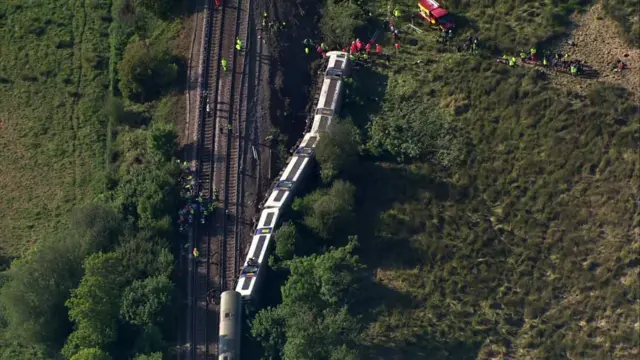
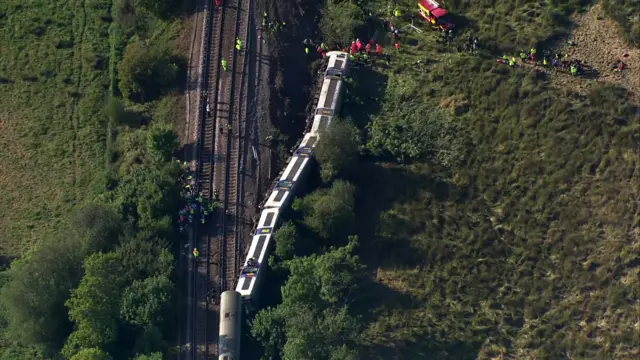
Aerial footage shows derailed train
  1. Track defect found on rails where train crashedpublished at 15:12 BST
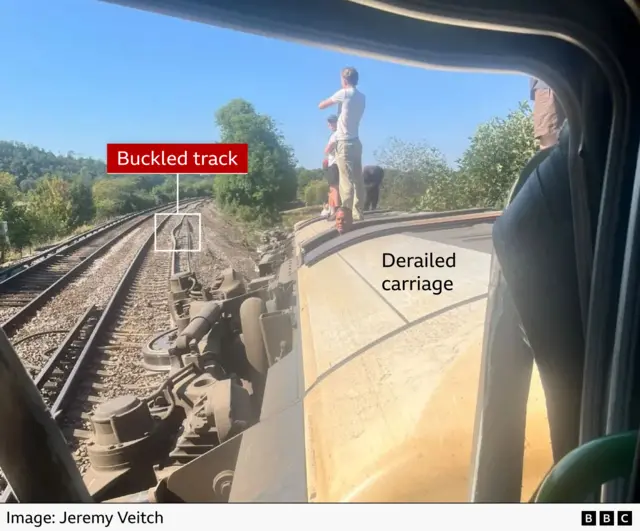
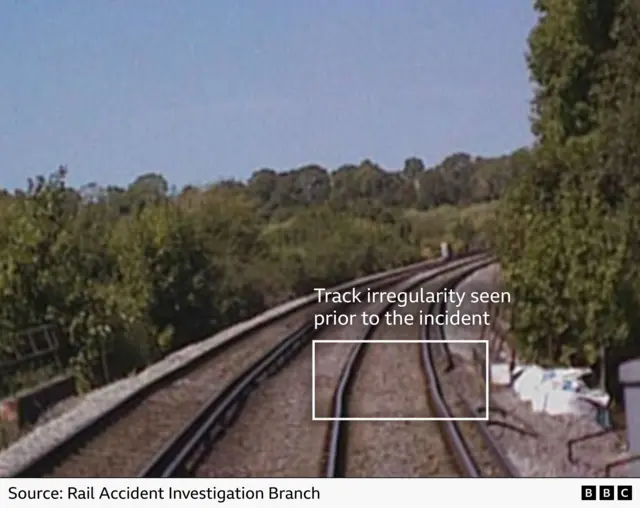
    A shot of the train tracks, and one section is slightly bent. There is a white square around this section to more clearly point it out.

    A track "irregularity" has been found on the rails where a train came off the tracks in Lewes last week, investigators have said.

    The Rail Accident Investigation Branch has released its initial report, external into the derailment which took place on Thursday 13 August, the hottest day of the year. The derailment threw three carriages off the track and onto their side, injuring 30 people, two of whom are still in hospital.

    Investigators said there was evidence of previous "track maintenance activity" in the area and there had been several reports of "rough riding" from passengers on other trains in the same location.

    In a joint statement after the report was released, Lucy McAuliffe, Network Rail's route director for Sussex, and John Whitehurst, chief executive of Greater Thameslink Railway, said they were "very sorry that this happened on our railway" and promised to "carefully consider any recommendations arising from the investigation".

    The next steps of the investigation will look at how the track was inspected and maintained, and the effectiveness of any measures designed to address risks of operating trains in hot weather.

    We're closing our coverage but you can read our full report here.
  2. Passenger belongings still inside derailed carriagepublished at 14:54 BST

    Following the derailment, some passengers say their belongings are still inside the overturned carriages.

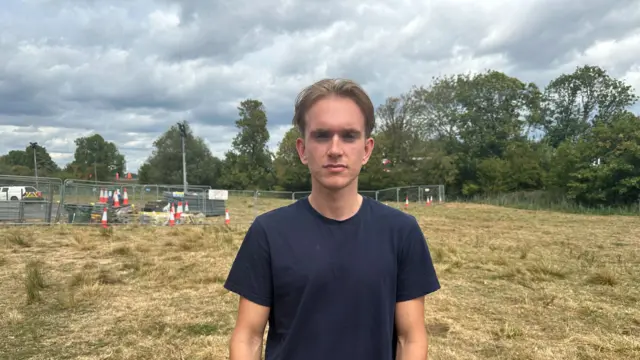
    Alvin Dybvik Payne, 20, was visiting his family in Seaford from Norway when the train derailed, and says his passport, luggage, house keys and laptop with all of his university work are yet to be returned to him.

    The economics student said on Tuesday: "It's quite frustrating due to the fact that it is right over there.

    "I could go home to Norway on an emergency passport, but if I did I couldn't get into my flat, I wouldn't be able to go to lectures, and I wouldn't have any of my essentials."

    British Transport Police (BTP) says carriages are not yet safe to access. Southern and Network Rail say they are "making every effort to reunite passengers with their belongings".

    A student wearing a dark blue top stood in a field with a metal fence in it.Image source, Oliver Whitfield-Miocic / BBC
    Image caption,

    Alvin Dybvik Payne, 20, says his passport, house keys and other belongings are still on the train

  3. Lewes-Haywards Heath railway still closed with repair operation to be carried outpublished at 14:39 BST

    Katy Austin
    Transport correspondent

    Following last week's derailment, the railway between Lewes and Haywards Heath remains closed. A complex recovery and repair operation will need to be carried out.

    Publicly-owned Network Rail looks after and operates the railway tracks, signals and structures.

    The train involved in the accident was operated by Southern Rail, part of Greater Thameslink Railway which was nationalised in May this year.

    Last Friday, the organisation’s group safety and engineering director Martin Frobisher told the BBC that speed restrictions were not in place along the section of track when the derailment happened.

    He insisted the railway was safe, and that Network Rail took various measures to manage the impact of weather on tracks and other railway equipment.

  4. Rail investigators attended the scene to inspect the rolled carriagespublished at 14:28 BST

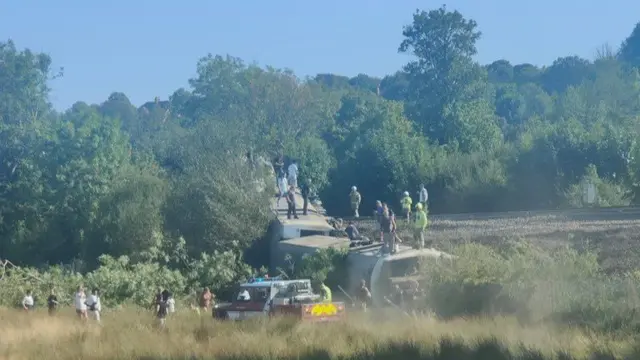
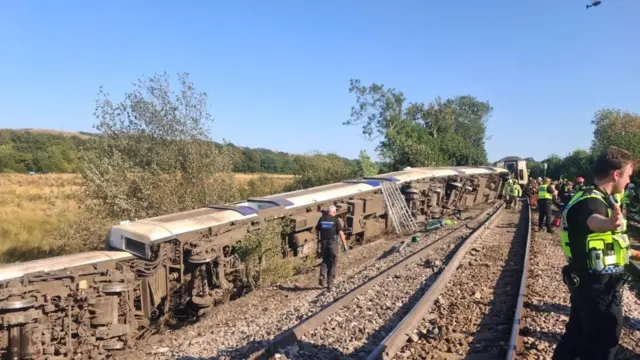
    After three carriages of the train left the tracks in Lewes, British Transport Police officers, rail investigators and ambulance services attended the scene.

    One passenger told the BBC that when the carriages rolled, she "took the brace position... preparing to die" and when the train stopped "we were stood on the glass of the windows".

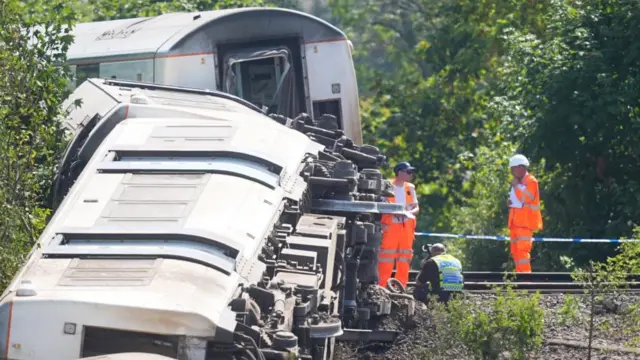
    A train carriage is lying on its side having fallen off the tracks and a British Transport Police office is crouching down to take a photo up close in the carriage's wheels while two other safety officers stand nearbyImage source, PA Media
    Image caption,

    A British Transport Police crime scene manager and rail investigators at the scene

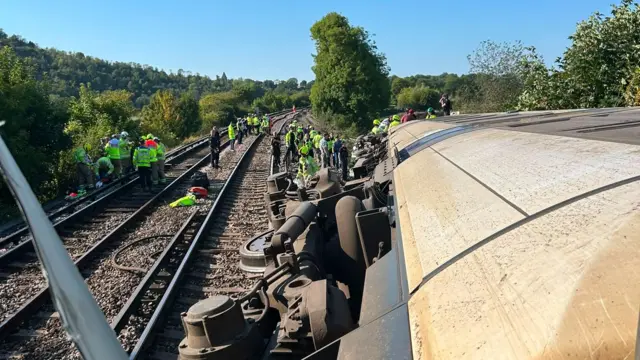
    Picture shot from the window of the train showing that it has fallen off the tracks and onto its side while emergency service workers investigate nearbyImage source, Rachel Heath
    Image caption,

    One of the train's passengers, Rachel Heath, told the BBC it felt like "we'd been lifted into the air" before the carriages rolled on their sides

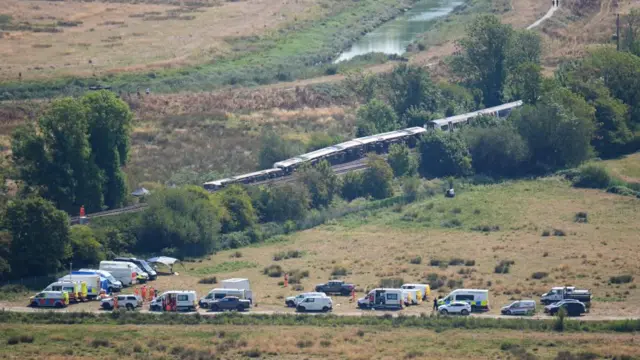
    Train tracks overturned on their side having fallen off the tracks while over a dozen emergency vehicles are parked nearbyImage source, PA Media
    Image caption,

    The incident happened around 15:44 BST on Thursday, 13 August

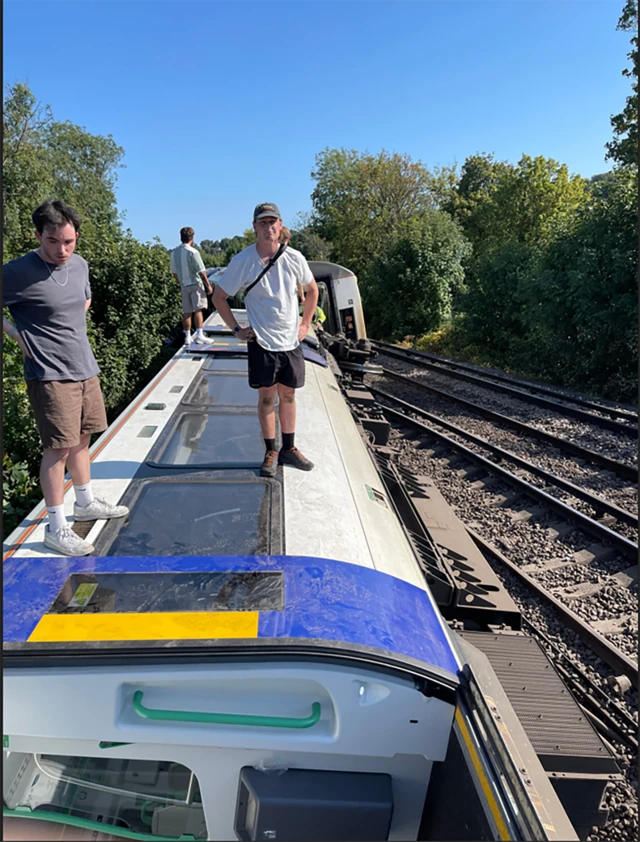
    Three commuters of a train that tumbled off its tracks are standing on top of the one of the carriages which is lying on its sideImage source, Chris
    Image caption,

    Passenger photos from the scene showed commuters standing on the sides of the rolled carriages

  5. ORR 'investigating circumstances' of derailmentpublished at 14:23 BST

    We have just heard from the Office of Rail and Road (ORR), which says that it is also "investigating the circumstances of the incident".

    "As this is a live investigation, however, we will not be commenting further at this time", a statement added.

    While the RAIB does not apportion blame in its investigations, ORR investigations are conducted "to see whether there have been any breaches of health and safety law", according to the regulator.

    "If it is appropriate, we have the power to prosecute under health and safety law", its website says.

  6. Crash was on hottest day of the year, during heatwavepublished at 14:12 BST

    Thursday's derailment came during the latest in a series of heatwaves that have hit the UK over the summer, with the RAIB saying that the accident took place "during a sustained period of hot and dry weather".

    An amber heat health alert had been issued in parts of the UK on the day of the derailment, and the hottest temperature of the year, 38.1C (100.6F) was measured at Kew Gardens.

    At Brighton City Airport, the closest weather station to the crash site, temperatures at the time of the derailment were measured at around 27C (80.6F) according to the report.

    In Herstmonceux, another weather station which is a similar distance to the site, temperatures peaked at 33.3C (91.9F) at 15:00 BST on Thursday 13 August, prior to the derailment - the highest measured at that site for the whole of August 2026.

  7. 'Kink' in railway could have been impacted by hot weather, says railway engineerpublished at 14:08 BST

    Gareth Dennis, a railway engineer and host of the podcast Railnatter, suggests the "track geometry irregularity" described in the RAIB report could have been impacted by the hot weather.

    He tells BBC Radio 4's World at One that it was likely that the front part of the derailed train went over the top of the "irregularity" - what he calls a "kink" - and that the "forces" from the train caused the kink to "snap... into a more dramatic buckle".

    That's why it was the rear carriages of the train that fell off the tracks, he says.

    Dennis adds: "The hot weather will have resulted in forces building up and those manifest in a kink if the track isn't able to sustain those forces."

    He also claims that from 2015, money was shifted away from renewals maintenance - when old materials are replaced with new ones - and allocated to making train enhancements instead.

  8. Watch: Inside train carriage moments after derailment near Lewespublished at 13:57 BST

    Media caption,

    Inside train carriage moments after derailment near Lewes

    Passenger Rachel Heath took this video moments after the 14:24 from London Victoria to Eastbourne left the tracks near Lewes.

  9. 'We are very sorry that this happened on our railway' - train bossespublished at 13:49 BST

    We have just heard from Lucy McAuliffe, Network Rail's route director for Sussex, and John Whitehurst, chief executive of Greater Thameslink Railway, who say they "remain fully committed to supporting the current investigation".

    In a joint statement, McAuliffe and Whitehurst say they are "very sorry that this happened on our railway", adding: "We will carefully consider any recommendations arising from the investigation and work across the industry to implement them, with the shared goal of making an already safe railway even safer for our customers, colleagues and the communities we serve."

  10. 'UK's railways remain among safest in the world' - Department for Transportpublished at 13:42 BST

    The Department for Transport (DfT) has released a statement saying "safety remains the absolute priority across our rail network". The department will ensure the rail industry "acts on any findings" when the full report from the Rail Accident Investigation Branch is published, a spokesman said.

    “The UK’s railways remain among the safest in the world, with the number of delays caused by track faults falling by 45% since the late 2000s," the statement says.

    It adds that the DfT is investing £29bn "to renew and maintain the network" and an additional £2.6bn to "improve climate resilience.”

  11. BBC Verify

    Early images from derailment examined by BBC Verifypublished at 13:36 BST

    By Adam Durbin and Richard Irvine-Brown

    Shortly after reports of the derailment emerged, photos showing overturned carriages began to circulate on social media.

    BBC Verify examined many of them to check their authenticity as AI-generated images and old pictures claiming to be new can circulate when news breaks.

    One image that we verified as authentic was taken from some distance way and gave us an early indication that at least two carriages had derailed and an emergency response was under way.

    Image showing two overturned train carriages with several people standing on top of them, as well as emergency services personnel around themImage source, Laura Arnold

    Perhaps the most striking picture that we confirmed was real showed at least four people standing on top of a train carriage while one man could be seen peering out of an opened set of doors.

    But the key point of interest in the image was what appears to be buckling in the rails behind the overturned carriage.

    An image showing an overturned carriage with four people standing on top of it, as well as a man's head poking out of an opened door. One rail of the train track is buckled.
  12. A 'track irregularity' and 'hot and dry weather' - what we've learnt from the reportpublished at 13:25 BST

    Tara Mewawalla
    Live reporter

    Three carriages of a train that have come off the track in Lewes and are lying on their side, while police officers work beside itImage source, John May

    The Rail Accident Investigation Branch has released its initial report into the derailment of a train in Lewes, East Sussex on Thursday 13 August - here's what we learned.

    The track:

    • A "track geometry irregularity" existed on the approach to the site where the train derailed "prior to the accident occurring"
    • There was evidence of previous "track maintenance activity" in the area and, since the incident, the branch has received "several" reports of "rough riding" from passengers on other trains in the same location

    The weather:

    • The accident took place during a "sustained period of hot and dry weather"
    • The embankment on which the railway sits is made of materials that are sensitive to water changes and could move as moisture levels change
    • The report said there is no evidence of a "significant embankment slip" occurring before the incident, although there is some evidence that some movement had previously taken place

    The train:

    • The train was travelling at 65mph at the time of the accident - within the 70mph speed limit for the area - and was braking at the point of the derailment

    The impact:

    • Around 30 people were injured, 20 of whom required hospital treatment, some with "serious injuries"
    • "Significant damage" was caused to the train and the railway infrastructure, the report adds.
  13. Black box recovered from train as investigators gather datapublished at 13:17 BST

    A train on its side by tracks with lots of people in hi vis walking around

    The RAIB report has also gone into more detail about how the ensuing investigation will be conducted, including analysing the data on the derailed train's "black box".

    Data from the front of the train has already been recovered, while more data from other recorders on the train "will be obtained during recovery operations" it said.

    Other data which has already been found and will be looked at during the investigation includes:

    • CCTV recordings from the train
    • Signalling data and radio communications from the train
    • Examinations of the train, track and embankment through laser scanning and aerial photographs

    As a reminder, today's report is only the initial findings of the investigation - more details about what caused the derailment are yet to come.

  14. CCTV, track irregularity, hot weather - a look at what this report sayspublished at 13:09 BST

    Katy Austin
    Transport correspondent

    Investigators say CCTV from the train which derailed near Lewes last week, and other trains that used the line on the same day, show there was an "irregularity" with the track geometry just before the point where the train came off the tracks.

    The Rail Accident Investigation Branch said it had received "several reports of rough riding at the location of the derailment from passengers on other trains". Its initial update also highlights that the accident took place during a sustained period of hot and dry weather.

    It says the clay embankment and the material underneath it are sensitive to changes in moisture content, and may move as moisture levels change. The RAIB says there is evidence that some movement had previously taken place, but no evidence to indicate a significant slip before the accident.

    The rest of the investigation will now consider elements including:

    • how that section of track was inspected and maintained
    • the condition and maintenance of the embankment
    • the weather conditions and how effective any hot weather mitigation measures were - intended to address the risks of operating trains in hot weather

    The train was travelling at around 65mph as it approached the point of derailment, within the 70mph speed limit. Three carriages of the train from London Victoria to Eastbourne came off the tracks on Thursday afternoon.

    They ended up on their side down an embankment. Twenty people needed hospital treatment, with two seriously injured. The RAIB has today released its initial update and its full investigation is continuing.

  15. Rail investigators received reports of 'rough riding' at 'irregularity' spotpublished at 13:08 BST

    We can now bring you more on the "irregularity" the report has identified on the train track where the derailment occurred.

    It says that a "track geometry irregularity" existed on the approach to the site where the train derailed "prior to the accident occurring".

    As well as this, there was "evidence of previous track maintenance activity" in the area.

    And since the incident, the Rail Accident Investigation Branch says it has received "several reports of rough riding" at the same location, from passengers on other trains.

    It also says that marks on the rails are "consistent with the wheels of the derailed rear vehicles having climbed over the rails".

    Image of three carriages of train falling off tracks from an aerial point of view
    Image caption,

    An aerial shot of the train of which three carriages fell off the tracks in Lewes, East Sussex

  16. Driver was braking at point of derailment - reportpublished at 12:56 BST

    The report also looks at the speed at which the train driver was going when it derailed.

    The RAIB says the train was travelling at 65mph, which is within the 70mph speed limit for the area.

    Data also shows that "the driver applied the train’s brakes as it passed the point of derailment, and that the train started to decelerate".

  17. Thirty people injured during train derailmentpublished at 12:53 BST

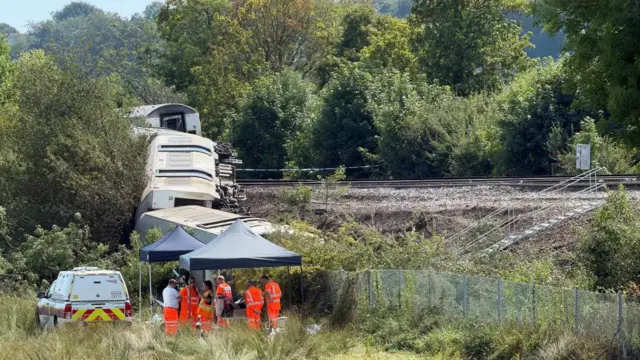
    A train on its side next to an embankment with workers under a tent watching onImage source, Network Rail/PA

    Around 30 people were injured, 20 of whom required hospital treatment and some had "serious injuries", this initial report says.

    Authorities previously said two people had serious but not life-threatening injuries.

    "Significant damage was caused to the train and to railway infrastructure," the report adds.

  18. Evidence of 'some movement' in embankment under tracks - reportpublished at 12:50 BST

    The report says the accident took place "during a sustained period of hot and dry weather" - on the day, it was "hot and sunny, with little wind" and around 27C (ambient air temperature).

    The embankment on which the railway runs is constructed of clay, sitting on alluvial/alluvium deposits, "consisting of loose clay, silt, sand and gravel", the report outlines.

    These are sensitive to changes in water content and could move as moisture levels change, the report says.

    It adds there is no evidence that a significant embankment slip occurred before the accident at this stage. However, there is evidence that some movement had previously taken place

  19. Photos of track 'irregularity' included in reportpublished at 12:44 BST

    The RAIB report also includes CCTV images from a different train, which appear to show the irregularity in the train tracks it has found.

    In the image, taken from a train that passed through at 14:04 BST on the same day, it shows a irregularity "adjacent to the white ballast bags", the report says.

    An image released by the Rail Accident Investigation Branch showing a still captured by forward-facing CCTV on the train. A label highlights a part of the track that investigators say shows a "geometry irregularity” next to some white ballast bags that are positioned next to the track in question.
    Image caption,

    CCTV image showing the "geometry irregularity” next to some white ballast bags that are positioned next to the track

  20. 'Track geometry irregularity prior to accident' - reportpublished at 12:36 BST
    Breaking

    The Rail Accident Investigation Branch has released its initial report into the incident, which took place at about 15:44 BST on Thursday, 13 August.

    It says that a "track geometry irregularity" existed on the approach to the site where the train derailed "prior to the accident occurring".

    Stay with us as we bring you more updates from the report as they become available.