Quick version
Tropical storms originate over the eastern side of oceans and move westwards where, when they cross land and can cause great devastation before dying out.
Causes:
- sea temperatures must be over 27°C
- air spiralling upwards
- large expanse of water
- damp, moist air with humidity greater than 60% per cent
Features of tropical storms include:
- low atmospheric pressure
- heavy rainfall
- high wind speeds
Impact:
- buildings and homes destroyed
- bridges and roads damaged
- power lines knocked over
- flooding and mud slides
Management strategies:
- advanced weather monitoring
- evacuation plans
- water and food reserves
- global support
Video - Tropical storms
Watch this video to learn how tropical storms form, the threat they bring and how their impact can be addressed.
Tropical storms are powerful weather events that impact millions worldwide.
Known as hurricanes, cyclones or typhoons, they develop near the equator and their wind speeds range from 60 to over 200 kilometres per hour.
Conditions for a tropical storm to form include warm seas, low air pressure, and damp, moist air.
Warm damp air rises from the ocean, creating an area of low pressure.
This draws in surrounding air, causing strong winds.
As the air rises and cools, moisture condenses into cumulonimbus storm clouds.
The Earth's rotation causes the storm to spin. This prevents winds reaching the storm’s centre, creating an area of calm called the eye.
It also propels the storm from east to west, away from the equator.
Tropical storms devastate landscapes.
Heavy rain causes landslides and flooding, while storm surges bring water inland, ruining crops.
They can cause extensive, immediate loss of life and serious injuries.
Thousands can be left without shelter, food and water.
Secondary dangers can also be fatal. Fractured water and sewage pipes can compromise drinking water and spread disease.
Storms can also disrupt power and damage infrastructure like roads and rail lines, creating a dangerous environment.
Reaching isolated communities can be difficult for rescue teams, as seen with the islands affected by Typhoon Haiyan, which devastated the Philippines in 2013.
The aftermath of a tropical storm can be catastrophic, with millions displaced, living in temporary shelters.
Predicting these storms remains difficult and relies on advanced technology like satellites.
Ensuring evacuation plans and alert systems are in place before storms hit and having immediate and long term aid to support recovery afterwards is crucial.
Where do tropical storms form?
Tropical storms are found:
- between the Equator and the An imaginary line that runs parallel to the Equator at 23.5° north. in the Any part of the Earth that lies to the north of the Equator.
- between the Equator and the An imaginary line that runs parallel to the Equator at 23.5° south. in the Any part of the Earth that lies to the south of the Equator.
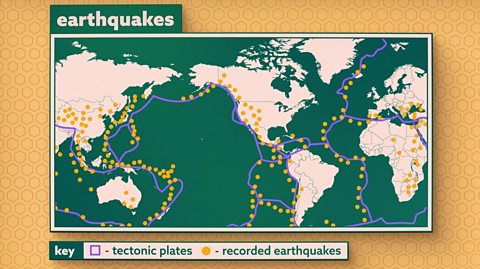
This world map highlights where sea temperature is over 27°C and where tropical storms travel.
Where do tropical storms come from?
Tropical storms originate over the eastern side of oceans and move westwards. They gain energy as they pass over warm water. Where they make landfall they can cause great devastation before losing energy and dying out.
Tropical storms over 74mph have different names in different parts of the world:
- hurricanes in the USA
- cyclones in India
- typhoons in China and Japan
This world map shows where hurricans, cyclones and typhoons come from.
What are the main features of tropical storms?
In appearance, a tropical storm is like a huge whirlpool - a gigantic mass of revolving moist air.
- Tropical storms are between 300 and 400 miles wide (482-644 km) and 5-6 miles high (8 to 10 km).
- They move forward at speeds of 16-24 km/h, but can travel as fast as 65 km/h.
- The rotation of the Earth causes the tropical storm to spin.
The central part of the tropical storm is known as the eye. The eye is usually 32-48 km in diameter. It is an area of calm weather, with light winds, clear skies and no rain. It contains descending air.
Large towering clouds surround the eye. These are caused by warm moist air condensing as it rises. This leads to very heavy rainfall and wind speeds of up to 320 km/h.
What causes tropical storms?
In order for a tropical storm to form, the following conditions need to be met:
- sea temperatures must be over 27°C
- low air pressure
- air spiralling upwards
- large expanse of water
- location between the tropics
- damp, moist air with humidity greater than 60%
How do tropical storms form?
Methods of prediction and planning
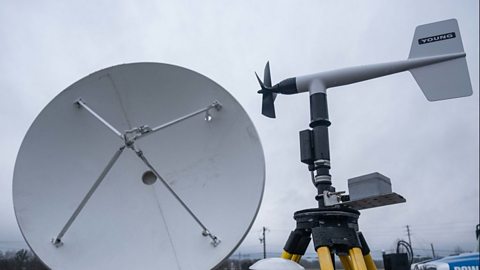 Image source, SETH HERALD / Getty images
Satellites send photos to computers which highlight the locations of storms. Combined with advanced weather equipment, experts gather detailed information.
Warnings to evacuate an area can be given in advance on planned evacuation routes.
However, tropical storms can change direction frequently and suddenly, so it can be hard to predict where they will make landfall.
Image source, SETH HERALD / Getty imagesCase study: Typhoon Rai, 2021
Typhoon Rai (also known locally as “Odette”) was a tropical storm that affected the Philippines in December 2021.
The Philippines is a lower-middle income country in Southeast Asia.
With wind speeds of 195 km/h, Typhoon Rai was a Category 5 tropical storm, which was later named a 'super-typhoon.' In some parts of the country, over 150 cm of rainfall was recorded in just three days.
Typhoon Rai hit Siargao Island in eastern Philippines at 1.30pm on Thursday 16th December. By 3.10pm on Friday 17th December, the typhoon had moved west to Palawan, before travelling out into the South China Sea.
Impact
Social
- By January 2022, 407 people were killed, 78 people were still missing and nearly 1,150 people had been injured by the storm.
- The storm affected 11 of the Philippines’ 17 regions. The lives of more than seven million people were disrupted.
- 36 million homes were damaged or destroyed. More than half a million people were left homeless over the Christmas period.
- There were outbreaks of diarrhoea and other diseases due to the lack of sanitation, food, water, shelter, and medication.
- Thousands of people were housed in temporary shelters, many without running water or sanitation.
Economic
- The overall economic impact of Typhoon Rai is estimated at around $550 million (£435 million).
- Crops and food supplies were washed away, affecting the country's international trade and farmers' incomes.
- Many flights were cancelled and dozens of ports were closed, affecting business and tourism.
- The fishing industry was severely affected with the storm destroying boats and associated equipment worth over $58 million.
Environmental
- Widespread floods damaged and in many cases destroyed homes and businesses in coastal areas.
- Farmland was damaged by strong winds and flooding.
- Thousands of trees were uprooted leading to a massive release of carbon dioxide and loss of habitat with resulting effects on wildlife.
- Protected areas, including Puerto Princesa Subterranean River National Park (PPSRNP) and El Nido-Taytay Managed Resource Protected Area, were damaged.
- Major roads were blocked by trees, and were impassable.
Response
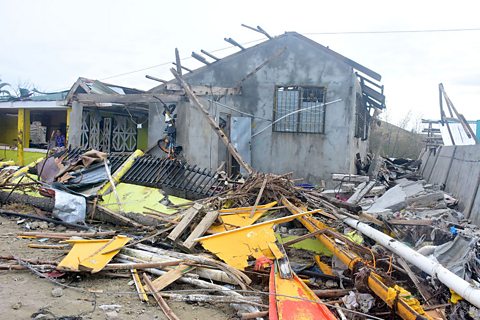
Typhoon Rai rapidly grew into a super-typhoon. Although its path was tracked, the storm exceeded all predictions. On the 21st December, the Philippines formally declared 'A State of National Calamity' and asked for international help.
The country’s military, coast guard and fire personnel brought aid and assistance to the worst-affected areas. Military aircraft and naval vessels were used to find survivors and distribute supplies.
Charities such as Oxfam, Médecins Sans Frontières (MSF), CAFOD and ShelterBox raised money for essential supplies, such as medication and shelter. In the longer term, these charities are helping people get their livelihoods back, for example by repairing fishing boats or distributing rice seeds.
The United Nations initially launched an international aid appeal for $107m to finance the humanitarian relief effort. One month after the storm it was clear that the situation in the Philippines was more serious than they first thought, so they increased this figure to $169m.
Case study: Hurricane Ida, 2021
2021 was one of the most active tropical storm seasons since records began. Within that year, Hurricane Ida was the most powerful and costliest storm in the Atlantic.
Hurricane Ida first made landfall on the 26th August 2021 in the Cayman Islands. It gained energy and grew stronger within the warm waters of the Gulf of Mexico. Three days later, on the 29th August, Ida reached the state of Louisiana on the US coast.
Hurricane Ida brought wind speeds of 277km/h and between 120 and 250mm of rainfall to Louisiana. This led to widespread flooding and a wide range of other impacts.
Impact
Social
- At least 115 people were killed across the Caribbean Islands and the United States.
- More pressure was placed on hospitals, which were already operating at full capacity due to the Covid 19 pandemic.
- Over a million were left without electricity as the storm knocked out Mississippi and Louisiana’s power grids.
- More than 800,000 people were affected by temporary food and fuel shortages.
- Emergency warnings for flash flooding were issued in New York for the first time ever. These are given out in exceedingly rare cases where there is a serious threat to life and catastrophic damage.
Economic
- Hurricane Ida was estimated to have cost over $65 billion in damages.
- Buildings, cars, people's possessions and business stock were lost.
- New Orleans airport cancelled all flights, leading to disruptions in business, tourism and trade.
- 478 square kilometers of sugarcane crops in Louisiana were destroyed. This was around 26% of the total sugarcane harvest in the state, resulting in loss of earnings for farmers.
- More than 90% of oil production in the Gulf of Mexico was shut down as a result of the storm. This led to a loss of earnings in the region.
Environmental impacts
- Fallen trees and flooded vegetation affected animals' habitats.
- A large oil spill was caused due to damage to an offshore drilling site in the Gulf of Mexico. The led to water pollution and the destruction of marine habitats.
- Roads, train lines and other transport infrastructure became unusable due to flooding, resulting in disruptions to travel and trade.
- Coastal wetlands and beaches were damaged, exposing the coast to further erosion and impacting wildlife.
Response
Ida was expected to be as serious as Hurricane Katrina. This was a 2005 storm that followed a similar path to Ida, killing 1,800 people. However, New Orleans' flood defences were strengthened after Hurricane Katrina. The new system ofleeves managed to withstand the storm surge and many lives were saved as a result.
President Joe Biden declared a major disaster and made extra funds available for rescue and recovery efforts. Around 5,000 National Guard members were sent to help with the search and rescue. In addition to this, over 25,000 workers from around the country were brought in to help restore power and support the recovery.
Take the National 5 Geography Tropical storms quiz
Recap
Tropical storms originate over the eastern side of oceans and move westwards where, when they cross land and can cause great devastation before dying out.
Causes:
- sea temperatures must be over 27°C
- air spiralling upwards
- large expanse of water
- damp, moist air with humidity greater than 60% per cent
Features of tropical storms include:
- low atmospheric pressure
- heavy rainfall
- high wind speeds
Impact:
- buildings and homes destroyed
- bridges and roads damaged
- power lines knocked over
- flooding and mud slides
Management strategies:
- advanced weather monitoring
- evacuation plans
- water and food reserve
- global support
More on Environmental hazards
Find out more by working through a topic
- count2 of 3
- count3 of 3