Overview of Da Clearance by Rhoda Bulter
- Da Clearance by Rhoda Bulter is a poem about the Clearances, a dark time in Scottish history.
- During the Clearances, people in the Highlands and Islands of Scotland were forced from their homes and had to find new places to live.
- Bulter describes the happy community that lived in one village, the arrival of the landlord’s men to clear the village and the way the village looks now.
- Bulter wrote her poetry in A language spoken in Shetland, also known as Shaetlan, and Shetland. It shares features with English, Scots and Norse., which roots the poem in Shetland.
This poem has themes of:
- nature and place
- power and morality
- humanity
- duality
You can read Da Clearance by Rhoda Bulter on the Scottish Poetry Library website.
Context
Rhoda Bulter and Shetland dialect
Rhoda Bulter (1929-1994) was from the Shetland Islands and wrote her poetry in a language known as Shetland, Shetland dialect or Shetlandic. This is quite distinct from English and from Lowland varieties of Scots, mainly due to the strong influence of Norse, or Norwegian, on the region.
There are words spoken in the Shetland Islands that are not typically used elsewhere in Scotland, such as ‘da’ for ‘the’ and ‘twartree’ for ‘two or three’ which appear in this poem. However, the other word in the title - ‘Clearance’ - is in English as if to emphasise that this was not just happening in Shetland. It makes it clear this is not local and specific to the place, but imposed from outside, arguably just like the English language.
Bulter grew up in the Shetland's main town of Lerwick. During World War Two, she lived with her aunt in Lunnasting, to the north of Shetland Mainland. Here she experienced a traditional, rural way of life. The landscape contains the remains of many crofts, so Bulter would have been very aware of the impact of the Clearances on this part of Shetland.
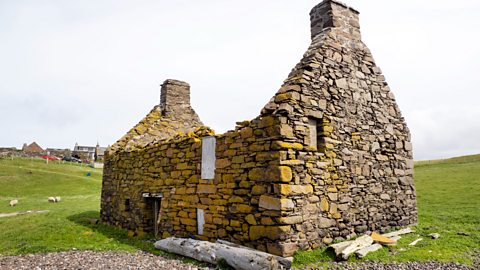 Image source, Getty Images
The Clearances
In some rural areas of Scotland (particularly in the Highlands and Islands, including the Shetland Islands) over a period of nearly 100 years from approximately 1750 to 1860, many villages and townships were ‘cleared’ of people to allow the land to be used for sheep farming, which was more profitable to landlords.
The way this happened was often sudden and brutal, with men employed by the landowner evicting the tenants from cottages and moving them to less fertile land so that sheep could graze there instead. Entire communities were cleared in this way, often violently, with the men sometimes setting fire to cottages to force the occupants out. As a result of being moved, many people starved or emigrated to countries like Canada as they were unable to make anything of the rocky or coastal land to which they were cleared.
In this poem, Rhoda Bulter encourages readers to imagine life before the Clearances in one village by vividly describing the happy community that lived there, the arrival of the landlord’s men to clear the place, and the way the village looks now – ruined and overgrown. This personal approach, dealing with a single place, brings home the tragedy of the Clearances in an intimate way that wider historical statistics cannot.
Image source, Getty ImagesVideo - The Highland Clearances
Watch this short video to learn about the history of the Highland Clearances.
Find out more about this dark chapter in Scotland's history
Form and structure of Da Clearance
- ‘Da Clearance’ is made up of four A stanza containing four lines.,
- Each stanza comprises two A pair of successive lines that rhyme, usually but not always of the same length.
- There are six or seven feet (or ‘beats’) in every line.
This traditional form refers back to older poems from Scotland such as A traditional form of narrative poem or song. A ballad tells a story about dramatic events including war, love, betrayal, long journeys and even magical events. A ballad normally features repetition, regular rhyme scheme and rhythm. Ballads were traditionally written to be sung or read aloud.. These typically told a story or reminisced about a person or people from the past. 'Da Clearance' does both by portraying one episode from the Clearances, while reflecting more widely on their impact.
Each of the four stanzas deals with a different scene. They are all told from the point of view of the speaker.
- Stanza one:The village and an everyday scene of work and play is portrayed. The scene feels productive and happy.
- Stanza two: Different generations are gathered inside one of the cottages. There is a sense of tension.
- Stanza three: The scene is suddenly disrupted as the landlord’s men enter, clearing the people and their few belongings from their home.
- Stanza four: In the present day, the village is ruined and overgrown, standing as a monument to the people who lived there and who were evicted ‘for twartree extry sheep’.
Narrative voice
The speaker begins each stanza my describing what they are experiencing ('I can see', 'I see', 'I hear', 'I see'). They are observing or 'bearing witness' to events rather than taking part in them.
Although the first three stanzas are set in the past, the poem is written in the present tense. This helps us experience what happens alongside the people portrayed. It also suggests how connected the speaker feels to the events, and how their impact continues into the present.
the opening phrase ‘I can see’ distancesthe speaker from the scene, as if the speaker is recollecting a time gone by. ‘I see’ and ‘Ihear’ is repeated throughout the poem, serving as a narrative device that suggests thespeaker is a witness to the events – perhaps through memories passed down from oldergenerations. Repetition is a common feature in oral storytelling.
Stanza one
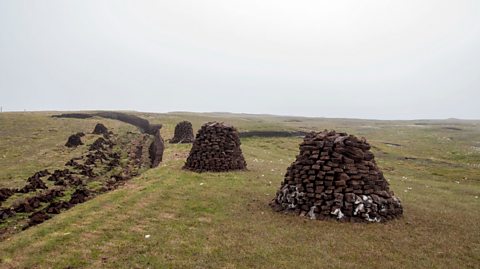 Image source, Getty Images
This stanza sees the speaker looking at the village as it was in the past:
I can see da rüfs aa taekit, an da hens aroond da door;
At first they see the thatched roofs ('rüfs aa taekit'), as if approaching from a distance, before describing various details of activity.
It is a very pastoral scene. The description of thatched cottages with hens around the door sets up an expectation that the poem to follow will be usually a short poem, in the pastoral tradition, celebrating simple rural life. .
Lines two to four of the stanza show that the scene is very active. This is a place full of life.
In line two, we see people carrying ‘twartree’ (meaning ‘two or three’) peats for the fire. (The word 'twartree' appears again later, in the final line of the poem, as an echo of this). Peat was dug from the bog and dried in the sun as blocks of bricks of fuel to burn in the fire. As only a few peats are being carried, there is a suggestion that this is an everyday activity, part of a daily routine that has been unchanged for years.
The speaker then describes the fields around the cottages:
- ‘rigs’ are rows for crops
- ‘delled’ is dug
- ‘voar’ is spring
From this we learn that the rows for crops, such as cabbages and potatoes, are dug in spring, ready to be planted. This suggests order and routine - a simple life but self-sustaining, independent and organised. This image of the yearly farming cycle again suggests a way of life that has gone on for generations.
Line three describes smoke coming out of all the chimneys, indicating that all the cottages are occupied and a place of life and comfort:
Aa da lums ir reekin, an I hear da happy soonds
On Hogmanay in Scotland, a popular greeting is ‘lang may your lum reek’ which expresses hope that everyone has enough prosperity to keep the fire going in their house - in this village that is the case.
The speaker then describes what they can hear as well as what they can see, to fully set the scene. The sounds are of small children laughing ('peerie bairns skirlin') and playing over the fields. This is another image of ordinary daily life. It brings the idea of different generations of families living here in this village. The first stanza sets a happy scene and tone, suggesting people at one with their surroundings.
Image source, Getty ImagesVideo: what is tone?
Bulter creates a happy tone throughout the opening stanza of Da Clearance, using detailed description and word choice.
Brush up on your understanding of tone with this short video for Higher English.
What is tone? How is it created?
The attitude that a writer expresses towards a subject.
Tone always sends a message!
“What are you doing?”
A simple question, right? Adding a few extra words to this sentence can completely change the tone.
“What the hell do you think you’re doing?”
Whoever sent this message is not happy, and their tone gets this message across.
Everything we say or write has a tone. It’s shown in lots of different ways through word choice, imagery, sentence structure and even punctuation.
Tones can be driven by emotion. What we say and how we say it can change depending on whether we’re worried, excited, upset or affectionate.
But tone isn’t just about emotions. The situation is important too.
This can affect whether you choose a formal or informal tone.
“Dear student, It is with great pleasure that we offer you a place on your chosen university course…”
Though this is a very exciting letter to receive, it’s still written with a formal tone. The message you send your friend right after it might be a tad more informal, though:
“OMGGG!! I GOT INTO UNI! ”
Tone can say a lot in poetry.
In Liz Lochhead’s poem, My Rival’s House, she describes a simple scene of visiting her lover’s mother for tea.
“my rival thinks she means me well. But what squirms beneath her surface I can tell.”
Lochhead’s tone here is hostile and critical, as she feels her partner’s mother is trying to undermine her. The word “squirm” suggests discomfort.
“Deferential, daughterly, I sip and thank her nicely for each bitter cup.”
On the face of it, “deferential, daughterly” and “thank her nicely” all sound pleasant enough, but the word choice and imagery of "bitter cup” brings this surface tone into question.
It shows there is a poisonous attitude between the two women, as the speaker feels she is being forced to be submissive in the older woman’s presence.
Lochhead’s attitude is expressed clearly here through lots of different techniques!
The next time you’re at someone’s for tea, watch your tone!
Or you’ll no get yer puddin’!
Stanza two
Stanza two again begins with the speaker telling us what they see. This reminds us that the speaker is addressing us directly, describing their experience so that we can share it. The phrase marks the move to a different scene.
In this stanza we are inside one of the cottages. Single individuals ('eens' (ones)) are sitting round a fire with two or three more ('twartree mair') outside, nearby.
I see eens sittin roond da fire, an twartree mair oot by;
Some children are breast-feeding ('Sookin infants at da breest'), other women are pregnant ('gjaan ta cry', meaning about to give birth). There are families here, and the suggestion that the community is thriving and healthy, growing all the time. This way of life has a future, and this sets up how great the loss will be when this village is cleared.
Da tochtfil, tried faces o dem at's lived ower lang
Here the speaker sees the old people of the village, suggesting how this way of life reaches into the past. They are described as having lived too long ('lived ower lang') which perhaps suggests that they, and their way of life have survived here longer than they might have done elsewhere. The fact they are 'tochtfil' (thoughtful) and 'tired' brings in a sense that they are perhaps worried, as well as vulnerable. The sense of foreboding is explicitly referenced, then, in line eight:
Fractious bairns feytin sleep, an sensin somethin wrang.
‘Fractious’ means anxious or fidgety and is an ominous suggestion that all is not well. It is an English word, further emphasised by the alliteration and its position at the start of the line. Although ‘feytin’ is Shetland dialect, it is fairly easy to understand the children are fighting sleep and the troubled mood is supported by the following - ‘sensing somethin wrang’ - where the repeated use of alliteration and the foreboding tone is unmistakable. This idyllic scene is about to be disrupted.
Stanza three
In this stanza everything changes. While the other three stanzas all start with the speaker saying what they see, here it is what they can hear that grabs their attention.
I hear a lood, lood knockin
The repeating of ‘lood’ emphasises how loud the noise is. The short vowel sounds and words suggest a sudden interruption. The tone something change of tone from the warm, happy atmosphere in the community we saw in the first two verses.
‘Knockin’ suggests there are visitors/intruders to the village as everyone there knows each other. The 'somethin wrang', sensed at the end of stanza two is now happening.
The The repetition of the same sounds or consonants in two more words nearby each other. of hard 'k' sounds in 'knockin' and 'crump' is and it makes the arrival of intruders seem harsh and aggressive. ''Crump' ('crunch') suggests something being pulverised or ground down under the force of the ‘monny feet’ coming into the village. 'Monny' stresses the number of men arriving, almost like a military invasion. Reading this we are fearful for the happy, thriving community we have been introduced to in the first two stanzas.
In line ten, the inclusion of English in the first half of the line contrasts with the Shetland words used elsewhere:
Men's voices raised in anger, an da bairns start ta greet.
The voices are not from here. They stand out both in terms of the language that describes them, and the tone of 'anger' that contrasts with the mood of the village before their arrival. The fact these are ‘men’s voices’, contrasts with the women, children and elderly people who have just been mentioned. This adds to the sense of threat.
It is not surprising to hear the children start to cry as these sudden, loud and angry voices invade their home. sounds intense and scary, but this emphasises the contrast between how frightening this visitation is and how innocent the villagers are, many of whom are children.
In the next line, people are ‘hirded oot’. This dehumanises the ‘fok’ in the village; they are treated like the sheep that will replace them on the land. We realise it is not just one or two specific people the men are here for it is ‘aa’ of them; the whole village is put out of their homes. Then we are given a clue to what is going on as these men are here on behalf of the ‘laandloard’ who owns the houses the villagers stay in. They pay rent to him or work for him but it is his right to put them out if he wants to.
The title of the poem set up the expectation that the poem is about the historical event of the Highland Clearances, but the immediate eye-witness account of the scenes allows the reader to see this through the speaker's perspective, as if they themselves are there. This mention of the landlord reminds the reader what is going on but the villagers themselves may have no idea why this is happening.
An aa da bits a things dey hed, fired ower da briggy-stane.
In the last line of this stanza we see all their possessions thrown out of the cottages. 'Aa' emphasising how total this invasion and clearance is - nothing of the people or their way of life is being left behind. 'da bits a things' suggests how little the people had. It suggests all their belongings are makeshift, as if everything they have has been cobbled together from what parts they could find. The image of 'bits a things' being thrown out could also suggest destruction, objects are being broken to pieces as they are 'fired' out by the men. The ‘briggy-stane’ is the flat stone at the doorway, the threshold. This detail shows the complete emptying of the cottages, and we feel we are also witnessing it.
Stanza four
As soon as the people are their belongings are thrown from the cottage, we suddenly shift to the present day.
Again, the speaker tells us what they see, but this time what they see is the village as it is now:
I see da bare waas staandin, an aa da laand lie green;
The bare walls contrast with the cosy, happy cottages full of life in the first two verses. It is significant that they are not described as cottages or houses, just as walls. It is as if they are separate structures that do not provide shelter or a home.
But the fact they are still ‘staandin’ suggesting a defiance, a testament or memorial perhaps to what has happened here, so we don’t forget.
This land that was once dug into rows to grow crops and had children playing on it is now ‘green’ as the grass has been allowed to grow up between the ‘bare waas’ of this now abandoned village. The simple description makes the image more stark and moving.
Lang syne da fire wis slokkit
You might recognise the phrase ‘Lang syne’ (line fourteen) from Auld Lang Syne, sung at New Year. It means ‘for a long time’ or ‘a long time ago’ so it is reiterated here that it was a long time ago that the fire was put out ('slokkit'), and that many years have gone by.
This reinforces the previous line. The Clearances happened many years ago but the hurt is still felt. The sadness that these communities could have thrived is still present.
The penultimate line of the poem is almost all in Shetland dialect:
Noo dey aa hae equal portions o aert ta tak dir sleep.
This literally translates into English as ‘Nowadays they all have equal portions of earth in which to take their sleep’. The people involved in the clearance (both the cleared villagers, and the landlords and men who cleared them) are buried in the same size of grave, which is an image used to remind us all that we are equal in death.
Despite what kinds of life we have led, whether we were rich or poor, had power or not, we all die, and then we are the same. The speaker is heading towards the question in the final line of the poem by pointing out that people are all the same in the end, and so we should perhaps treat each other better in life.
Tell me, wis it wirt it aa for twartree extry sheep?
The final line of the poem provides a sudden shift. Up until now, everything has been a description reported by the speaker. Now they turn to the reader and ask a question. But the question is addressed as a command. Perhaps this suggests a tone of anger.
The question is powerful as it contrasts the people, the way of life, the culture of this land, with a belittled note of what the Clearances were about; providing land for two or three extra sheep. While the Clearances as a whole involved thousands of sheep and large profits for the landowners, when reduced to this one example, the personal benefit seems meager, even silly, compared to what was lost.
Somehow the use of Shetland words to question the destruction of so much of Shetland's culture makes the question all the more poignant as it is were words and voices like this that were cleared.
Themes and comparisons with other poems in the collection
Nature and place
The theme of place is evident throughout this poem in several ways.
Firstly, the title, with the capitalisation of ‘Clearance’ hints that the poem is about the Highland Clearances, but one instance in particular. This places it both in Scotland and in a historical period.
Shetland or Shetland dialect is used in the title and throughout the poem, instantly identifiable by the word ‘Da’, meaning ‘the’. As well as placing the poem in Shetland, the richness of the language throughout the poem gives it a unique identity. The village as described in the poem, both in the past and in the present, is firmly rooted in nature:
- ‘paets’
- ‘rigs’
- ‘touns’
- ‘aa da land lie green’
The opening two stanzas are mostly a pastoral - an idealised description of rural life without too many difficult or unpleasant aspects mentioned. The subversion of this in the last two stanzas ends in nature taking over the ruins of the village as the grass grows through the old walls, emphasising the shattering loss of the community and the idyllic life they shared there.
The themes of nature, place, and the environment are also shown in the other poems:
| Composed in August | This describes a rural walk in nature, in a place clearly known to Burns, focusing particularly on the birds which occupy the area. The natural world is represented as offering harmony, where everything has its place, and as a source of peace and love. |
| Summit of Corrie Etchachan | The depiction of nature in a real location is harsh but beautiful and awe-inspiring. The effect this has on the climber is profound. |
| Thomas the Rhymer | Nature is mysterious in this poem – it is not comforting, it is full of enchantment, danger and the unknown. Although this poem makes reference to a real location ("Huntlie bank") at the start, the switch into the magical realm is a direct contrast that emphasises the duality of the poem. |
| The Bonnie Broukit Bairn | The place in this poem is our planet, Earth, and how it fits into our wider galaxy, provoking us perhaps to think about taking more care of it. |
Power and morality
Power and morality are dealt with in Da Clearance as we see the abuse of power, by the landlords over their tenants.
A class divide is evident here as the villagers in the poem are all tenants of a rich landlord or landowner. As we see in this poem, and in rural communities around Scotland at this time of the Clearances, these tenants had absolutely no power and could be evicted at a moment’s notice. Whole communities of men, women, children and the elderly – who had lived there for years and worked the crofting land to provide for themselves with crops and livestock - were suddenly and often brutally cleared out of their homes.
Sometimes there was violence, sometimes the cottages were burned, possessions were thrown outside, just as this poem describes, and the reader can only imagine how terrifying this must have been, although the poet paints a very vivid picture here for us through her speaker so it feels like we are there watching it all unfold.
The themes of power and morality are also shown in the other poems:
| The Bonnie Broukit Bairn | We see the planets as the Roman gods they are named after, to emphasise their awesome power. Earth, like the tenants in Bulter's poem, is presented in contrast as vulnerable. |
| 33 | Mary's power, her throne and title, are no use to her now as she has been sentenced to death. The poem references her previous power and status and how she has fallen to this desperate point. |
| Thomas the Rhymer | The power here is magical - the Queen of Elfland and the laws of that realm hold so much power over Thomas. However, the decisions to doff his cap and kiss her are his, and he gives his power up willingly. |
| Composed in August | The cruelty of the hunters demonstrates man's violent power over the animals, This is in contrast to the rest of the poem, which emphasises the beauty and harmony of how man and Nature should live together. |
| Summit of Corrie Etchachan | The moral message is that hard work and toil, whether physical or philosophical, will yield a great and enriching reward. |
Humanity
Perhaps the clearest comparison to all other poems in this collection is that they all comment on humanity, particularly the idea of taking wider significance from a very individual experience. In this case the Clearances are a widely known and understood event in Scottish history, but in Da Clearance the direct report of one village being cleared allows the individual example to help us understand the reality of the Clearances.
The theme of humanity is also shown in the other poems:
| Summit of Corrie Etchachan | The personal experience of the climber is emphasised here. The poem considers how this is similar to achievements of the mind and how they can be equally surprising and profound. |
| 33 | Although this is writen from the perspective of Mary, Queen of Scots, the poem expands to comment on wider issues of religion, power, greed and loss. |
| Composed In August | Burns describes his own experience of walking in nature, but muses on the universal effect of humans on the natural world. |
| Thomas the Rhymer | The folkloric story in the ballad isn't a personal story - it's a story that will be shared in a community, with wider comments on morality and religion. |
| The Bonnie Broukit Bairn | MacDiarmid personifies the planets, giving Earth a vulnerable, childlike persona. However his points are universal, as he is using the planets to discuss big themes such as power, class and morality. |
Duality and contrast
In Da Clearance, there is a direct contrast between the gentle crofting community which is then overrun by the landlord’s men. The idyllic, familiar home is suddenly turned into a frightening place. The use of two languages in the poem emphasises this, with half a line in English describing the angry men's shouts.
The theme of duality is also shown in the other poems:
| Thomas the Rhymer | We have contrasting images of beautiful countryside with desert and ‘red blude to the knee’. The real location of "Huntlie bank" gives way to the magical realm of Elfland, a direct duality in the poem. |
| Composed in August | A contrast is made in between the idyllic walk with a loved one and the ‘murder’ of innocent birds in shooting season - not an image you'd expect to find in a poem about nature and love. But the contrast allows the reader to compare both of these aspects - which emphasises Burns' point about finding harmony in nature. |
| Summit of Corrie Etchachan | The duality here is between the physical achievement of climbing the mountain and the profound philosophical effect this has on the speaker. |
| The Bonnie Broukit Bairn | The speaker contrasts the beauty of the galaxy with neglect on Earth, showing that humanity has much to offer but is currently suffering under the rule of the elites. |
| 33 | The metaphor of light and dark is used throughout this poem, highlighting Mary's previous power, where she now has none, and the obvious duality of life and death. |
Revise Da Clearance by Rhoda Bulter
Revise Da Clearance by Rhoda Bulter with this interactive quiz for Higher English
More on Higher Poetry collection
Find out more by working through a topic
- count4 of 7

- count5 of 7
- count6 of 7
- count7 of 7
