Key points
Overview
A sonnet describing memorial tributes to soldiers who die in war, comparing the sounds of war to the choirs and bells usually heard at funerals. Written in 1917.
Main themes
- Death
- The destruction and waste of war
- Loss
- Remembrance
- Grief
- Mourning and religious rituals
- Nationalism
Tone and voice
The tone is bitter, ironic, angry, grim, Being full of sad and sorrowful thoughts. and mournful.
The speaker is a third-person speaker generally assumed to be the persona of Owen himself, reacting to his wartime experiences.
Context
Wilfred Owen gained first-hand experience of war while serving in the British Army during World War One. After suffering shellshock, he was evacuated to hospital in Scotland in 1917, where he met Siegfried Sassoon, who helped edit Anthem for Doomed Youth and suggested its title.
Owen wanted to record the reality of war and pass those experiences on to people at home. He returned to France in 1918 and was killed in action one week before the war ended.
Form and structure
The poem is a sonnet of 14 lines. It is structured as an octet and a sestet and is presented as two stanzas. The poem combines features of a Petrarchan sonnet and a Shakespearean sonnet. Each stanza opens with a rhetorical question, and a volta occurs in line nine, shifting focus from the sounds of war to funeral and Christian imagery.
The rhyme scheme is ABAB CDCD EFFE GG, and the poem is written largely in iambic pentameter.
Poetic devices to spot
- Simile – "these who die as cattle".
- Metaphor – "shrill, demented choirs", "The pallor of girls' brows shall be their pall" and "drawing-down of blinds".
- Personification – "monstrous anger of the guns", "sad shires".
- Rhetorical questions – "What passing-bells for these who die as cattle?" and "What candles may be held to speed them all?"
- Repetition – repeated use of "Only", "no" and "nor".
- Alliteration and consonance
- Enjambment
- Juxtaposition – the contrast between "doom" and "youth" in the title.
Anthem for Doomed Youth
by Wilfred Owen
What passing-bells for these who die as cattle?
— Only the monstrous anger of the guns.
Only the stuttering rifles' rapid rattle
Can patter out their hasty orisons.
No mockeries now for them; no prayers nor bells;
Nor any voice of mourning save the choirs,—
The shrill, demented choirs of wailing shells;
And bugles calling for them from sad shires.
What candles may be held to speed them all?
Not in the hands of boys, but in their eyes
Shall shine the holy glimmers of goodbyes.
The pallor of girls' brows shall be their pall;
Their flowers the tenderness of patient minds,
And each slow dusk a drawing-down of blinds.
From Wilfred Owen: The War Poems (Chatto and Windus, 1994), edited by Jon Stallworthy.
A link to this poem is available in the CCEA Poetry Anthology which can be downloaded from the CCEA website.
The BBC is not responsible for the contents of any other sites listed.
Summary
A description of memorial tributes to the soldiers who die in war, comparing the sounds of war to the choirs and bells which usually sound at funerals.
Written in 1917.
Title: The term ‘anthem’ usually suggests a special and especially relevant song that is important to a specific group of people; Owen names this particular group “Doomed Youth”, using Over-the-top exaggeration for effect. to show how war would destroy an entire generation.
The Placing two or more contrasting ideas, images or words close together to highlight their differences. of “doom”, a negative and hopeless fate, with “youth” – a state we associate with potential, growth and a bright future – further highlights the destructive nature of war.Themes: Death, the destruction and waste of war, loss, remembrance, grief, mourning and religious rituals, nationalism.
Tone: Bitter, Happening in the opposite way to what is expected and maybe causing amusement because of it., angry, grim, melancholic, mournful.
Speaker: A third person speaker, generally assumed to be the The voice adopted by an author for a particular purpose, this voice does not necessarily reflect the author's true thoughts. It can also mean a mask that someone presents to the world as their real character ('persona' is the Latin word for an actor's mask). of Owen himself, reacting to his harrowing wartime experiences.
Applicable context
Wilfred Edward Salter Owen was born on 18 March 1893 in Oswestry, Shropshire. He began writing poetry as a teenager. Having failed to get a university scholarship, he became an unpaid lay assistant to a Church of England vicar in Oxfordshire when he was around 18. He assisted with the care of the poor and sick in the parish. It was during this time that he lost faith in the church to support people in need. This is a Central, unifying idea(s) that run through a text. running through Anthem for Doomed Youth as he shows his disillusionment at religion and the associated ceremonies.
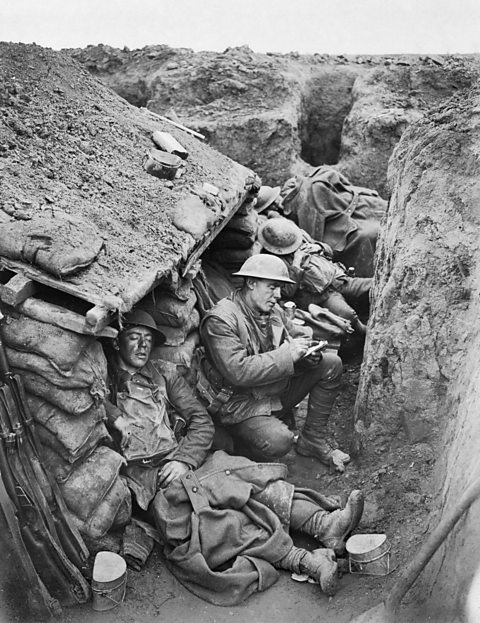
Enlisting in the army in 1915, Owen gained first-hand experience of the horrors of war and life in the trenches during World War One. After surviving heavy fighting, he was diagnosed with shellshock - the term used then to describe what is now referred to as post-traumatic stress disorder (PTSD). He was evacuated to hospital in Scotland in June 1917 and there he met the poet Siegfried Sassoon (1886-1967) was an English poet, known for his poetry during the First World War which described the horrors and futility of the war., whose work Owen admired very much. The two became friends, and with Sassoon’s influence and encouragement Owen developed into a confident, talented poet. Anthem for Doomed Youth was written during this time; Siegfried Sassoon helped edit it and suggested the title.
Owen returned to France in August 1918 and in October was awarded the A medal awarded to officers for gallantry, first instituted in 1914. for bravery. Although he could have been discharged from the army after his injuries, Owen felt his duty was to return to battle and authentically record the experiences of himself and his comrades. He wanted to pass on the reality of war to those at home, writing: "All a poet can do today is warn. That is why the true Poets must be truthful". Tragically, Owen was killed in action just one week before the war ended, in November 1918. His parents received the telegram informing them of their son’s death while the church bells rang to announce the Armistice.
Only a little context is needed for each poem; where used, it should be applied to the point you're making.
Form and structure
Anthem for Doomed Youth is a A fourteen-line poem, usually with ten syllables in each line., a particular Some poems adopt specific 'forms'. For example, they could be sonnets or narrative poems. Many don’t have an identifiable form. of poetry made up of 14 lines arranged in a particular A strong pattern of words, sounds, musical notes or movement found in poetry, music and dance. and rhyming pattern. It has the basic structure of an Italian or Used by the Italian poet Petrarch it's a 14-line poem split in two parts: the first 8 lines (octave) use the rhyme scheme ABBAABBA and show a problem or idea. The last 6 lines (sestet) often use CDECDE or CDCDCD and give a response., with its 14 lines divided up into two unequal groups, but it varies from the rules of a Petrarchan sonnet in several significant ways. The poem is presented as two separate A grouped set of lines within a poem. where most sonnets have only one, and its How words and sounds form a pattern to produce an intended effect for the reader. differs from the classic Italian pattern and is more like a A Shakespearean sonnet is the variation of the sonnet form used by William Shakespeare. A Shakespearean sonnet has a rhyme scheme. sonnet. This hybrid mixes European and English traditions in a gentle way that could on some level represent the pointlessness of war between nations who have more in common than what divides them. The sonnet form – often used to praise or elevate – seems Happening in the opposite way to what is expected and maybe causing amusement because of it. in its use here, because the poem is a sad A heartfelt expression of sorrow, usually in verse or song. for the brutal deaths of young innocent men.
The poem is structured as an octet (a group of eight lines) and a sestet (a group of six lines). The structure of the sestet mirrors that of the octet in that both stanzas open with a A question asked in order to create a dramatic effect or to make a point, rather than to get an answer. which is then answered by the speaker in the following lines. The octet introduces the reader to the brutal environment of the trenches; the Bringing about a sense of sadness or regret. final line of the octet moves from the noise of war to link the reader to the silence of the sestet. This A change in focus within a poem, perhaps revealing a ‘twist’ with further information, new detail or emotion that may make us feel differently about the first part. occurs in line 9, beginning the sestet by signalling a move from the sounds of war to the funeral practices associated with Christianity.
The rhyme scheme uses alternating rhymes in the octet (with an ABAB CDCD pattern) and then divides the sestet into a kind of rhyming A type of stanza - or a complete poem - consisting of four lines that have a rhyming scheme. (a four-line unit) with an EFFE rhyme pattern, and a final In poetry, a pair of lines that rhyme and have the same length and metric pattern.. Use of a couplet at the end of a sonnet is highly conventional for the form, and here it helps convey the finality of the deaths and the inevitable A type of drama in which characters undergo suffering or calamity and which usually ends with a death. A sad or catastrophic event causing suffering or death. of the losses.
The poem is written largely in One ‘iamb’ is a two-beat combination: an unstressed syllable followed by a stressed (emphasised) syllable, making a ‘da-DUM’ pattern, like a heartbeat. Pentameter means five of these two-beat units per line, making ten syllables altogether, which was the traditional The rhythm of a line of poetry based on how many syllables it has and where they are stressed or emphasised – likes beats in music. used in most sonnets. One ‘iamb’ is a two-beat combination: an unstressed syllable followed by a stressed (emphasised) syllable, making a ‘da-DUM’ pattern, like a heartbeat. A line of poetry that has five metric feet or beats in it. means five of these two-beat units per line, making 10 syllables altogether:
| Nor a-     | -ny voice | of mourn- | -ing save | the choirs |
| da-DUM | da-DUM  | da-DUM    | da-DUM  | da-DUM    |
Not every line uses iambic pentameter, particularly in the octet section, which may be another small but purposeful deviation from the standard sonnet form in order to subtly show the terrible disruption the war causes.
Language and poetic methods
Rhetorical questions: Anthem for Doomed Youth begins each of its two stanzas with a A question asked in order to create a dramatic effect or to make a point, rather than to get an answer. that the poet then examines in the lines that follow. The opening line – “What passing-bells for these who die as cattle?” – is particularly phrased to suggest two different implications. The first is as a straightforward question, asking what sounds do the young men hear as they die and going on to offer answers that demonstrate the horror of the situation. However, it also works as a rhetorical question, sharply suggesting the inadequacy of any “passing-bell” or tribute to those who have suffered so much and died so pointlessly.
The second question, “What candles may be held to speed them all?”, is a little less pointed and bitter in its The overall mood or 'feel' of the text or part of the text; this can be created by the writer or speaker's choice of words, pace, rhythm or imagery., attempting to actually ask how these young men should or will really be honoured, remembered and missed. Again it can be seen as both a straightforward question and a rhetorical device to show that there is no “candle” or ritual that will really help. Owen is not merely recommending ways to more effectively and respectfully mourn those gone too soon; he is detailing the actual pain of those who lose them, to heavily underline the fact that this generation of young men should not be dying in such terrible circumstances.Metaphor: A A metaphor is a word or a phrase used for dramatic effect, to describe something as if it were something else. is a direct comparison between two things, and Owen uses this throughout the poem to draw a direct line between the funeral rites or grieving rituals that societies use to mourn the dead and the sickening reality of the battlefield. He describes the “wailing shells” – explosives that make a whining noise as they drop when thrown or fired – as “shrill, demented choirs”. A choir is thought of as peaceful and beautiful; this metaphor distorts that into something ghastly and terrible, as if it mocks the deaths of the men.
In the second stanza, Owen highlights the homes and loved ones these dying men will never see again and links them to their deaths far away and alone. He compares the “candles” lit in churches to the light “in their eyes” as the boys on the battlefield die, showing how empty and inadequate the rite of a church candle is in marking the tragic circumstances of these deaths. “The pallor of girls' brows shall be their pall” A figure of speech in which a term or phrase is applied to something to which it is not literally applicable, to stand for or symbolise another thing. states that the real pall (a cloth covering on a coffin) for each man will be the pale sad faces of the girls who loved them.
In the final rhyming couplet the “drawing down of blinds” is both literal, as those who had a death in the family would traditionally leave their curtains and blinds unopened, and metaphorical, as an image of life fading into death.Simile: The famous opening line of Anthem for Doomed Youth contains the only A simile is a word or phrase used to make a comparison for dramatic effect, using 'like' or 'as'. in the poem: “What passing-bells for these who die as cattle?”. This comparison between the young men fighting in World War One and the nameless, countless animals slaughtered for their meat each day is a powerful one, and shows Owen’s anger at the situation from the outset. The “doomed youth” he describes are To take away the features that make a person human, such as free will or dignity. by war and die as quickly, as easily and in as huge a number as the livestock killed to satisfy the demand for meat. The simile portrays the men as consumed by the war, reduced to piles of dead bodies, while the unconcerned governments on both sides continue to send more and more people to their deaths. The use of such a shocking comparison in the very first line creates a sharp and bitter tone; it is a pointed question, openly stating the terrible truth as Owen sees it – that the war has made people into animals and then destroyed them.
Personification: The poem uses A type of imagery in which non-human objects, animals or ideas are given human characteristics. to show how the impersonal weapons of war seem to take on the hateful and destructive impulses of the people who built and supplied them. The guns seem to show “monstrous anger” against the men, displaying traits of rage and hatred that underpin the war itself. Owen states that the rifles metaphorically “patter out their hasty orisons”, as if the rapid ongoing gunfire is some kind of rushed prayer the weapons are muttering. Elsewhere, the use of “sad shires” personifies the towns and villages back home, showing the loss of the young men to be so deeply tragic that the places themselves feel grief. Each use of personification deepens the intense anger and sadness of the situation by showing how these emotions are so strong and powerful that they can even infect inanimate objects.
Repetition: Owen uses Where a word, phrase or idea is repeated for emphasis. in the first stanza to emphasise the bleakness of the situation for the young men at the battlefront. The repeated phrase starting the lines “Only the monstrous anger of the guns. / Only the stuttering rifles' rapid rattle” shows how they receive nothing but the endless noise and danger of gunfire – Owen implies the men deserved better.
In line five, he repeats “no” and “nor” – “No mockeries now for them; no prayers nor bells; / Nor any voice of mourning save the choirs” – to show the utter lack of real hope, support or respect these men earn by dying for their country so pointlessly.
This is not a list of every method or notable use of language and structure in Anthem for Doomed Youth.
Look at the poem again. Can you find any of the following?
A sound feature; the repetition of the same sounds usually at the beginning of words. and The repetition of similar consonant sounds in nearby words.
The repeated sounds of alliteration and consonance create small pockets of internal resonance within the poem, often complimenting the point being made by the poet. The best known example occurs across the lines: “Only the stuttering rifles' rapid rattle / Can patter out their hasty orisons”. Here, Owen deliberately uses alliterative ‘r’ sounds and repetition of the consonance of ticking ‘t’ sounds buried within the words to mimic the whirring machinery and rapidly firing bullets of a machine gun.
These A word that sounds like what it is describing, eg 'crunch', 'meow', 'plop' and 'scrape'. qualities add to the atmosphere of the poem, evoking the relentless gunfire that surrounded and endangered the men constantly. Owen is answering the question of what sounds the men hear as they die at this point in the poem; use of alliteration and consonance helps the reader hear it too.
A poetic device where a sentence continues beyond the end of the line or verse.
Enjambment is used once in the first stanza and once in the second, for a different effect each time. Between lines three and four it gives a sense of continuation, adding to the idea that the fire of the rifles is ongoing, a relentless and never-ending rattle. Across lines 10 and 11 it is used to create a smoother effect by transitioning the reader into a quieter place of grief and mourning.
It also helps to emphasise the word “eyes” at the end of line 10 to make the metaphor more resonant and let the reader envision the light in their eyes going dark as they die, humanising the dying men and adding the poignant feeling of loss.
If you have found these methods, consider what you know about the poem and the poet already.
What effects do these methods create? Why has the poet used them?
What other poems could I compare with Anthem for Doomed Youth?
Poppies – both poems focus on remembrance, showing ways that individual grief affects those left behind in conflict.
Easter Monday (In Memoriam E.T.) – where Owen graphically confronts the widespread inadequacy and hypocrisy of mourning those lost at war, Farjeon struggles to process the idea that her friend has been killed even as she continued to write to him; her own individual and tragic loss bears some resemblance to his allusions to those at home who grieve the fallen personally.
Last Post – Owen’s poems interrogating the purpose of war partially inspired Carol Ann Duffy when writing Last Post; aside from the poet connection, both poems also allude to those ‘back home’ awaiting the soldiers, and ultimately find the war to be pointless.
Example questions
Use these questions to hone your knowledge of Anthem for Doomed Youth, and to practise using your notes and analysis in organised paragraphs that focus on how particular themes or ideas are shown in the poem. There is an example answer in the following section to demonstrate how you can do this.
How does Owen demonstrate the realities of war in Anthem for Doomed Youth?
How does Owen portray the young men at war in Anthem for Doomed Youth?
What poetic methods does Owen use to show his attitude to remembrance in Anthem for Doomed Youth?
How does Owen create a poignant tone in Anthem for Doomed Youth?
Example answer
Below is a demonstration of how to use the material in this section to answer an example essay question. The answer below is not a full essay, but only an extract of a longer answer, showing some of the points that could be made.
Q: How does Owen demonstrate the realities of war in Anthem for Doomed Youth?
A: Wilfred Owen wrote his war poetry from a place of bitter experience, much of it while he was hospitalised recovering from injuries and shellshock that he received while fighting in World War One, and his drive to document the terrible conditions and sickening slaughter of the trenches made him return to the front when released from hospital, even though he could have been discharged and avoided more direct conflict. He felt he had a duty to expose the real experiences the young men that enlisted would face, and to make readers understand the difference between Propaganda is when words, images or films are used to try and make people think a certain way. and the realities of war.
Anthem for Doomed Youth, even in its title (which was suggested by fellow poet and Owen’s mentor Siegfried Sassoon), suggests the hopeless fate of all who signed up to fight. An anthem suggests a special and especially relevant song that is important to a specific group of people; Owen names this particular group “Doomed Youth”, using hyperbole to show how war would destroy an entire generation. The juxtaposition of “doom”, a negative and hopeless fate, with “youth” – a state we associate with potential, growth and a bright future – further highlights the destructive reality of war.
Anthem for Doomed Youth is a sonnet, a particular form of poetry made up of 14 lines arranged in a particular rhythm and rhyming pattern. It has the basic structure of an Italian or Petrarchan sonnet, with its 14 lines divided up into two unequal groups, but it varies from the rules of a Petrarchan sonnet in several significant ways. The poem is presented as two separate stanzas where most sonnets have only one, and its rhyme scheme differs from the classic Italian pattern and is more like a Shakespearean sonnet. This hybrid mixes European and English traditions in a gentle way that could on some level represent the pointlessness of war between nations who have more in common than what divides them. The sonnet form – often used to praise or elevate – seems ironic in its use here, because the poem is a sad lament for the brutal deaths of young innocent men that seeks to expose the dreadful reality of war, and what happens when entire generations are persuaded to ‘fight for their country’.
This essay could go on to make the following points, backed up by evidence from the poem and detailed analysis of that evidence:
Owen uses a simile in the opening line to shock the reader and show how dehumanising and brutal war is, slaughtering young men like livestock, and rhetorical questions to point out the inadequacy of the usual mourning rituals for deaths that occur so frequently, violently and senselessly.
Owen uses repetition to emphasise the negative, hopeless atmosphere of the battlefield and show these young men deserved better than the terrible realities of war.
Owen uses personification, metaphor, alliteration and consonance to show the intensity of the battlefield, painting a picture of the chaotic, hopeless and hostile scene in which the young men die.
Test your knowledge of Wilfred Owen's Anthem for Doomed Youth
Further study
Who was Wilfred Owen? revision-guide
Wilfred Owen was a poet who wrote about the horrors of war from his experience serving in the British Army during World War One.
In Our Time. podcast
Melvyn Bragg and guests discuss one of Britain's greatest war poets, who published only 5 poems in his short life yet whose works became seen as a warning of the futility of wars.
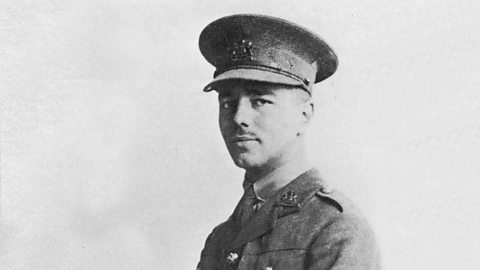
Memories of Wilfred Owen. audio
Wilfred Owen died just a few days before the end of World War One but his poetry ensured he would be remembered. Little is known about the man behind the poems but his younger brother Harold spoke to the BBC about him in the 1960s.

More on Anthology Three: Conflict
Find out more by working through a topic
- count2 of 14
- count3 of 14
- count4 of 14
- count5 of 14