All about medieval and early modern England
By historian Dr Onyeka Nubia of the University of Nottingham and Edgehill
When you think of medieval and early modern England, you probably think of Vikings, Anglo-Saxons and Normans.
You might think there was no place for Africans in that society. However, we now know some cities in pre-colonial England had diverse populations, including Africans.
But who were they? And what did they do? Here, BBC Bitesize finds out…
Africans in medieval England (1066 -1485)
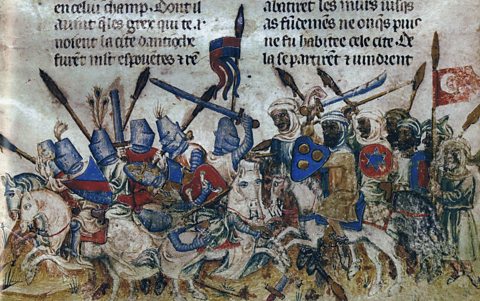 Image source, Heritage Images
The medieval English writer Richard Devizes describes London as being populated by ‘Garamantes’ (a term for North African Muslims), and ‘men from all nations’ that ‘fill all the houses.’
These Africans were described by various terms such as: ‘Black’, ‘Ethiopian’ (a word used at the time to describe all Africans), ‘Moor,’ and ‘Blackamoore.’ Other terms such as ‘Saracen’ were also used to refer to Africans, as well as people from elsewhere, such as Western Asia. Some of these terms are now considered derogatory.
Financial records called Pipe Rolls can help us understand who some of these people were. For example, 'Bartholomew' was an African on the run in Nottingham in the 13th century. He is mentioned in the Pipe Roll of 21 June, 1259, where he was called an ‘Ethiopian’ and a ‘Saracen.’ The Pipe Roll says Bartholomew was brought to England by ‘Roger de Lyntin.’ The roll also gives ‘a mandate to arrest’ Bartholomew, for ‘running away from his said lord [Roger de Lyntin].’ Bartholomew may have been on his way to the city of Nottingham to escape his lord’s authority.
Image source, Heritage ImagesThe ‘Ipswich Man’ in Grey Friars Monastery
Another African, nicknamed the ‘Ipswich Man’, was buried in the cemetery of Grey Friars monastery in Ipswich, Suffolk, c. 1225-1285.
We do not know where in Africa he originated from. But it is possible that his presence in the monastery is linked to the medieval church’s international connections, or he may be connected to the Crusades.
This was when Europeans went to fight ‘in the Holy Land’ against non-Christians. As a result of this conflict, sometimes Saracens (a historical term that should not be used to refer to someone now) came to England. In 1272, during the Ninth Crusade, ‘four Saracens’ arrived in England with the English knight Thomas de Clara, who was connected to Robert Tiptoft, the benefactor of the Grey Friars monastery.
So, the Ipswich Man may have been one of those four Saracens, and this could explain why he was buried in that cemetery.
Africans in early modern England (1485-1660s)

Africans were a significant presence in cities such as London, Plymouth and Bristol during this period, but they were also present in Derby, Leicester and Northampton. Africans also lived in rural villages such as Barnstaple (North Devon), Holt (Worcestershire) and Hatherleigh (West Devon).
Elizabeth I had her ‘favourite lytle Blackamore'. The powerful politician Robert Cecil had a servant named Fortunatus, and Katherine of Aragon - Henry VIII's first wife - her ‘lady of the bedchamber’, Catalina de Motril.
Some of these Africans and their descendants were born in Tudor England and others had origins from the Iberian Peninsula (Spain and Portugal). Africans also came to England from kingdoms in West and North Africa and some people arrived via the Caribbean and Central America. These last sets of peoples were often connected to English merchant adventurers - investors who explored and colonised overseas territories from the 15th century onwards.
It is not possible to know the exact number of Africans living in early modern England. But they were certainly more than a few isolated individuals. In the cosmopolitan parish of St Botolph without Aldgate (London) Africans were 5% of the total population.
John Blanke, ‘the black trumpeter’, was employed in the English Tudor court and depicted twice on the Westminster Tournament Roll of 1511 that celebrated the birth of Henry VIII and Katherine of Aragon’s son.
In London’s Cheapside, a famous but unnamed African craftsman lived between the years 1553-1558. This man of African descent came from the Iberian Peninsula and brought the art for making ‘fine Spanish needles’ to England.
William Harrison described him as someone who would never share the secrets of his art, and so the historian Thomas Fuller states his art ‘dyed with him.’
African women in early modern England
Other people of African descent include Mary Fillis of Morisco. This young woman was about 20 years old when she was baptised in St Botolph on 3 April 1596. Parish records call her 'a Black', 'a blackamoore' and 'of Morisco' - a historical term for Muslims who were forced to convert to Christianity in 16th and 17th-century Spain.
Her father, Fillis of Morisco, had the profession of a basket and shovel maker, which meant that he was probably a metal worker. And Moorish metalworkers were famous throughout Europe.
Another woman of African descent living in early modern England was Grace of Hatherleigh (Devon). Her records show tragic moments in her family’s life. Both of Grace's children, Honour and Rebecca, died early. Rebecca died after just a year and four months, while Grace herself disappears from the records after 1613.
Voting, owning land and writing wills in Tudor England

Henrie Anthonie Jetto was baptised when he was 26 in 1596. He was described as ‘a Black’, a ‘Black More,’ and ‘Jetto’ (from the French word for ‘Black’).
Initially, Jetto ‘belong[ed]’ to Henry Bromley and lived in Holt. But this status changed! By the time Jetto wrote his own will on 20 September 1626, he could vote, owned land and referred to himself as ‘Jetto of Holt.’ Jetto married ‘Presida’, a woman whose ethnicity is unknown. They had five children together, and Jetto went on to have 32 grandchildren — his descendants are alive today in Holt.
In England, there were also African merchants, mapmakers, explorers and nobles. This included people such as Dederi Joaquah from the ‘country of Cestos’ in West Africa. Joaquah was baptised in St Mildred’s Poultry, London on 1 January 1611. Joaquah came to England through diplomatic missions from West African kings, seeking allies against the Ottomans, Spanish and Portuguese.
This article was published in October 2020 and updated in September 2026