Strictly steps: The stories behind the dances
An institution of British TV, Strictly Come Dancing has been a fixture on our screens for over 20 years now. Whether it's the samba, the foxtrot or the cha-cha (sans slide), families across the country quickstep to their telly week after week to see the latest dance numbers the show has to offer.
But what actually happens? And how is one dance different from another?
Well, to celebrate the start of a new series, BBC Bitesize has put together this guide to all your favourite Strictly dances. So, to borrow a phrase: keeeeep reading!
 Image source, BBC/Ray Burmiston/BBC Creative
What are the different types of dance?
On any given weekend, Strictly Come Dancing gives viewers a glimpse of all manner of different dances.
Be it the waltz - Viennese or otherwise - the foxtrot, the samba or the salsa, Strictly's got them all! So let's take a look at what they are and where they come from.
1. What is waltz dancing?
The waltz is a couple's ballroom dance made up of six steps, which form the shape of a box across the dance floor. A standard waltz is danced in a 3/4 time signature.
Originating in Europe in the 13th century, the waltz is among the most popular styles of ballroom dance. It's considered a closed-position dance, with partners holding and facing one another throughout the routine - which probably explains its popularity at weddings!
There are many different types of waltz, the most famous of which is the Viennese waltz. Running at a quicker tempo than a standard waltz, the Viennese waltz sees partners whirl around the dance floor at around 180 beats per minute.
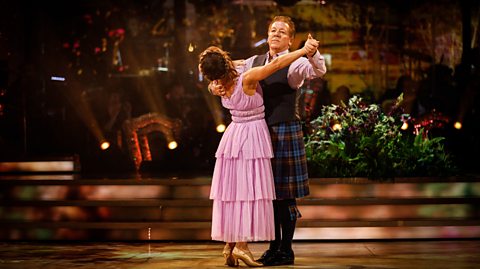 Image source, Guy Levy/BBC/PA Wire
2. What is samba dancing?
The samba is a form of ballroom dance adapted from traditional Brazilian samba dancing, which has its roots all the way back in the 16th century.
Samba dancing is characterised by lively, energetic movements usually set to fast-paced percussion music. Derived from Carnival in Brazil, the dance found popularity in the UK and US sometime in the 1940s.
Samba can be danced in either a 2/4 or 4/4 time signature.
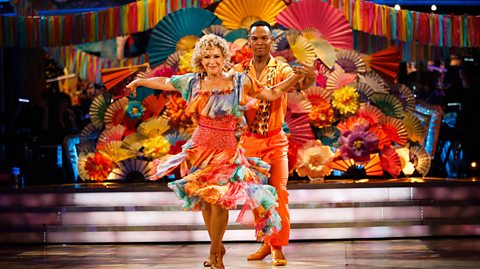 Image source, Guy Levy/BBC/PA Wire
3. What is foxtrot dancing?
The foxtrot is a popular but difficult ballroom dance that hails from the USA. It's made up of long, slow steps and short, quick steps - which create a trot that matches the music.
A foxtrot is performed in a 4/4 time signature, with long steps taking up two beats while short steps take up one.
Usually danced in a slow-quick-quick or slow-slow-quick-quick rhythm, the foxtrot comes in a number of different styles - with the international foxtrot tending to go at a faster pace than the traditional American style.
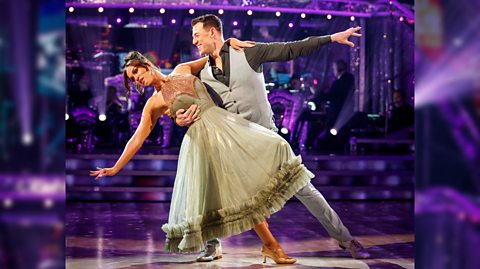 Image source, Guy Levy/BBC/PA Wire
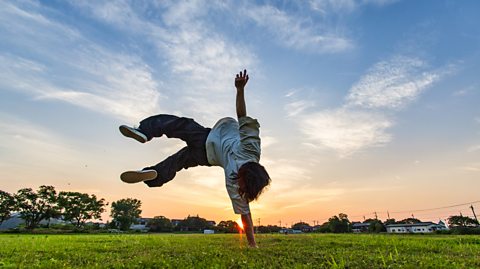
4. What is breakdancing?
Breakdancing is an urban dance style that originated in New York during the 1970s. Developed by Black and Puerto Rican communities in the Bronx borough of New York, breakdancing combines elements of hip-hop culture with acrobatic, athletic movement.
Breaking, as it is more properly known, is made up of a number of aspects, including toprock, go downs, freezes, power moves and footwork. If those terms seem a little unfamiliar, here's a breakdown (honestly didn't even mean that one)!
Toprock is any move made while the dancer is stood up, before going down to the floor. Go downs are the moves a 'breaker' makes to go from the top rock down to the floor. A 'freeze', rather predictably, is when a dancer holds a body position for a number of seconds, whilst a power move is a more dynamic, eye-catching motion - such as a sustained spin.
When is Strictly Come Dancing on?
Strictly Come Dancing airs on BBC One on Saturday evenings, with the results programme airing on the following Sunday.
In 2026, the much-loved show returns to iPlayer and BBC One from 7.25pm on Saturday 19 September and will air every weekend until Christmas. This year, there is also a new presenting line-up for Strictly Come Dancing featuring three hosts - presenter Emma Willis, professional dancer Johannes Radebe and comedian Josh Widdicombe.
Who is on Strictly Come Dancing?
When it comes to Strictly Come Dancing, glitz and glamour is never hard to find, nowhere more so than with its starry cast of competitors.
This year's competition is no different, with contestants ranging from athletes to actresses, including:
- Lacey Turner
- Dani Dyer
- Delta Goodrem
- Chris Appleton
- Cach Mercer
- Will Best
- Dame Sarah Storey
- Jaime Winstone
- Bethany Antonia
- Shaun Wright-Phillips
- Graeme Hall
- Lawrence Robb
- Tabby Stoecker
- John Nellis
- Melanie Walters
The returning Dani Dyer had been set to compete in the 2025 competition, but sadly had to withdraw due to injury.
Who won Strictly Come Dancing last year?
The 2025 competition was won by former Lioness Karen Carney and her professional partner Carlos Gu. The pair beat actress and reality TV personality Amber Davies and social media star George Clarke in the final.
Other former champions include actor and comedian Chris McCausland, actress Rose Ayling-Ellis, singer and TV personality Alesha Dixon and wildlife TV presenter Hamza Yassin. The show's first winner was newsreader Natasha Kaplinsky, who won the competition in 2004.
