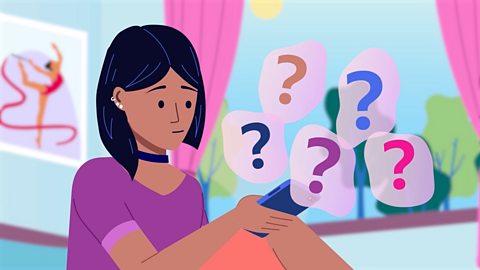
The films cover:
- a year 9 pupil who falls in love for the first time
- how to cope when a relationship gets serious and how to set healthy boundaries
The first film introduces Tomos’s story. Tomos is a year 9 pupil who has a ‘girlfriend’ for the first time and is trying to navigate a challenging situation as he feels that he hardly sees his friends since being in a relationship. The second film gives advice on how to recognise if things aren’t healthy in a relationship, and the things that can be done to help keep a balance.
Themes: relationships; setting boundaries; identifying difficult behaviour; discussion and negotiation.
Tomos's story: Film 1
This is me and the boys. We’ve been mates since like Year 7. We’d play football every break time and hang out after school - like all friends do.
But that all changed when Sara arrived.
She moved here from another school and as soon as I saw her, I couldn’t stop thinking about her! The amazing part was she liked me too.
And pretty soon we were going out. She was my first girlfriend! I made her my phone screen saver and wallpaper. Sorry, Wales!
We’d hang out every break time; have our lunch together. I didn’t have time for footy.
We’d even co-ordinate toilet breaks so we could meet for a few minutes during lessons too.
After school, we’d go to the cinema, the beach, the park.
Sometimes I’d see the boys in passing, and I kind of wished I had time to have a laugh with them.
We weren’t the only couple in Year 9. There was Rhys and Amelie. But their relationship seemed different to ours.
They didn’t hang out nearly as much as me and Sara did. Rhys was always with his friends at break time and only had lunch with Amelie every now and again.
I realised that it seemed like there was a way to have a girlfriend as well as have time for friends.
So, I talked about it with Sara and she was like, “You saw your friends loads yesterday." When I said that Double P.E. doesn’t count she just sighed.
Then at home, my sister was watching a dating show and they were talking about ‘relationship boundaries’.
I had no clue what that meant really, but it did kind of make me think maybe “boundaries” could be like ground rules that me and Sara could try to get a better balance.
The next day at school, we had a chat. It was awkward but I told her that even though I really liked hanging out with her, I needed time with my mates too. It didn’t feel right that I hardly spoke to them anymore.
She got upset and asked if I was breaking up with her but I was like, “No, I just miss my friends.”
Anyway, we tried it out - setting boundaries. I started to spend more time with the boys at break.
Sara found it hard at first, we even argued about it about it, but soon enough, she started making new friends in her lessons. We still hung out loads after school, but not every single day.
Thing is, when I started sharing my time between my friends and Sara, me and Sara had more stuff to talk about when we were together because we both had stuff going on outside the relationship.
We’re together, but now we’ve got a better balance.
Tomos's story: Film 2
Good relationships can make us happy, teach us new things, and challenge us in ways that help us grow.
When they’re not so good, they can make us feel bad about ourselves, or make us stressed and anxious.
But it’s not always easy to tell which is which. Even in great relationships, people argue sometimes.
And when we have a strong bond with someone, it can be hard to notice the bad things.
It’s important to know what to look for, and to be honest with ourselves. So keep an eye out for ‘green flags'; these are signs of a good relationship, and ‘red flags’ which are signs of a bad relationship.
In healthy relationships, people respect and trust each other, and everyone feels free to be their own person.
It’s important for you to be yourself, but also to compromise on some things. Today, you may watch the film you like and tomorrow, eat the food they like.
You don’t have to spend every moment with someone for it to be a good relationship. In fact, doing that could be unhealthy.
If a new relationship is keeping us from other relationships or preventing us from making new friends, that’s a red flag.
Healthy relationships depend on respecting each other’s point of view. So, it’s important to try to see things from other people’s perspectives.
You can work on this by imagining yourself in other people’s situations, and by making friends with people who have different experiences from your own.
If you feel like you can talk openly and honestly with someone you care about, that’s great and is a sign of a healthy relationship. If you feel you can’t, ask yourself, why not?
And if you’re struggling in a particular relationship, talking with someone else you trust could help you work out how you’re feeling or talk about what might help.
It may sound like a lot but basically it’s about remembering to ask yourself‘Is this friendship or relationship making me feel good?’
If the answer is no, think about why that might be. Maybe you can work on it and improve the relationship.
But if you keep trying and things don’t ever get any better, it might be healthier to end that particular relationship and prioritise spending time with other people in your life.
Possible activities
Activity 1 - Healthy relationships
(Health and Well-being; Language and Literacy; Mathematics and Numeracy)
Pupils could be asked to consider what they think makes a healthy relationship – and what are the elements that make relationships difficult? In groups they could be asked to list three things under a column entitled ‘healthy’ and three things under a column entitled ‘difficult’.
For example:
| Healthy | Difficult |
|---|---|
| enjoy each other’s company | no time to do other things you enjoy |
| shared interests | pressure to spend less time with your friends |
| an opportunity to laugh | feel that you have to be 'someone different' in his/her/their company |
| a nice feeling that someone wants to be in your company | |
All the ‘healthy’ factors and all the ‘difficult’ factors recorded by the class could be inputted on a voting software, and then asking the pupils to choose their favourite ‘healthy’ thing about being in a relationship and the factor they think might be the ‘most difficult’.
In groups, pupils could be asked to think about the following:
- How would they deal with a ‘difficult’ factor or factors in a relationship?
- Who would they turn to for advice?
- At what point would they feel the relationship needed to be brought to an end?
Activity 2
(Health and Well-being; Language and Literacy; Digital Competence)
Tomos realises that he is not happy in his relationship with Sara because he misses the company of his friends.
Pupils could be asked to list all the activities they enjoy and that make them happy. For example: seeing their grandmother; being part of a netball team; spending time with friends; art; taking the dog for a walk; working in the garage with dad.
Pupils could be asked to think about how much time they spend on their favourite activities during the week. They could create a digital timetable marking the time they spend doing the activities that make them happy. On completion of the timetable, they could consider:
- Is there an opportunity for them to undertake an activity they enjoy every day?
- Can they increase the time they spend on these activities?
- What could affect this time?
Further activity: In the film, Tomos hears about ‘relationship boundaries’ when watching a television programme.
In pairs, pupils could be asked to discuss the following:
- What does Tomos think are boundaries in a relationship?
- What boundaries did Tomos set in his relationship with Sara?
- What boundaries are important to you?
- When looking at your digital timetable, what activities would you want to protect if you started a relationship?
Activity 3
(Health and Well-being; Language and Literacy; Digital Competence)
Pupils could be asked to use the information in the second film to consider:
- What is a ‘green flag’ in a relationship? Can you think of any more examples?
| Show respect | Show empathy | Able to trust | Compromise | Good communication |
|---|---|---|---|---|
- What is a ‘red flag’ in a relationship? Can you think of any more examples?
| Controlling | Criticising | Talks nastily | Sulks easily | Affects how you feel |
|---|---|---|---|---|
In groups, pupils could be asked to create a short reel to raise the awareness of pupils aged 11-14 of some of the behaviours from the ‘green’ or ‘red’ table above. In preparing the reel they could consider completing the following steps:
- Create a story board for the reel
- Draw up a script
- Select locations / props / actors
- Select a style for the editing work
- Think about their use of text / graphics
- Select music / sounds
Curriculum links
Health and Well-being
- I can reflect and learn from the past in order to anticipate and prepare myself and others for future experiences.
- I can identify different strategies to self-regulate my emotions in response to a range of experiences.
Language, Literacy and Communication
- I can understand and analyse general meaning and implied ideas.
- I can listen empathetically to different people’s viewpoints on various subjects, using them to arrive at my own conclusions.
- I can make informed choices about vocabulary, idiomatic language and syntax in order to express myself with fluency, clarity and accuracy.
- I can respond to others’ points of view, summarising and evaluating what I have heard, read or seen, structuring arguments and challenging what others say with confidence and sensitivity.

Where next?
Alys's story. video
Alys is feeling sad and lonely as her best friend has become close friends with another girl. How will Alys cope with this? What can she do to make herself feel better?
Elis's story. video
Elis's mum died this year. In these films, we see how he adjusts to life without his mum and also learn how someone could help support a friend who is grieving.
Eva's story. video
Eva finds it difficult to say 'no' to her friends - but will this mean she'll have to miss out on a special trip to Cardiff with the gymnastics team? What will Eva choose to do? How can she make better decisions from now on?