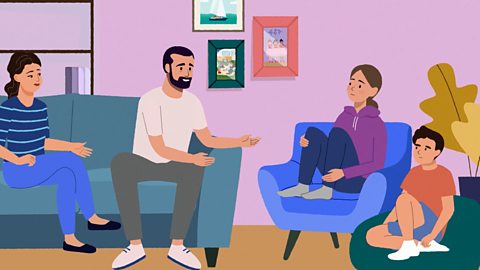
The films cover:
- the experiences of a child faced with making a decision and dealing with the consequences of their decision.
- some ideas a child could use to help them make good decisions
In the first film, Eva chooses to go to the beach with her friends instead of helping her gymnastics team raise money. Eva’s decision has an impact on the whole team and she tries to resolve the situation. The second film looks at ideas pupils can use to use to help them make better decisions.
Themes: making good decisions; dealing with consequences; what to do when in a dilemma; mental health; managing feelings; guilt; developing maturity.
Eva's story: Film 1
Last summer, my gymnastics team was getting ready for the national championships. We were all training really hard and we had to fundraise so we could afford to go and compete in Cardiff.
I’d promised I’d do bag packing with the rest of the team at the local supermarket to help raise money for the trip.
But that morning, my girlfriend messaged to say that she, and a load of our friends, were at the beach and did I want to join them. That sounded way more fun than spending a sunny day stuck inside a supermarket.
My coach and teammates would be fine without me, wouldn’t they?
I muted my phone and went to the beach. It was a fun day, but when I looked at my phone later there were loads of messages from my teammates, asking where I was and if I was okay. I said I was fine, I’d just made other plans.
My best friend on the team texted back. She said I’d worried everyone, and they hadn’t reached the fundraising target without me.
She was gutted. There was a risk we wouldn’t be able to go to the championships. I was so annoyed with myself. We’d worked so hard in training and now I’d let everyone down.
I could go to the beach anytime, but we might never make it to the championships. Why hadn’t I thought things through? I felt really guilty.
My heart was pounding. I didn’t know what to do.
I called my girlfriend and told her what had happened. She said the team would get over it. They couldn’t expect you to give up every weekend!
But I knew I was in the wrong. At the next practice I spoke to the coach. We agreed I should apologise to the team. I was pretty nervous, but I said sorry to everyone. It wasn’t easy.
I still remember the looks on their faces – some of them were really angry with me.
But then I told them that I had a plan to do a sponsored walk to try and hit the fundraising target. Everyone thought that was a good idea.
My girlfriend came along with me – the walk was tough, but we managed to make up the money.
I was really glad I managed to make it up to the team, but I still wish I hadn’t let everyone down in the first place.
Now before I make any big decisions, I take a moment to think about how it might affect other people, and me.
It’s not like I’m perfect now, but when I make mistakes, I try to learn from them, take responsibility for my actions and fix things if I can.
Eva's story: Film 2
From what to have for lunch to which GCSE subjects to study, the older and more independent we get, the more decisions we need to make.
But making the right decisions can be challenging.
Scientists have found that the frontal lobe in our brains – the part responsible for decision making and emotion – only finishes developing when we get to our mid-twenties.
This means that when we’re teenagers, we make more decisions on the spur of the moment and are more likely to take risks.
Peer pressure – when we get pushed in to doing things by others – can also have a big influence on the decisions we take.Luckily, decision-making is a skill that can be improved.
Here are four good tips to keep in mind when you need to make decisions.
Firstly: Keep your cool.
We don’t always think clearly when we’re under pressure or feeling overwhelmed. Take a moment to calm down, and consider the consequences of your decision. Notice how you feel about each of your options and think about how you might feel afterwards. Sometimes choices that feel good in the moment can make us feel bad in the future.
Secondly: Own your decisions.
We want to fit in, which is why peer pressure can be so powerful. So it’s good to ask yourself if you’re just doing what you think others expect you to, or if you’re actually making the best decision for you.
Next up: Talk about it.
Talking through a dilemma with someone you trust can help you think it through. They might also be able to give you advice or a fresh point of view.
Lastly: Make a list.
Writing your thoughts down can give you a break from juggling it all in your head. A list of pros and cons can make the consequences more obvious, which makes it easier for you to see whether it would be a good decision.
All these techniques can help us with individual decisions. Practising them over time can help us get better at decision-making.
Of course, there’s no getting around the fact that we all make bad decisions sometimes. But if we can realise when we’ve made a mistake then we can learn from it for next time.
Possible activities
Activity 1 - A good decision
(Health and Well-being; Languages, Literacy and Communication)
In the film, Eva chooses to undertake an activity that is fun for her in the short-term rather than something that will make her happy in the future. Pupils could be asked to work in pairs and discuss the following:
- Would they have chosen to go to the beach (as Eva did) or go to the supermarket to help the team?
- What are the reasons for their decision?
Pupils could be asked to consider the scenarios below. What would they decide to do in these situations and why? If none of the suggested options appeal, pupils could be asked to add an alternative answer under the ‘Option 3’ column.
| Situation | Option 1 | Option 2 | Option 3 |
|---|---|---|---|
| The school hockey team is training tonight – but it’s raining and you’re feeling tired. What do you decide to do? | Go home on the bus straight away without telling Mr Jones (the coach) – and then go to Zack’s house to play computer games. It’s the right thing to do – you want to keep warm and have fun. And you’ll feel less tired tomorrow after relaxing tonight. | Go to the training anyway. It’s raining but you’ve got a place on the team and that means you have to go to the training. | ________________ |
| Your friend has lost her cash card and she has no money to pay for her lunch. Your mum has given you five pounds – but you need this money to buy your lunch and to get a bus to grandma’s house after school. What do you do? | Share the money with your friend so she can have lunch too. You’ll walk to grandma’s house afterwards – it doesn’t feel too far on the bus! | Buy your lunch and give your friend some of your apple. There’s nothing else you can do. | ________________ |
| Your phone has fallen on the floor and the screen has cracked. You’re sure your mum and dad will be very angry about this. | You tell your mum what’s happened and let her know that you’ll put your birthday money towards the cost of buying another phone. | You hide the broken phone and tell your mum that someone from the class has taken your phone out of the bag. Your mum might phone the school and make a fuss – but that’s better than having to face what’s happened. | ________________ |
Activity 2 - Technique when making a good decision
(Health and Well-being; Languages, Literacy and Communication)
The second film shows that the part of the brain that helps us to make decisions does not fully develop until we are in our 20s. The film also introduces four techniques that can help when making decisions. One of these is to make a list of the good and negative things about a decision (the ‘pros’ and ‘cons’).
Pupils could be asked to fill in the table below noting the good and negative things about Eva’s decision to go to the beach with her friends:
Eva’s decision to go to the beach:
| Good things: | Negative things: |
|---|---|
| seeing friends | ________________ |
| ________________ | ________________ |
| ________________ | ________________ |
| ________________ | ________________ |
| ________________ | ________________ |
They could be asked to think of a decision they made in the last month. Looking back, can they draw up a list of the good and negative things about their decision. Did they make the right decision?
My decision: _______________________________
| Good things: | Negative things: |
|---|---|
| ________________ | ________________ |
| ________________ | ________________ |
| ________________ | ________________ |
| ________________ | ________________ |
Pupils could be asked to rate how effective this technique is in helping them to make a decision from 1 – 10.
1 (least effective) - - - - - → 10 (most effective)
| 1 | 2 | 3 | 4 | 5 | 6 | 7 | 8 | 9 | 10 |
|---|---|---|---|---|---|---|---|---|---|
| ☐ | ☐ | ☐ | ☐ | ☐ | ☐ | ☐ | ☐ | ☐ | ☐ |
How likely would pupils be to use this technique when making decisions in the future? They could be asked to note three things that make this a useful tool in their opinion – as well as anything that makes it less useful.
Activity 3 - Dealing with the consequences of a decision
(Health and Well-being; Languages, Literacy and Communication)
Pupils could be asked to think of a poor decision they made in the past. They could be asked to fill in the writing grid below (individually):
| My poor decision: | ________________ |
| Reasons for the decision: | ________________ |
| What were the consequences of this decision: | ________________ |
| How did you feel after you made the decision: | ________________ |
| Why did you feel like this? | ________________ |
| Would you make this decision again? | ________________ |
| If not, why not? | ________________ |
| What would you decide to do next time? | ________________ |
| Why would you decide to do this next time? | ________________ |
Curriculum links
Health and Well-being
I can reflect and learn from the past in order to anticipate and prepare myself and others for future experiences.
I can identify different strategies to self-regulate my emotions in response to a range of experiences.
Languages, Literacy and Communication
I can understand and analyse general meaning and implied ideas.
I can listen empathetically to different people’s viewpoints on various subjects, using them to arrive at my own conclusions.
I can respond to others’ points of view, summarising and evaluating what I have heard, read or seen, structuring arguments and challenging what others say with confidence and sensitivity.

Where next?
Jay's story. video
Jay feels very tired all the time. He spends a lot of his time playing on his phone and computer. Things can't carry on like this – how can Jay get things under control?
Kareem's story. video
Kareem feels really bad about the way he looks – mainly because of the pictures of perfect people he sees online. How can he change the way he feels about his body?
Seren's story. video
Seren's parents have separated. Seren's father is moving away with his partner and having a baby with her. How will she cope with all of this?