Please always refer to the latest government advice before booking travel and departing on any trip.
Journey beyond the tourist trail. Discover the hidden gems and silver linings of rural Japan.
The people of the San'in region have fought to preserve their historic buildings, traditional crafts, and rural way of life. If you are willing to travel a little further and delve a little deeper, the San'in region will reward you with rich, memorable experiences.
Access to the western part of the San'in region is fastest by flying into Hagi-Iwami Airport from Tokyo's Haneda Airport. If you're travelling west by the Shinkansen it is 4 hours and 20 minutes from Tokyo or two hours from Osaka to Shin-Yamaguchi Station, from where you can access Hagi by bus or Tsuwano by train.

Hagi Town
The castle town of Hagi sits on the Sea of Japan coast, a 70-minute bus ride north from Shin-Yamaguchi. The castle, once the home of the lord of the Mori Clan, is now a ruin, but the samurai mansions and merchant quarters have been lovingly preserved. At the Kikuya Residence and the Kubota Residence visitors can admire the craftsmanship with which these homes were built several centuries ago. The town is most famous for its Hagi ware ceramics, which are valued and collected, particularly for use in tea ceremonies. Coarse sand is used in the clay, giving the finished pieces a rough texture. The pottery is also porous, so with each serving of matcha their colours slowly change. Look around the stores of the local artisans, and you'll notice that each cup, plate and bowl is different. The variations, and even the flaws, in handmade pieces are celebrated as wabi sabi (the beauty of imperfection). The town has several pottery museums, and some workshops even allow visitors to make their own pieces.
Tsuwano Town
East from Hagi, at the foot of Mt Aonoyama, is the beautiful castle town of Tsuwano. Most arrive on the local train, but for those who wish to really embrace the area's history, reserve a spot on the SL Yamaguchi steam train that huffs and puffs its way between Shin-Yamaguchi Station and Tsuwano Station. The historic buildings of Tsuwano have distinctive white earthen walls topped by red or black roof tiles. Even more unusual are the narrow canals of clear water that run along the edge of the roads. Look closer and you'll see koi swimming along these miniature waterways. Pick up a box of carp food for 100 yen, and dozens of koi will be happy to make your acquaintance.

Perched on the mountain above the town is Taikodani Inari Shrine. Like in other great Inari shrines, hundreds of vermilion torii gates form a tunnel that welcomes visitors. Numerous stone statues of foxes can be seen amongst the torii gates and lanterns, as these sacred animals were believed to be favored by the Inari gods. Once at the main shrine, visitors make their prayers for prosperity and wish fulfilment. Offerings are made of candles and deep fried tofu – the favorite food of the beloved foxes.
Iwami Ginzan
In 2007, Iwami Ginzan Silver Mine and its Cultural Landscape became a Unesco World Heritage Site. The historic silver mine, Japan's largest at that time, operated from 1527 to 1923, and today visitors can go on guided tours through sections of the tunnels. Once mined, the silver ore would be transported down from the forested mountains to port towns such as Yunotsu. Today, Yunotsu Town may no longer be exporting silver, but it is blessed with a constant supply of hot, mineral-rich waters. The town's onsen have both public and private baths which will soothe weary muscles, and, if you believe the locals, leave you with beautiful looking skin.
Another significant part of this cultural landscape is the local version of kagura, ritual dances and storytelling. Iwami kagura is famous for its use of smoke and fireworks to recreate battles with giant serpents and dragons. Kawamura Takahiro of the Iwami Ginzan Kagura Association explains: "In neighboring cities, towns, and villages, we can see many different forms of kagura. This is our traditional art form and we have to carry it on, but we are not too rigid in our approach. Iwami Kagura itself has undergone many changes and transformations in this way before becoming what it is today. Therefore, Iwami Kagura is more flashy and entertaining than Kagura in other areas."

Izumo Taisha
Travelling east along the San'in Coast you reach Izumo Taisha Grand Shrine, one of Japan's oldest and most revered places of worship. Enshrined here is Okuninushi no Okami, the deity that built Japan, who is now venerated for love and marriage. Unlike at other shrines where you bow twice, clap twice then bow during prayers, at Izumo Taisha visitors bow twice, clap four times, then bow.
Matsue Town
Further east along the coast, you reach the stunning Matsue Castle, one of Japan's few original castles. While other castles fell through battles, earthquakes, fires, and modernisation, the black tower of Matsue-jo has remained intact. Take a relaxing cruise around the moat, then stroll through the samurai district. Matsue Town is famous for the consumption of matcha (green tea) and wagashi, delicate Japanese sweets. There are many great cafes, but it is hard to beat a tea ceremony experience at the Meimei-an Tea House or Gesshoji Temple.

Oki Islands
For those willing to venture even further, shuttle buses run from Matsue Station to Shichirui Port. From there it is two hours by ferry, or an hour by hydrofoil, to the Oki Islands. For local residents such as Fukuda Takayuki of Oki Shizen-mura this distance is seen as an advantage. "The scenery here is unique to these remote islands, and I think it gives visitors the opportunity to see lifestyles that are quite different from the ordinary. We use bicycles to take visitors around the island, and on our adventure tours we start with a hike through the forest, then use a packable sea kayak to come down the coast."
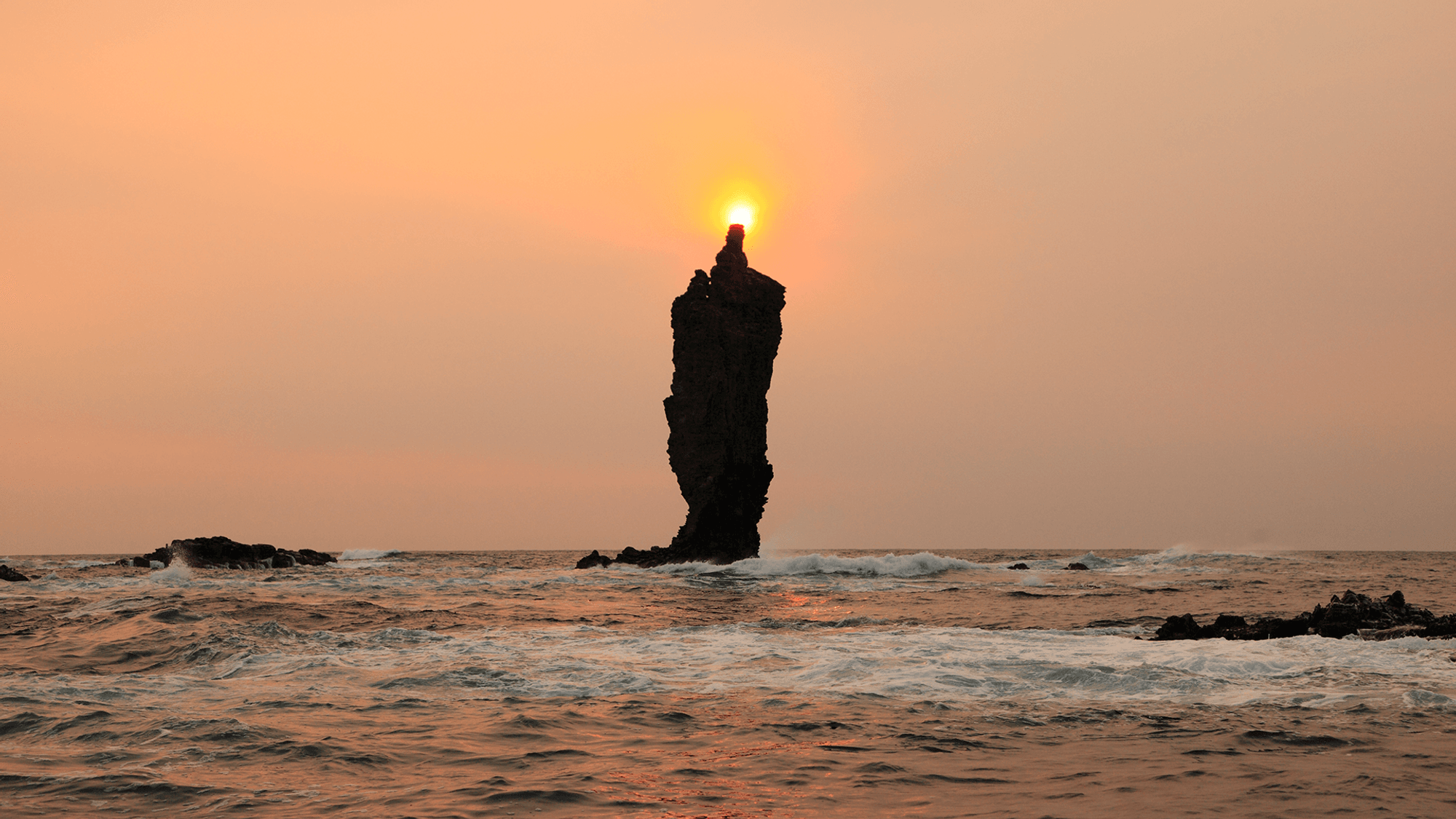
Some hikes take visitors through local shrines to ancient cedars. Highly recommended is to head to the northwest coast of Okinoshima in late afternoon, stroll down to the Rosoku-jima (Candle Island) lookout and wait. Inhale the ocean breeze, listen to the birds and watch the clouds slowly glide across the sky. There's no need to rush. Follow the example of the San'in locals. Savor the moment, cherish conversations with friends and bathe in the glorious sunset.
Japan's fast-paced, high-tech cities offer glimpses into the future. The San'in region provides its residents and visitors the chance to embrace the traditions and beauty of the past.