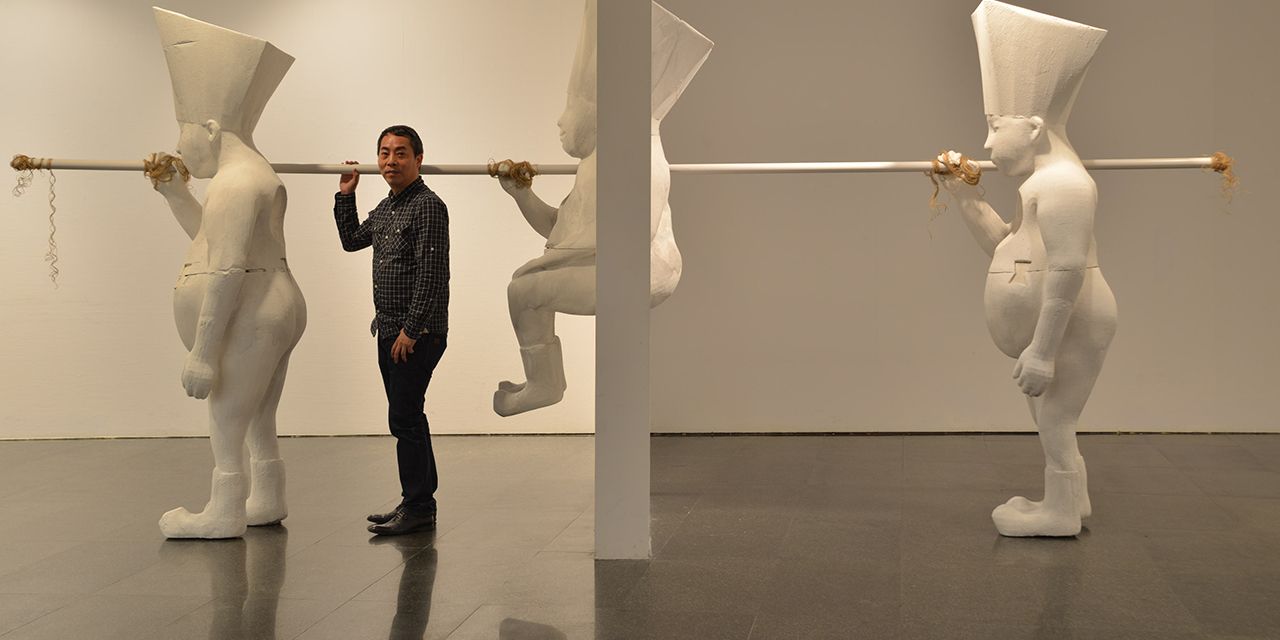
Russian artist Konstantin Bessmertny’s studio resembles an other-worldly cabinet of curiosities.
Tara Loader Wilkinson
“The studio’s actually looking quite photogenic today,” beams Konstantin Bessmertny as he holds open the door for me. I accept his offer of a morning espresso, but actually I don’t need it.
As I gaze around the surreal and wonderful contents of this Russian artist’s studio, I feel powerfully energised. It’s a trip down a rabbit hole of political jousting, provocative commentary and absurdly surreal art; an out-of-this-world cabinet of curiosities.
“One thing I do constantly, is to make you doubt reality,” he muses as I get a tour of his works-in-progress. “People try to live the status quo but life is up and down. My message is, challenge authority and challenge yourself.”

There’s definitely no status quo here. In one corner of the room a foot-high Samurai soldier brandishes a baguette in one hand and a pistol in the other. In another, a propped-open Baby Grand piano is full of ping-pong balls. A life-size, antique wooden lion covered in graffiti forms the rooms’ centrepiece, flanked by a pair of replica Ming vases showing cheeky historical parodies. On the wall is an enormous oil painting of Queen Victoria, encrusted with Swarovski crystals and cute unicorn stickers. My eye is drawn to a perfectly-proportioned doll’s house living room, filled with miniature Masterpieces from throughout the ages, each painstakingly framed. And there’s much, much more.
Bessmertny is truly an artist who defies categorisation, at the crossroads of East meets West, past and present, contemporary and classical. His ambiguity is at least partly down to his upbringing. Growing up in a city on the Chinese border in the turbulent era of the Union of Soviet Socialist Republics, Bessmertny was born into what he calls “a dissident family”.
“My mother’s family were considered enemies of the state during the Bolshevik revolution and were sent to the Gulag (Soviet labour camp). So, since a young age I lived with the burden of this historical narrative. As a child, on one hand you had a big Communist propaganda machine bracing you daily, and then on the other you were trying to find a way to resist it.”
Bessmertny studied art for 14 years, culminating in a degree at Vladivostok’s Institute of Fine Arts. Partly through talent, partly through his excellent level of English, he was selected to exhibit his work in Macao. His style was an instant hit with the Asian dealers, who were used to a brand of quieter minimalism.
“My work had a philosophical approach, inspired by the large horizons of my home, but it was always complex. There’s a phrase: art is in complexities, and design is in simplicity. I think art should be complex.”
He was approached for representation by a gallery and soon it made sense to make a permanent move, which he did in the early ’90s with his wife Galina, a music teacher, and their two children, Sasha and Max.
“I arrived here as an outsider and I found unlimited inspiration. I came with fresh eyes, elevating the mundane, painting everything about local life from gambling to dim sum to Chinese teapots,” he recalls. “I started asking questions in a funny way.”

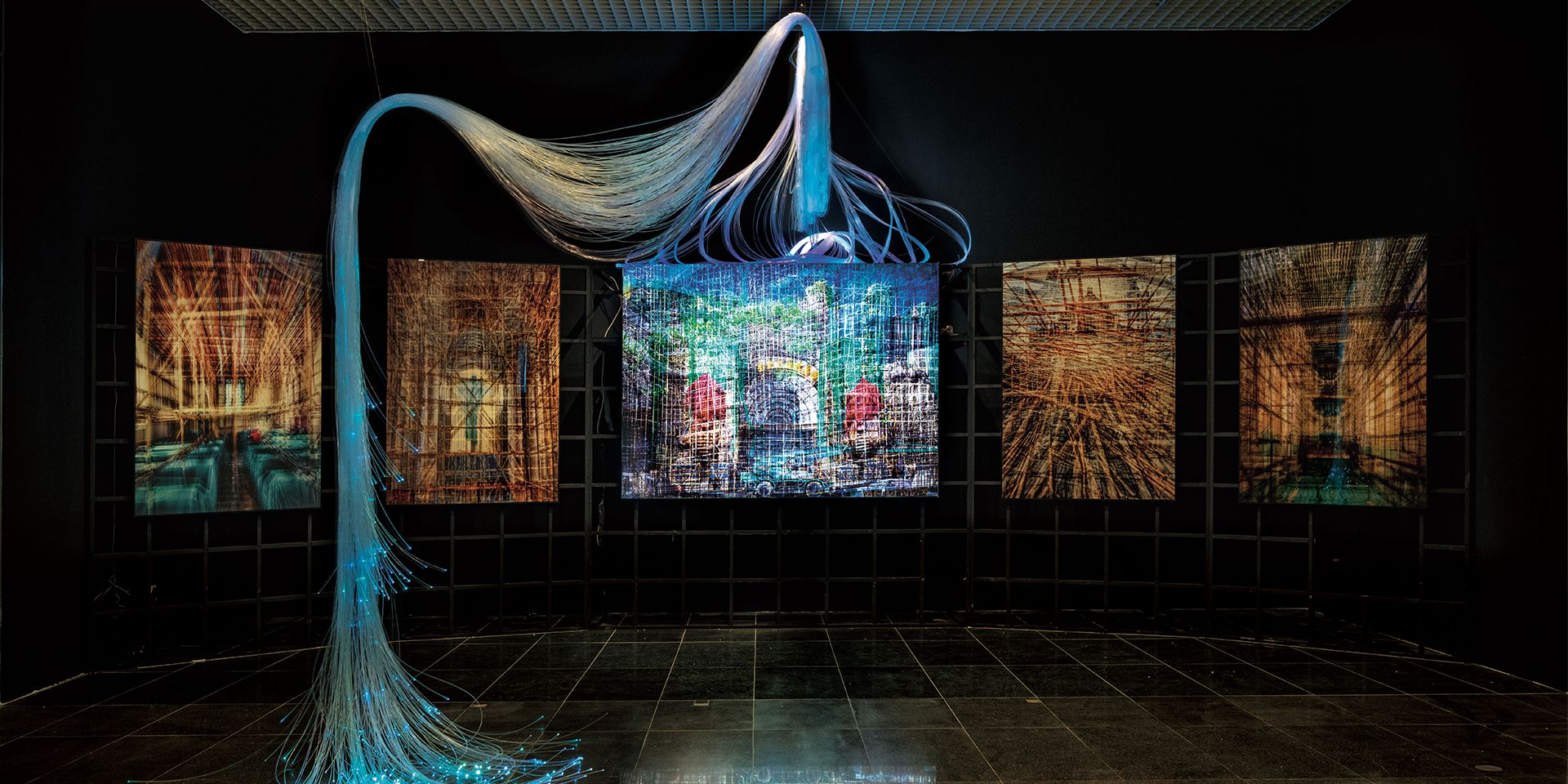
His work began to take stronger form, ironic observations of local culture and politics, mixing prostitutes and gamblers with politicians and financiers, always permeated in symbolism and annotated with spidery Latin script. Straddling high culture and parody, he looked back to Old Masters and classical painting techniques, like his Monument of Universal Decisions, which references Renaissance painter Pieter Bruegel’s Tower of Babel (1563), or Luncheon after Velazquez (2018), a nod to the Spanish Old Master Diego Velazquez, on show at this year’s Art Basel Hong Kong.
In 30 years, Bessmertny became arguably Macao’s most famous artist, representing the city-state at the 2007 Venice Biennale and presenting solo shows all over the world, from the Macau Museum of Art, to London’s Rossi & Rossi Gallery and The Arts Club. His work hangs in global institutions, with a recent acquisition made by Hong Kong’s prestigious visual culture museum, M+, due to open in March.

But Macao, as Bessmertny will attest to, has changed unrecognisably in his three decades as a resident. He still lives on the leafy island of Coloane with Galina and his two elderly dogs. He has turned the garage into a small studio, but it’s not big enough for more than a couple of artworks.
Macao he says, has given him everything. “When I came, it was a village, dirty, dusty. Now it’s the richest place on Earth per capita, and things progress with such speed and scale,” he says with awe. But like other artists, he finds the city’s stratospheric success has made space unaffordable. He has had to relocate his larger studio twice, most recently to Macao’s neighbouring SAR of Hong Kong.
For the last five years he has been catching the first ferry three times a week to come to his airy, 2000 square foot studio, looking out over the industrial harbour of Chai Wan. It’s a journey he relishes to clear his mind and his inbox, which he aims to have at zero messages by the time the boat docks. “Every morning I free my brain and my energy, grab a coffee and meditate.” Bessmertny is positive about the future of the art market, as long as people look for art and craft with intrinsic value. He hopes that as collectors become more knowledgeable and sophisticated, they will move away from derivative, easy-to-digest work and seek out the genuine. “Go to the artists’ studio and see what they are doing, first hand,” he advises.
Bessmertny collects art too, but nothing like what he creates. His home in Macao is filled with simple, careful ceramics, cherry-picked from around Asia.
“The price you pay for art is your direct contribution to support culture. The artist will buy materials with your money to make more,” he says.
“If you see something good, you should buy it as an investment into the culture you want.”