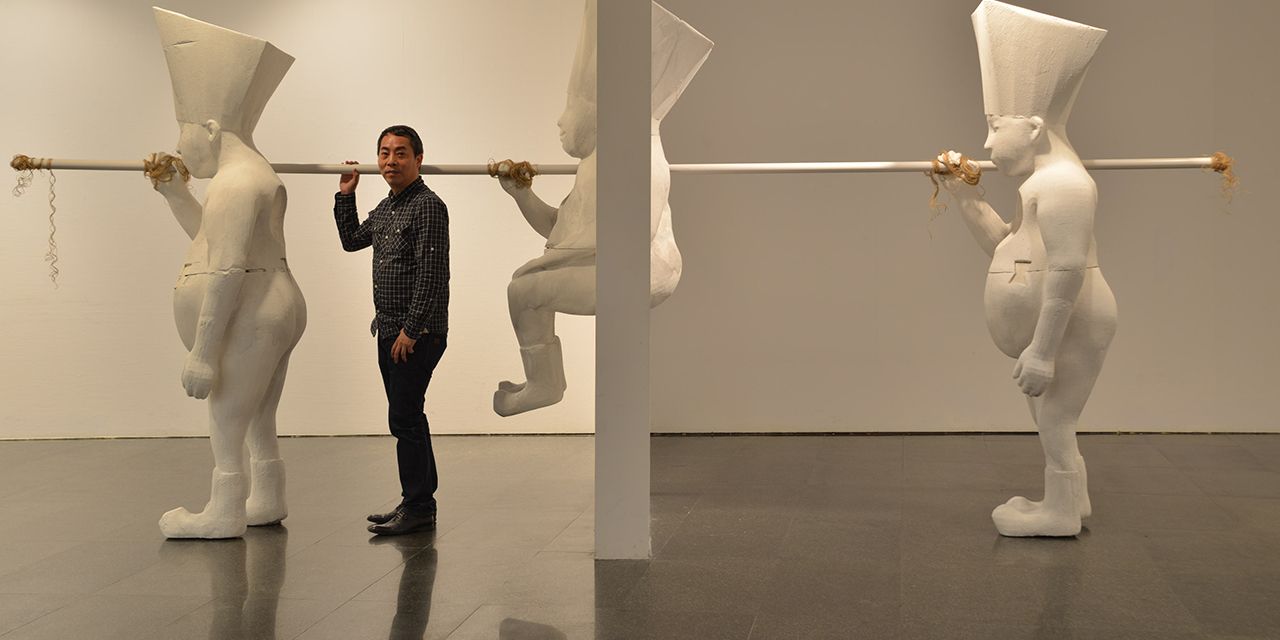
Macao artist James Wong’s impact on art education in the SAR cannot be underestimated.
Tara Loader Wilkinson
“I’m a monster!” laughs James Wong Cheng-pou self-deprecatingly, in a roundabout way answering my question: how would he describe his role in Macao’s art scene?
Never mind monster, Wong is probably the artist who has contributed most to the development of modern art education in the SAR.
Born in 1960 in Macao, the fourth son of eight children, Wong’s first memories were of going to the movies with his father. “My dad worked for the Hong Kong-Macao Ferry and every year he got a month’s break while the ferry was being serviced. There was a cinema opposite our apartment, so he would often take us to see Batman, cartoons, 007, Japanese movies. That’s how I started my love of visual arts,” Wong recalls.
After graduating from high school in the 1980s, Wong studied art in Hong Kong, Tokyo and Taiwan. Upon his return to Macao in 1989, he marvelled at the fact that the SAR did not have any formal education centre for the arts. So he created one.

He approached the government’s head of culture with a proposal to create a Visual Arts Academy. “At the time Macao didn’t even have a university. But they found a piece of reclaimed land and allowed us to just make a start.”
“The main purpose was to see if there were any potential art students at that time. We started with weekend classes and it was quite successful, we amassed 100 to 200 students pretty quickly.”
Following a three-year stint in London where he took on a research role at the Slade School of Fine Art at University College London, he again returned to Macao with renewed intent. This time it was to help curate a multimillion-dollar cultural complex comprising the Macao Museum of Art, the Handover Gifts Museum and two performance auditoriums.
Now aged 59, taciturn yet warm, Wong still doesn’t like to pigeon-hole himself, but he is proud of his role nurturing the art scene. “I consider myself as an art lover, art educator and an art worker. But yes, most of Macao’s modern art history comes from the Academy of Visual Art I co-founded.”

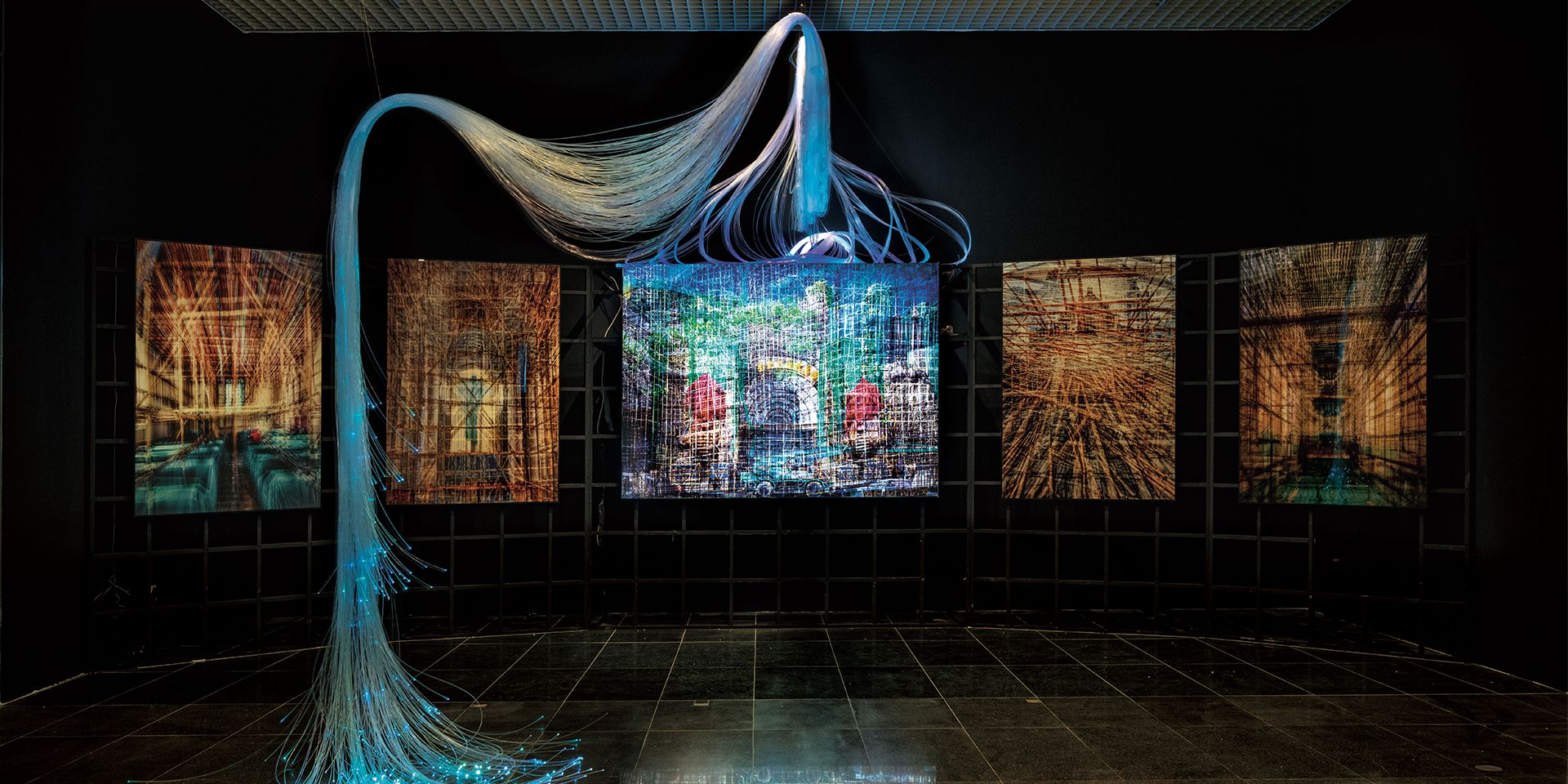
We are chatting on stools in his cool studio in an annex of the Macao Museum of Art, a welcome refuge from the shimmering midday heat. He comes here to teach but also work on his own art, which ranges from 3D models to paintings, installations and mobile images.
In front of me is Wong’s two-headed, popish 3D-printed sculpture called YAM. YAM, he explains, is short for You And Me. “It lives in one body with two heads, to suggest the multifaceted nature of humans.”
He shows me another large sculpture of a humanoid egg titled Egg Man II. “It’s an ovipara, it looks like humans but it is hunted by humans,” he explains.
These were both part of his show when he represented Macao at the 57th Venice Biennale, widely considered the world’s most prestigious art exhibition. His exhibition of some 17 works was called A Bonsai of My Dream, inspired by the classic Chinese text, the Shan Hai Jing, which is one of the world’s oldest books. It took place in the upstairs of a 200-year-old walled house within the leafy giardini della biennale.
Venice was the greatest exhibition of his three-decade career, but there have been many great shows. His first solo show was at Macao’s Museum Luis de Camoes in 1987 and he went on to have others in galleries and museums in Portugal, Belgium, Singapore, London and Japan. His work can be seen on display in the Macao Museum of Art, the Oriente Foundation in Lisbon, the Peninsula Hotel in Hong Kong, the Fullerton Hotel in Singapore, the Shangri-La Hotel in Beijing and several of Macao’s gaming properties. He was named as a top 30 finalist of the Sovereign Asian Art Prize.
What inspires his art? “I just do whatever comes to me,” Wong replies. He says he enjoys the moment staring at a blank canvas, or the surface of an unscratched copper plate with almost religious fervour. “I often embrace the moment before anything begins; this chaotic state of uncertainty … allows me to slip out of the boundaries of time between two eternities.”

Indeed, Wong cites one of his greatest influences as religion. His mother was a devout Buddhist who devoted herself to prayers and daily offerings. This is something that Wong has carried through into his own life. “I pray daily, I offer thanks and burn incense at my apartment in Taipa,” he says. His home is full of small statues of Buddha, which he has been drawn to since his childhood.
“I would have frequented the temple with [my mother] at a young age, where I marvelled over the portraits of Buddhist icons.” His early education, however, was at a local Catholic school which has always inspired his art. “The clerical attires my teachers wore always attached a fairy kind of mysticism. I find them just like my imaginary Gods.”
He is also inspired by antiquities. “I love the Chinese old culture. In those days, you were identifiable by the precise language of visual uniform. Nowadays you don’t know where people are from.”
At the moment he is working on commissions for prints, drawings and paintings from his clients. Most of them are from overseas, including Hong Kong, Japan, New Zealand and Germany, but one of his first and most well-known clients was Macao billionaire businesswoman Pansy Ho, who exhibited his work in her Hong Kong art gallery as well as her other key properties.
Wong is also still teaching print-making two or three times a week at the government-subsidised art centre, which has tripled in size since it opened in 2006.
Over the years he has taught “thousands of students”, many of whom are talented, but he says their success comes down to whether they are given the right support. “Different talent needs different soil,” he says.
Does Macao have a future as an incubator of art talent, I wonder?
“Art is not something like a square of grass which can grow by the nature’s will, artists’ existence is more complicated than that,” he muses.
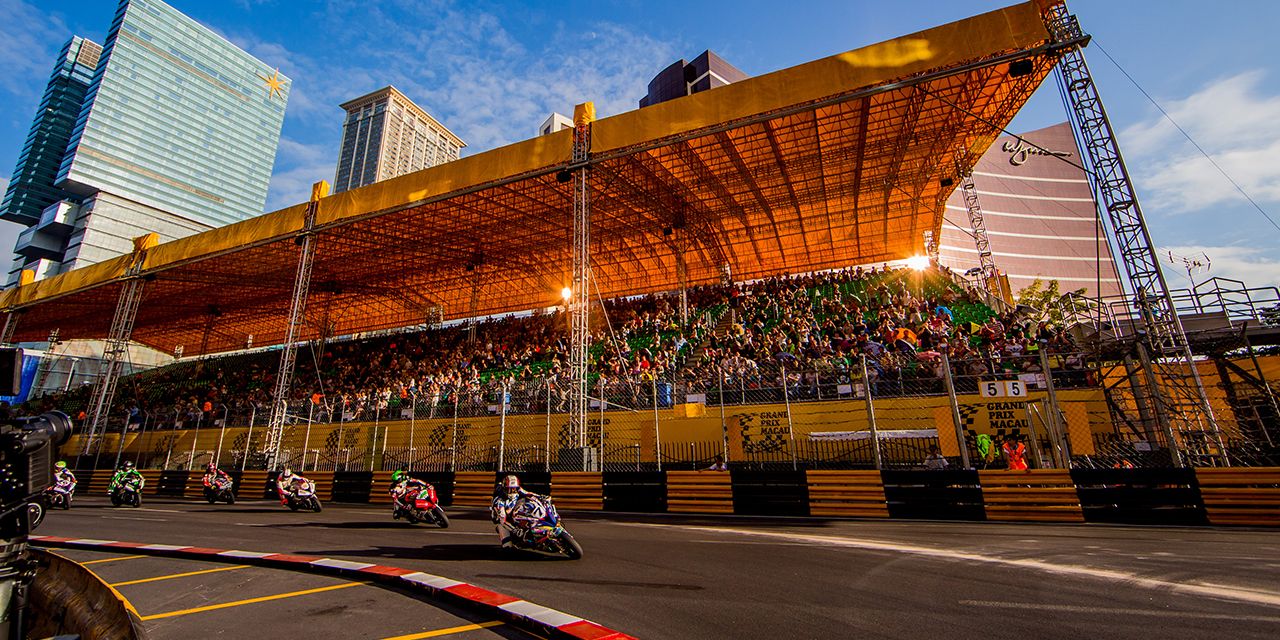
After our interview I walk back towards Macao’s ferry terminal and admire the awe-inspiring structures along the way. The futuristic exoskeleton of the Morpheus Hotel by Zaha Hadid Studios, the golden windows of Sands Macao and the palatial scale of the Galaxy Macao are jaw-dropping. Not to mention MGM Cotai’s glittering cubist façade, the sleek lines of Wynn and the iconic peacock’s tail of Grand Lisboa.
I’m reminded of the phrase, ‘if you build it, they will come,’ and I wonder if the same could be applied to the city-state’s art scene.
Only time will tell.