

At the age of 41, Dutch entrepreneur Bernard Muller received devastating news: he had the incurable neurological disease amyotrophic lateral sclerosis (ALS) commonly known as Lou Gehrig's disease. He remembers the feelings of "disbelief, disorientation, being powerless and feeling robbed".
"It's not just you confronted with the worst news ever. It affects your whole family," he says.
A successful innovator at the helm of a billion-Euro maritime business, Bernard decided that he wasn't going to let the disease define his life. Instead, he took an entrepreneurial approach to dealing with the disease: "I decided to treat ALS as a project and not just passively accept it."
Bernard's fascinating journey as an ALS Challenger, innovator, and artist have been shared with the world, as part of a campaign called #HONORtheChallenger. The campaign celebrates people like Bernard – those who are undaunted by their circumstances, daring to achieve the extraordinary, and living lives filled with passion.

What is ALS?
"ALS is a progressive disease of the nerve cells in which your muscles gradually fail," explains Limore Noach, executive director of ALS Foundation Netherlands, an NGO which helps to finance scientific research into the cause and treatment of ALS, and the related diseases, progressive spinal muscular atrophy (PSMA) and primary lateral sclerosis (PLS).
"Every loss of function is forever," she says, adding that ALS patients often retain control only of their eye movement in the later stages of the disease.
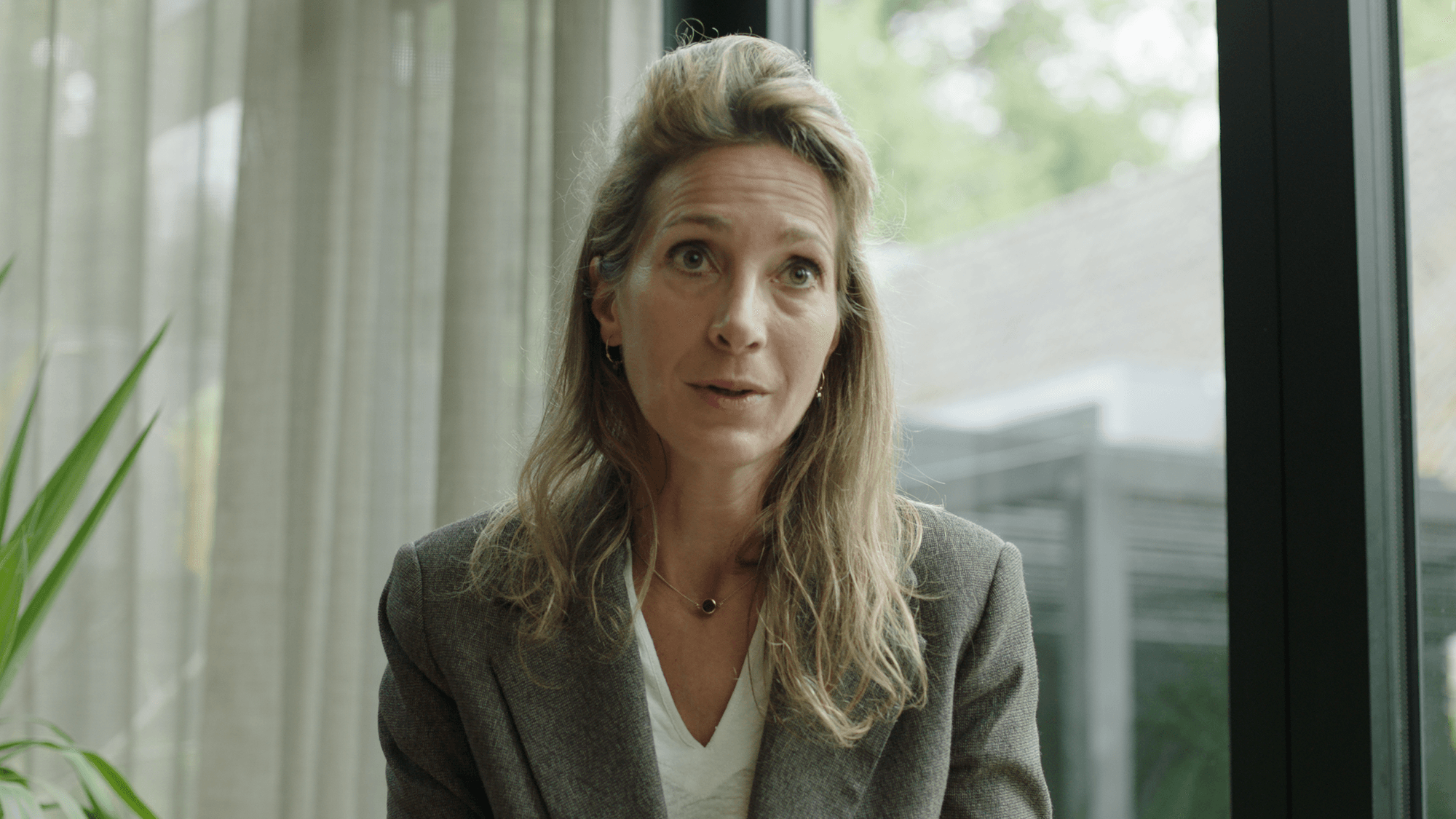 Limore Noach, Executive Director, ALS Foundation Netherlands
"People who have been diagnosed with a life-changing disease often find a renewed sense of purpose and want to do something meaningful."
Fourteen years after his diagnosis, Bernard is a shining example of the Challenger spirit.
Despite now being bound to a wheelchair and dependent on a ventilator, Bernard communicates and builds worlds through just the movement of his eyes. He raises awareness about ALS as a successful AI-assisted artist, using eye-tracking technology to create stunning artwork. Frida Kahlo and Dutch artist Jan te Wierik are are some of his inspirations, he says, reminding him of the resilience and creativity that can arise from challenging circumstances.
"I was so excited that my art reached a wider audience and knew this was my new calling. It gave me a renewed sense of purpose in life," he says, describing a moment when he sold his first art collection through an online auction.
When technology becomes a core part of the Challenger's toolbox
"ALS has taken away my ability to speak, but groundbreaking AI innovations have given me a new voice," says Bernard. "I'm mesmerised by the power of multimodal technologies to bring my ideas to life with my words, allowing me to challenge myself and express my creativity, despite my physical limitations."
Accessibility technologies can enrich our lives in many ways, but for people with ALS and disabilities, they can unlock new pinnacles of human potential and innovation, by helping them maintain interaction with a world that gets increasingly hard for them to participate in. "It's a testament to human resilience and the transformative power of technology," says Ben Wood, chief analyst at CCS Insight.
 Ben Wood, Chief of Research, CCS Insight
"Multimodal technology is the ability to use different contexts, such as sight or speech, to interact with a device and select something on a screen," says Ben, who has been observing smart technologies for many years. "Eye-tracking is a breakthrough technology for people with disabilities. When you lose the ability to speak or move, it means the tiniest little actions like moving your eyes, allow you to create an image or an action. It's a game changer," he adds.
Bernard used this technology to create a digital work of art for the #HONORtheChallenger campaign. It's a vibrant, rich image showing a young sprinter poised at the start of a race. Every element of the athlete's body speaks of energy building for the starting gun, every brushstroke describes her focus and determination. "It's astonishing how Bernard has used technology in such an innovative way to express himself," says Ben.

HONOR's belief that the most powerful technology is the technology that's accessible to all, is perhaps best realised through the power of the smartphone, the everyday pocket device of the masses.
Earlier this year, HONOR released MagicOS 8.0, the brand's latest operating system with fully integrated platform-level AI to support multimodal interaction. This evolution has paved the way for more intuitive and immersive experiences, revolutionising the way we interact with digital devices and applications. "The power of the mobile phone is that it's so accessible. Now, with the ability to use our eyes, speech, and sound to interact with our devices, we have the revolutionary ability to make these features widely available," says Ben.
Another immense possibility that has been unlocked for those with ALS is that of voice cloning. ALS patients often have slurred speech as the disease gradually weakens their muscles. But with a personal audio sample, machine learning is now capable of learning an individual's vocal characteristics and rhythm information to synthesise speech that sounds similar to the original speaker with realistic, rich, and natural sound quality. Access to these technologies has led to many ALS patients recording their voices before they lose their ability to speak, something that Bernard Muller also did.
"Multimodal technologies will be the key to restoring a sense of humanity for those who feel their disease or disability is the end of the world." - Bernard Muller
Non-invasive brain-computer interface technology could one day also offer new possibilities, providing a way to communicate between the brain's electrical activity and external devices. Driven by a desire to enable equal access for everyone to use technology, HONOR is also developing such technology in its lab. When focusing on a flickering object, like a shape on a screen or LEDs, our brains generate corresponding electrical signals. In the future, this technology may enable people with prosthetic limbs to control mobility devices through the power of thought.
Wei Zhang, a 34-year-old Chinese ALS challenger who has lived with the condition for 26 years, recently experienced the new technology. He shared his excitement around the potential for it to make a real difference to the ALS community.
"We can still think even if we can't move, so being able to control devices like a computer with our thoughts means a lot to us. This technology holds significance not only to the ALS community, but also for other individuals with restricted mobility," says Wei.
 Zhang Wei, Content Creator, ALS Challenger
For ALS Challengers, the search for a cure continues
Thanks to the millions raised by donors, particularly as a result of the viral ice bucket challenge in 2014, more research into ALS and other motor neurone diseases has been conducted. And the good news, says Limore, is that there is hope on the horizon. Last year, a new drug displayed positive results for ALS patients with a very specific genetic defect.
"The drug shows delay, and in some cases it even shows muscle regain," explains Limore. "This success is only applicable for 1% of people with ALS, but it leads scientists to believe that a possible treatment for all people with ALS may be within reach in the future. That is why it is so important to accelerate research now," she urges.
Meanwhile, Bernard continues to embody the philosophy that "nothing is impossible". He embraces the "little moments" in life that bring him happiness daily, such as "completing an artwork, a good day on the stock market, the smile of my caregiver, a surprise visit from my wife on our 30th wedding anniversary, seeing my boys, friends dropping by. Just the stuff that makes everybody happy. These little moments make life wonderful and drive me every day."
He concludes: "Focus on what you can still do and what you can control. It's easy to get overwhelmed by what seems impossible, but shifting your attention to your strengths and capabilities can make a huge difference. Embrace the small victories. Keep pushing forward with what you have, and you'll find the strength to overcome challenges."
The #HONORtheChallenger experience on social media
HONOR is also inviting people to contribute to raising awareness about ALS by participating in the #HONORtheChallenger social media campaign through a physical challenge.

"I was inspired by the Challenger spirit behind this campaign and how it highlights the resilience and fortitude of the ALS community," said Nile Wilson, an award-winning British gymnast who participated in the campaign online. "I hope it encourages more companies to create accessible AI technologies that aid injured or disabled athletes."
People can watch or partake in the social media challenge on Instagram, TikTok, X or Facebook by searching for #HONORtheChallenger.
Learn more about how to support Challengers with ALS by visiting the International Alliance of ALS associations.
Special thanks to Olaf & Marlies for their contributions in the production of this video.
