Discovering Mary at Walsingham
Catholic theologian, Tina Beattie, unpacks some of the mysteries surrounding the Virgin Mary by visiting the holy shrines in the historic Norfolk village of Walsingham.
Catholic theologian and Thought for the Day contributor, Professor Tina Beattie, unpacks some of the mysteries surrounding the Virgin Mary on a visit to one of the world’s most important pilgrimage destinations: the historic Norfolk village of Walsingham.
With its origins going back to Saxon times, Walsingham has been a focus of Marion devotion following a vision of the Virgin Mary to a local noble woman, Richeldis de Faverches, in 1061. Marking the Feast of the Assumption, when Mary was taken up, body and soul, into heaven, Tina Beattie visits both the Catholic and Anglican shrines of Walsingham to explore how Mary’s presence still draws people to this place of natural beauty.
Reflecting on the mystery of Mary’s immaculate conception, status as virgin mother, and bodily assumption, Tina explains how she has discovered Mary anew as the Mother of God and the beginning of a new creation in Christ. Tina is joined by Chine McDonald, director of the religious think tank, THEOS, who reflects on the experiences of motherhood.
Presenter: Professor Tina Beattie
Producer: Mark O’Brien
Last on

More episodes
Programme Script
TINA:
Good morning! I’m on my way to Walsingham, a beautiful corner of Norfolk that for nearly a thousand years has been a focus of deep devotion to Mary, the Mother of God. But I’ve just pulled over at this little stone church.
This is St Giles church, not far from both the Anglican and Catholic shrines of Walsingham.
And inside, the treasure that greets you at the top of the nave, is this richly coloured medieval roodscreen, depicting the Virgin Mary surrounded by her mother and female relatives. This is wonderful! ……I can make out her aunt, St. Emerita… and Mary’s two sisters, Mary Salome and Mary Cleophas…this must be Mary’s cousin Elizabeth, with her son, John the Baptist…and this is my favourite, Mary’s mother, St. Anne, teaching her little daughter to read. I just love the way these popular medieval devotions show Mary in a very ordinary and domestic world.
I grew up as a Presbyterian and became a Roman Catholic when my four children were very young. The Virgin Mary soon became a vast presence for me, representing as she did all the joys and sorrows, hopes and anxieties, of maternal life. I discovered the rich traditions she has inspired, not only as Mother of Jesus and Queen of Heaven, but as a cosmic force of nature who personifies God’s creation.
This morning, as I head into Walsingham to explore its shrines, I want to reflect on how Mary still draws people to this historic place of natural beauty, to discover her anew as the mother of God and Mother of the Church, the beginning of a new creation in Christ.
PRAYER
Hail Mary full of grace the Lord is with thee. Blessed art thou among women and blessed is the fruit of thy womb Jesus. Holy Mary, mother of God pray for us sinners now and at the hour of our death, Amen.
MUSIC – Hail! Blessed Virgin Mary, C. Wood
TINA:
Walking down the narrow-cobbled pavements, here in Little Walsingham, is like stepping into a picture postcard. The road leads to this delightful village square, surrounded by Tudor-style timber-framed houses, all leaning and crooked with time…
MUSIC – ‘As I went to Walsingham’ (annon Elizabethan folk song)
MUSIC – Walsingham Galliard
TINA:
Walsingham has been a place of devotion to Mary since 1061, when Mary appeared in a vision to Lady Richeldis de Faverches and asked her to build a replica of the Holy Family’s house in Nazareth, where the Angel Gabriel invited her to become the Mother of God.
The Holy House soon became an Augustinian priory, and Walsingham became one of Europe’s most popular pilgrimage destinations. It’s hard to believe that this quiet Norfolk village was as famous as Rome or Jerusalem. For nearly 500 years, the road from London to Walsingham was one of the kingdom’s main highways. Even the Milky Way was dubbed, ‘the Walsingham Way’ as it was said to show a heavenly route to ‘England’s Nazareth’. All came to an abrupt end when the Holy House and Priory were destroyed during the Reformation. But I find it extraordinary that, after centuries of repression, Mary is irrepressible, and these traditions have revived. The Catholic National Shrine was restored in 1897, and a new Anglican shrine was built in 1931, both shrines welcoming thousands of pilgrims from all around the world
TINA:
Well, that was good timing! I’m outside the entrance to the Anglican shrine, and I’ve arrived just in time for the afternoon chimes of that famous Marian Carol, The Angel Gabriel from heaven came.….
This is an Italianate church with warm terracotta roof tiles and arches opening off a courtyard with a lovely little fountain and pigeons everywhere!
but going inside, the atmosphere feels ancient …. A long dark nave, surrounded by side chapels, decorated with colourful frescos, icons, candles and ornate silver oil lamps hanging from the roof… Mmm, there’s a wonderful smell of incense and candlewax…
Here in the first side chapel there’s a beautiful blue and white glazed panel above the altar, showing the Annunciation. The Archangel Gabriel is kneeling in front of Mary.
St Bernard of Clairvaux imagines Mary pondering as the angel Gabriel waits. He urges her to say yes before the angel goes away, because all creation is waiting for her response. I wonder what would have happened if she had said no!
Early Christians saw the incarnation as the beginning of a new creation, with Mary’s virginal motherhood being likened to the virgin earth of paradise. The title Virgin Mother refers to the belief that as mother, Mary embodies Jesus fully within the human story. She is the one who gives him his humanity, and he becomes one of us. Her virginity is the miracle that reveals Christ as God breaking forth within creation, fully divine as well as fully human. In this sense, virginity is an elemental power, uncorrupted by human interference, free and untamed in its wild beauty. Mary was sometimes referred to as the rational paradise, because her body was the matter from which Christ’s body came to be, but as a rational person she was free to decide whether or not to say yes to the angel’s invitation.
The Virgin Birth reminds us of the beauty and goodness of the original human condition, and a call to rediscover the graced harmony of the natural world.
MUSIC – Ave Maria (annon) – Choir of Buckfast Abbey
TINA:
Right now, I’m watching pilgrims walking down the steps to the holy well, here at the Anglican shrine. Every day, there’s a healing service of ‘sprinkling’ at this 11th century Well.
First they are given some water to drink, as a reminder that Jesus quenches our thirst for Him, then the sign of the cross is made on their foreheads. And finally, the water is poured over their open hands to represent God’s generosity that is poured out and cannot be held onto.
Shrines to Mary are often linked to springs and holy wells drawing people to the natural world and the healing she represents. All this week, over 200 11 to 18 year olds from across the country have come to Walsingham for the annual Youth Pilgrimage. Most are camping out in tents, in a large field not far from the village…I met up with a group of them in one of the big marquees. Who is Mary for them?
INTERVIEW
MUSIC – Joys Seven (Joys of Mary) – His Majestie’s Clerkes
Medieval pilgrimages were often quite arduous affairs involving a lot of physical discipline. Pilgrims to Walsingham would’ve walked the last mile barefoot and I’m going to give it a try. So, I’m taking my shoes off and I’m stepping onto this gravel path – part of the old pilgrim way, leading between the Anglican and Catholic shrines…. and already it’s hurting my feet. This sensation of being barefoot helps me to understand the feeling of penitence and humility as pilgrims prepared for their arrival at the shrine.
I’m about to meet the Rector of the Catholic shrine, Fr Robert Billing, to find out what modern pilgrims are seeking from Mary.
MUSIC – Come, Let’s Rejoice (John Amner)
INTERVIEW
TINA:
I find it fascinating that Mary as mother appeals to so many different cultures. I love that God chose two pregnant women to be the first to celebrate the incarnation, when Mary hurried to visit her cousin Elizabeth in an encounter known as the visitation.
We hear this story in St Luke’s Gospel, read for us by Julia, one of the pilgrims here.
READING: (LUKE 1:39-49, NRSV)
In those days Mary set out and went with haste to a Judean town in the hill country, 40where she entered the house of Zechariah and greeted Elizabeth. 41When Elizabeth heard Mary's greeting, the child leapt in her womb. And Elizabeth was filled with the Holy Spirit 42and exclaimed with a loud cry, ‘Blessed are you among women, and blessed is the fruit of your womb. 43And why has this happened to me, that the mother of my Lord comes to me? 44For as soon as I heard the sound of your greeting, the child in my womb leapt for joy. 45And blessed is she who believed that there would be a fulfilment of what was spoken to her by the Lord.’
46And Mary said,
‘My soul magnifies the Lord,
47and my spirit rejoices in God my Saviour,
48for he has looked with favour on the lowliness of his servant.
Surely, from now on all generations will call me blessed;
49for the Mighty One has done great things for me,
and holy is his name.
TINA:
Mary’s Magnificat is a great hymn of joy, but much suffering lay ahead, for both Mary and Elizabeth’s sons would be cruelly put to death. When things go wrong for our children, we mothers ask ourselves if it’s our fault. Did we fail in our mothering? I’m comforted by knowing that Mary was chosen by God to nurture and care for Jesus, but though she was blessed and graced, that did not protect them from life’s sorrows and sufferings. Mary at the foot of the cross experiences the greatest anguish any mother can imagine, and yet she was the perfect mother of the perfect child. Suffering is a mystery woven into life – not a punishment for our ordinary human failings.
Reflecting on her own relationship with Mary is Chine McDonald, Director of THEOS, the religion and society think tank…
CHINE MCDONALD
In the church tradition in which I grew up, Mary was uninteresting. One-dimensional, passive, doting; a woman who we heard from only at Christmas, and what we heard was that she said yes. That she did what she was told. It was when I embarked upon the profound rollercoaster of motherhood myself that I started to pay a little more attention to Mary. In those early days, she felt like an oppressive standard against which I could never measure up. The Mary represented in art and culture for centuries bore no resemblance to me; not least because she was represented as white. But later, I began to see her in a new light, as I revisited the Mary of scripture. It wasn’t her perfection that drew me to her, but rather her humanity. In Black Madonnas – black depictions and icons and statues of Mary - I saw myself a little more; a place of welcome for all who are subjugated and oppressed. Mary’s New Testament vignettes paint a picture of a woman who asks questions, who declares the coming kingdom of God – a world that will be turned right-way up. A woman who is anxious when she loses her son for three days, who is there at the foot of the cross watching her son die a horrific death. Who is a leader in the Jesus movement in the years that follow his resurrection. This is no one-dimensional woman, and in her stories I found the multi-layered and textured nature of motherhood reflected. Rather than someone to be admired from a distance, I discovered in Mary someone to walk alongside. Mary points us to a God who works through ordinary people, who steps into the mess and the beauty and brokenness of our humanity.
MUSIC – Mother of God, here I stand – John Tavener
TINA:
Today is the Feast of the Assumption, which commemorates the Virgin Mary being taken body and soul into heaven at the end of her earthly life. I’m looking at an image of this depicted in stained glass in the East Window of the Slipper Chapel, here at the Catholic shrine. This chapel dates back to the pre-reformation heyday of the shrine, but the window was installed in the 1950s. It shows Mary in a blue robe, being lifted up to heaven by seven angels, with green hills and trees beneath their feet, with ringing bells above their heads under a canopy of gold and white stars…
Mary’s assumption reminds us that our bodies are created by God and destined for eternity. We are not eternal souls briefly trapped in mortal bodies. There is a timeless reality shimmering through the finite appearances of the natural, material world, and that includes the bodily creatures that we are. All creation is being redeemed and transformed through the mystery of the resurrection. The Catholic Church leaves open the question of whether Mary died or simply fell asleep at the end of her earthly life. Some medieval images show Jesus appearing at her bedside as she rests in old age, gathering her as an infant in his arms to carry her to heaven. It’s a beautiful image that completes the incarnation as a story of earthly birth and heavenly rebirth.
The Assumption was one of the earliest Christian feasts. However, the Assumption was only declared as an official dogma of the Catholic Church by Pope Pius XII in 1950. After the atrocities of two world wars, the Holocaust and the atomic bombing of Hiroshima and Nagasaki, when human bodies were slaughtered with such cruelty and contempt, the Assumption affirmed the eternal dignity and grace of the body. Mary, a Jewish woman, was the first of the redeemed, the representative of all humankind called to the eternal glory of bodily life.
MUSIC – Assumpta ext Maria (David Bednall) – Ora Singers
PRAYERS
TINA:
We’re staying in the Slipper Chapel for our prayers….this small, intimate chapel only seats about 15 people, and it’s where today’s pilgrims come to present their petitions to Mary. Some pray silently, others put written prayers in this small box at the foot of Mary’s statue in front of the altar. In this holy place, we continue the prayers of countless pilgrims throughout the centuries who have come here to ask for Mary’s help and guidance in bringing us closer to her son Jesus.
Our prayers are led by Fr Sunday and Fr Roland, Augustinian Friars who work here at the Catholic shrine – with Sister Lily, from the Adoration of the Blessed Sacrament.
- (Fr Sunday)
- Lord, we give thanks for the great gift of your mother, Mary, our companion and comforter along life’s pilgrim way. Help us to follow her example of faithfulness and trust, so that we too are gathered up body and soul into eternal joy with all the saints, when our earthly pilgrimage is over.
- (Sr Jeslin)
- Mary, whose ‘yes’ enabled God to break forth within creation. Forgive us Lord for when we have abused this wonderful world with its abundant beauty and diversity. May we, like Mary, live in love and harmony with one another and with all God’s creatures, fully alive and ready to embrace each day with compassion, courage and wisdom in all that we do.
-
- (Fr Roland)
Mary’s Magnificat tells us of a world turned upside down, where the hungry are filled with good things, the lowly are exalted, and the rich are sent empty away. Lord, help us to build that vision of your kingdom, of justice, peace, generosity, and kindness. Fill our hearts with the joy and hope of Christ, born of Mary and risen to new life.
MUSIC: O Lord hear my Prayer – Taize
TINA:
I’m ending my pilgrimage here at Walsingham, back at the Anglican shrine. I’m inside the Holy House, and have just lit a candle, placing it among the many that already adorn the wall of this small and peaceful space. This is of course a modern replica of the original Holy House built by Richelids de Feverches in 1061 following her vision of the Virgin Mary. Legend records Mary’s words to her:
“All who are in any way distressed, or in need, let them seek me in this little house you have made at Walsingham that they shall be given succour and hold in remembrance the great joy when Gabriel told me I should become the mother of God’s Son.”
Mary’s maternal love embraces all who seek to follow her Son. She remains such a presence here in Walsingham, in the ordinary lives of the people who come here. And yet I leave this place with a renewed sense of how vast she is in the story of creation and redemption, the one who makes Christ present to all who seek him, and offers consolation, hope and joy along life’s pilgrim way.
MUSIC – Immaculate Mary (hymn)
Broadcast
- Sunday 08:10BBC Radio 4
Lent Talks
Six people reflect on the story of Jesus' ministry and Passion from their own perspectives
No fanfare marked Accession Day...
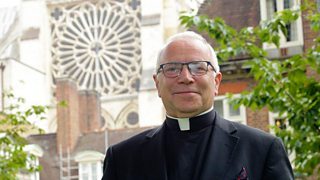
In the Queen, sovereignty is a reality in a life, says the Dean of Westminster.
The Tokyo Olympics – Stretching Every Sinew
Athletes' reflections on faith and competing in the Olympics.
"We do not lose heart."
Marking the centenary of HRH Prince Philip's birth, a reflection from St George's Chapel.
St David's Big Life Hack
What do we know about St David, who told his monks to sweat the small stuff?
Two girls on a train
How a bystander's intervention helped stop a young woman from being trafficked.
Sunday Worship: Dr Rowan Williams
How our nation can rise to the huge challenges it faces, post-Covid-19.