Why Don't Women's Clothes Have Pockets?
Why do women's clothes rarely have pockets, when men's garments are full of them? As well as being few and far between, a 2018 survey showed that women’s pockets are 48% smaller than men's and 90% can't even fit a hand.
In Here for the History on BBC Sounds, Alice Loxton and Ben Henderson take us through a potted history of women’s pockets, from capacious beginnings, to fabulous Regency dresses inspired by the ancient Greeks, to super-pocketed suffragette suits.
They unpick the surprising moments that have contributed to the inconsistency of these sewn-in marvels today and ask, why are women still struggling to get pocket parity?


Henry VIII is a possible pioneer of the pocket
In the medieval period both men and women sported pockets. These were long pouches, tied around the waist, outside their clothing.
It was in the Tudor period that things begin to change.
“The pocket goes from outside the clothing to within the clothing, but the way that that happens is very different for men and for women,” states Alice.
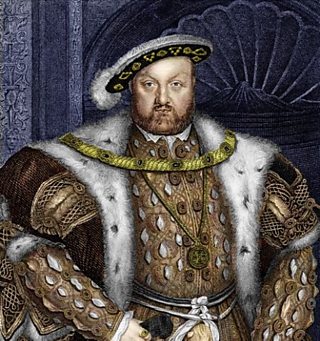
The Tudor breeches that the King and his male subjects were wearing in the 1540s were incredibly baggy. “There's a huge amount of space within them for a pocket,” states Alice. “Some of these were up to 20 inches in size.”
It is in Henry VIII's wardrobe accounts of the 1540s that we see the first written evidence of a sewn-in pocket.
“Henry the VIII could be a kind of pioneer of the pocket,” suggests Alice.
Unfortunately, the tailor who first implemented this innovation remains an unknown hero from history!
The tie-on pocket
While Tudor men were wearing breeches, the women were sporting corseted dresses, tight at the bust, waist and hips, then flowing out into an enormous skirt.
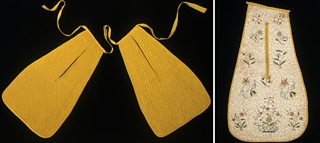
They didn't have sewn-in pockets but instead had pouches that were tied around the waist, under the skirt, known as the tie-on pocket. There were slits in the skirt so the wearer could reach through and put their hand into the pouches.
This style stayed in place until the late 1700s.
Later versions were often beautifully made and embroidered and – because they were known only to the wearer or a lover – seen as something quite intimate.
“Historians have even likened them to lingerie,” says Alice.
Pockets large enough to smuggle wild-fowl
These tie-on pockets could be fairly spacious.
“You could put your lunch in there, sewing kits, writing tools,” Alice suggests.
In the year 1777, in the county of Worcestershire, one Jane Griffith – recorded in the history books as a woman of bad character – went for a walk. On seeing some ducks, she decided to take two home with her – in her pockets.
“It is a fascinating insight into women’s pockets in the past because, of course, they must have had to be pretty roomy to fit a duck in each of them,” says Alice.
The Regency Revolution
In the late 18th century, something radical happened in fashion. Structured dresses with enormous, heavy skirts were out; the empire silhouette was in.
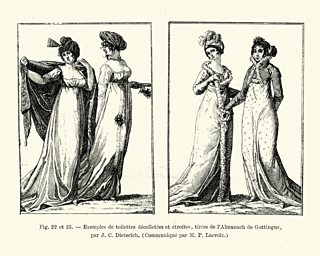
Regency dresses (think Bridgerton or Pride and Prejudice) were tight just beneath the bust. Below that, floaty material flowed freely to the ground.
One reason for the change was a renewed interest in the ancient world. These dresses were not dissimilar to the get-up of the Greek goddesses.
The second big influence was The French Revolution, which kicked off in 1789. There was a rejection of aristocratic excess and a push to dress more simply. Napoleon’s wife, Empress Josephine, was one of the proponents of the style, boosting its popularity.
Thirdly, a new beautiful, lightweight material was on the scene: muslin.
A pocket-related problem ensued. The delicate, flowing fabric was revealing of any lumps and bumps. Although many historians note it’s resilience through the years, the tie-on pocket fell from fashionable favour.
“There are some quite funny examples of people trying to put a pocket in an empire line dress,” explains Alice. “There's one that’s kind of under your armpit.” (Needless to say, they didn’t catch on.)
The reticule
During this period, women developed the use of a little bag known as the reticule. With pockets generally seen as lingerie, this was considered quite shocking.
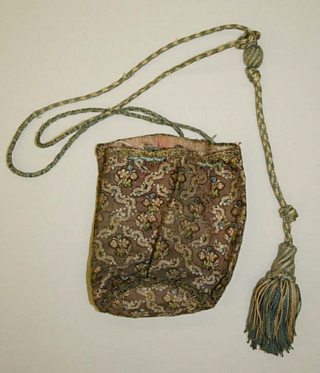
“People viewed the reticule as almost displaying your underwear in your hands, so completely inappropriate,” explains Alice. They were also very small and very impractical. “In England, they came to be known as ridicules.”
Many lamented not having tie-on pockets anymore. Pockets were, after all, a link to personal independence.
“If you can carry your money, your keys, your tools on your own body, and safely and securely, then you have this small but meaningful freedom,” states Alice. “That is a freedom that is lost to women in that period.”
Bustles and bags
In the late 1800s, fashion changed again. Victorian skirts became flat at the front, tight on the hips, with an enormous gathering of fabric at the back called the bustle.
“You could have enormous pockets in the folds of the bustle. You could even fit a champagne bottle, that's how big it was,” states Alice.
Women could also carry little bags, or chains with keys, around their waists. But these belongings were on the outside of clothing, on display. “They were vulnerable to being stolen,” says Alice.
A lack of pockets was still limiting women’s behaviour and freedom.
In 1894, a woman wrote to Harper's Bazaar to complain about pocket disparity. She had no pockets yet her husband had 14 and her son had seven. She described her son’s as his “Certificate of empire.” They were a symbol of his independence and power. “All through life, he will carry the sceptre of dominion by right of his pockets,” she argued.
The suffragette suit
More and more women were openly challenging the idea that fashion should come before functionality.
The Rational Dress Society, established in 1881, pushed back against women’s styles that limited movement, like corsets or heavy skirts. They brought in ‘the divided skirt’, which had trousers underneath.
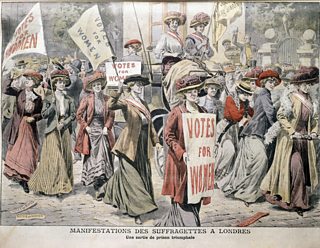
Soon there was the suffragette movement of the early 1900s. They were fighting not only for the vote for women, but also for a wider involvement in public life.
A big part of this campaign was clothing. They developed an outfit called the suffragette suit: a short coat that had pockets on the side and a divided skirt, which had two pockets in the front and two behind.
“This clothing is practical, it's tailored, equipped with pockets, and it's the exact opposite to the idea that women should be decorative first and functional second,” says Alice.
“Girls need to carry things too”
Recently, an eight-year-old schoolgirl shopping for uniform was furious to find that the boys’ trousers had pockets and the girls’ did not. She started a petition with the tagline, “Girls need to carry things too.”
“That sounds exactly the same as what the suffragettes would have been saying 100 years before,” says Alice.
“It shows that perceptions of men and women having different roles in society are very hard to shift,” suggests Ben.
“And women and men’s experiences throughout history, in so many different ways, even in the smallest details, are so different, and even those tiny details have a massive impact,” states Alice.
“In the case of this story, with pockets for women, it's very limiting for women.”