Modern homes and buildings have so many doors that we barely give them a second’s thought, unless we can’t find our keys and are frustratingly stuck outside one.
But there are some truly important doors out there in the world - from those that have a special cultural significance to ones that resemble works of art. BBC Bitesize picks out some of the most extraordinary.

Rome’s Holy Doors
These four doors are only opened during a Holy Year, or Jubilee Year, which usually takes place every 25 years - including 2025. Sealed shut with a wall of bricks, the Holy Door of St Peter’s Basilica would traditionally be opened by the Pope on the first day of the Jubilee Year.
Historically, they would use a silver hammer to chisel away the cement and knock down the wall. However, since 2000 the ceremony has been simplified with the cement being removed in advance so that the Pope can simply push the door open with his hands.
The further three Holy Doors at Basilicas in Rome are opened during the following days, and in 2025 the Pope also unusually opened a Holy Door in the Roman prison of Rebibbia. There are other Holy Doors around the world, including in the Cathedral of Santiago de Compostela in Spain and Notre-Dame Cathedral in Quebec City.
Pilgrims are invited to walk through them as a symbol of making a fresh start without sin.
A new doorway to space
When a crew member arrives at the International Space Station, they enter through an airlock - an area with a door on either side, one leading outside to space and the other to the inside of the station. Only one of the doors can be opened at a single time as the air pressure is different on either side.
These airlocks are also used when an astronaut goes outside for a spacewalk or to deliver equipment. In 2020, NASA added what it called “a new doorway to space” - a larger airlock called the Nanoracks Bishop Airlock Module, which could fit much bigger items and increase the amount of research being carried out.

Florence’s Biblical bronze doors
Have you ever seen a set of doors as elaborate as those on the Baptistery of Saint John in Florence in Italy? Made from bronze, they adorn one of the city’s oldest religious buildings, which was consecrated in 1059.
There are 28 panels on the door, with 20 of them telling the story of St John the Baptist, who is considered to be a prophet by a number of different faiths including Christianity and Islam. The other eight panels stand for eight virtues - behaviours that Catholics believe everyone should strive to. Faith, hope and charity are known as the Theological virtues while fortitude, justice, prudence, and temperance are the Cardinal virtues, with humility also featured.
Even before they notice the doors, visitors to Florence can’t help but be struck by the Baptistery of St John due to its octagonal shape, 24 windows and white and green marble design.
Doors of Thrones
In 2016, Storm Gertrude blew down some of the 200-year-old beech trees in County Antrim, Northern Ireland, that lined the location for the famous Kingsroad in the TV series of Game of Thrones.
Their wood has been carved into 10 intricately designed doors, each one symbolising an episode from series six, from a map of Westeros to Daenerys dragon, Drogon. You can pick up a special free “passport” showing all of their locations, and stamp it at each one.

Notting Hill’s blue door
The front door of 280 Westbourne Park Road in the Notting Hill area of London became famous after starring in the 1999 film Notting Hill.
In the romantic comedy, Hugh Grant’s character William "Will" Thacker lives in this house, unmistakable for its bright blue door. After the film was a hit, the door was auctioned off for charity but so many fans visited to take selfies with its replacement that the owners decided to paint it black. Fortunately for Notting Hill aficionados, it’s now back to its distinctive blue colour.
Washington's Columbus Doors
At the east entrance to the US Capitol Building stands the Columbus Doors, an imposing sight telling the story of the life of explorer Christopher Columbus. Designed by American sculptor Randolph Rogers, they are cast in bronze, and are curved, with each one divided into sections.
Scenes begin with Columbus’ unsuccessful attempt to convince a council appointed by King Ferdinand V of Spain to support a new route to India, and end with his death in 1506. Above the doors is a tympanum - or semi-circle panel - showing his arrival in the 'New World' and claiming the island now known as San Salvador.
While the doors were installed in 1863 as a celebration of Columbus’ achievements, he is a more controversial character today due to his poor treatment of indigenous people. Some Columbus statues have been removed in the US and since 1991, some cities and states mark Indigenous Peoples’ Day to acknowledge the history and contributions of Native Americans, instead of the annual Columbus Day.
This article was published in April 2025.
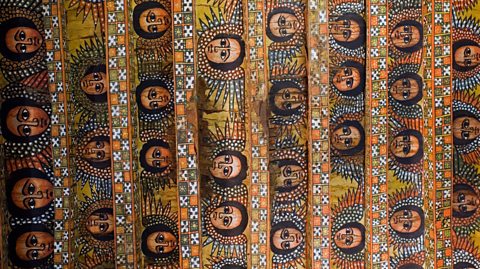
Five amazing ceilings from around the world
Amaze at the stunning artwork that can be found on ceilings worldwide, from stained glass to geometric tiles to informative paintings.
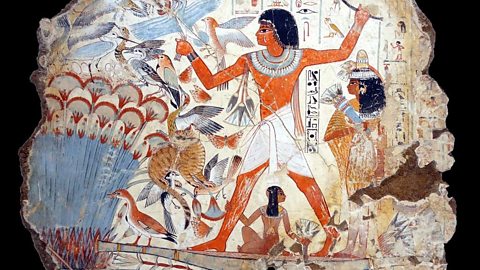
Three incredible ancient frescoes that aren’t in Pompeii
From Egypt to Italy to India, join BBC Bitesize as we explore three stunning ancient frescoes that aren't in Pompeii.
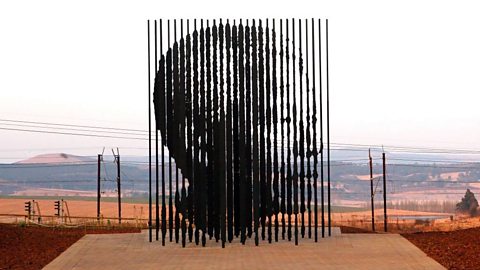
Five amazing sculptures from around the world
From the world's largest bird and equine sculptures to the face of Nelson Mandela, there's something to inspire everyone.